Home › ENGINE ยท 1GR-FE › ENGINE CONTROL SYSTEM › SFI SYSTEM

DTC    P011B    Engine Coolant Temperature / Intake Air Temperature Correlation

for Preparation Click here


DESCRIPTION

The engine has two temperature sensors, an engine coolant temperature sensor and an intake air temperature sensor, to detect the temperature while the engine is in operation. A thermistor, whose resistance value varies according to the temperature, is built into each sensor. When the temperature is low, the resistance of the thermistor increases. When the temperature is high, the resistance drops. These variations in resistance are transmitted to the ECM as voltage changes. Based on these temperature signals output from the sensors, the ECM determines the fuel injection time and the ignition timing to control the engine.

DTC No.
DTC Detection Condition
Trouble Area
P011B
All of the following conditions are met (2 trip detection logic):
  1. Battery voltage 10.5 V or more
  2. 7 hours or more elapsed from engine stops on previous trip
  3. 700 seconds after cold engine start
  4. Either of the following conditions is met:
    1. Minimum intake air temperature after engine starts -10°C (14°F) or more
    2. Average engine coolant temperature before engine starts -10°C (14°F) or more
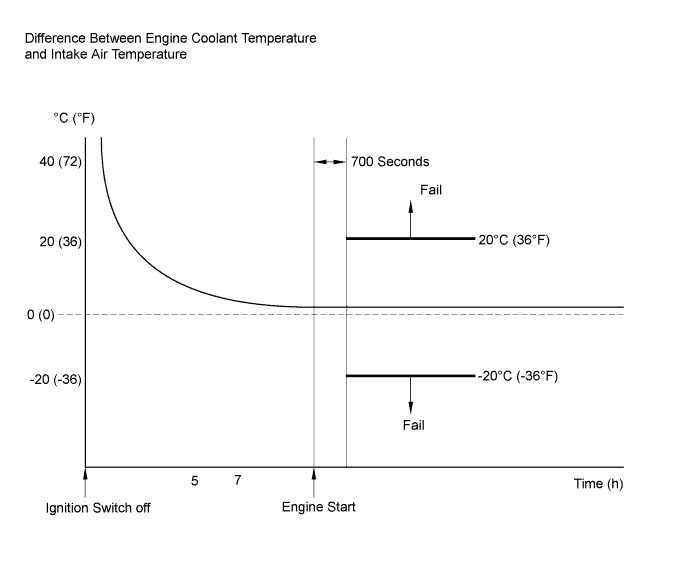
  5. Difference between readings of engine coolant temperature and intake air temperature greater than 20°C (36°F)
  1. Intake air temperature sensor (built into mass air flow meter sub-assembly)
  2. Engine coolant temperature sensor
  3. ECM

A204087E36

HINT:
  1. Waiting is required to prevent the temperature of the engine from affecting the readings. If the engine has been operated recently, it will not be possible to accurately compare the readings.
  1. For diagnosis, in order to duplicate the detection conditions of the DTC, it is necessary to park the vehicle for 7 hours. Parking the vehicle for 7 hours ensures that the actual temperature of the engine coolant temperature and intake air temperature are very similar. When the vehicle has been parked for less than 7 hours, differences in the readings may exist, but this does not necessarily indicate a fault.


MONITOR DESCRIPTION

The ECM monitors the difference between the engine coolant temperature and the intake air temperature when the engine is started cold to detect the engine temperature conditions accurately. The monitor runs when the engine started cold after 7 hours or more has elapsed since the engine was stopped (ignition switch turned to off) on the previous trip. If the difference between the engine coolant temperature and the intake air temperature on a cold start exceeds 20°C (36°F), the ECM interprets this as a malfunction in the engine coolant temperature sensor circuit and intake air temperature sensor circuit, and stored the DTC.

MONITOR STRATEGY


Related DTCs
P011B: Engine Coolant Temperature / Intake Air Temperature sensor correlation
Required Sensors / Components (Main)
Engine Coolant Temperature
Intake Air Temperature sensor
Required Sensors / Components (Related)
-
Frequency of Operation
Once per driving cycle
Duration
-
MIL Operation
2 driving cycles
Sequence of Operation
None

TYPICAL ENABLING CONDITIONS


Monitor runs whenever following DTCs not stored
None
All of the following conditions are met
-
Time engine not running after ignition switch ON
Less than 20 seconds
Soak Time
7 hours or more
Battery voltage
10.5 V or more
Time after engine start
700 seconds or more
Either of the following conditions are met
Condition (a) and (b)
(a) Minimum intake air temperature after engine start
-10°C (14°F) or more
(b) Engine coolant temperature sensor before engine start
-10°C (14°F) or more
Intake air temperature sensor circuit fail (P0112, P0113)
Not detected
Engine coolant temperature sensor circuit fail (P0115, P0117, P0118, P0125)
Not detected
Soak timer circuit fail (P2610)
Not detected

TYPICAL MALFUNCTION THRESHOLDS


Deviated engine coolant temperature and intake air temperature
Less than -20°C (-36°F) or more than 20°C (36°F)

CONFIRMATION DRIVING PATTERN


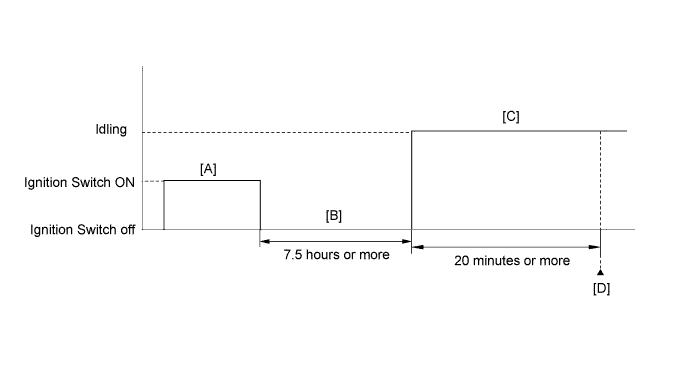
A213993E10

  1. Connect the Techstream to the DLC3.
  2. Turn the ignition switch to ON and turn the Techstream on.
  3. Clear DTCs (even if no DTCs are stored, perform the clear DTC operation) [A].
  4. Turn the ignition switch off.
  5. With the engine stopped, leave the vehicle as is for 7.5 hours or more [B].
  6. Start the engine and wait 20 minutes or more [C].
  7. Enter the following menus: Powertrain / Engine and ECT / Trouble Codes [D].
  8. Read pending DTCs.

    HINT:
    1. If a pending DTC is output, the system is malfunctioning.
    2. If a pending DTC is not output, perform the following procedure.

  9. Enter the following menus: Powertrain / Engine and ECT / Utility / All Readiness.
  10. Input the DTC: P011B.
  11. Check the DTC judgment result.

    Techstream Display
    Description
    NORMAL
    1. DTC judgment completed
    2. System normal
    ABNORMAL
    1. DTC judgment completed
    2. System abnormal
    INCOMPLETE
    1. DTC judgment not completed
    2. Perform driving pattern after confirming DTC enabling conditions
    N/A
    1. Unable to perform DTC judgment
    2. Number of DTCs which do not fulfill DTC preconditions has reached ECU's memory limit

    HINT:
    1. If the judgment result shows ABNORMAL, the system has a malfunction.
    2. If the judgment result shows INCOMPLETE or N/A, perform steps [A] through [D] again.

  12. If no pending DTC is output, perform a universal trip and check for permanent DTCs (Click here).

    HINT:
    1. If a permanent DTC is output, the system is malfunctioning.
    2. If no permanent DTC is output, the system is normal.


INSPECTION PROCEDURE

HINT:
Read freeze frame data using the Techstream. The ECM records vehicle and driving condition information as freeze frame data the moment a DTC is stored. When troubleshooting, freeze frame data can help determine if the vehicle was moving or stationary, if the engine was warmed up or not, if the air fuel ratio was lean or rich, and other data from the time the malfunction occurred.

1.CHECK ANY OTHER DTCS OUTPUT (IN ADDITION TO P011B)
  1. Connect the Techstream to the DLC3.

  1. Turn the ignition switch to ON.

  1. Turn the Techstream on.

  1. Enter the following menu: Powertrain / Engine and ECT / Trouble Codes.

  1. Read DTCs.

    Result 
    Result
    Proceed to
    DTC P011B is output
    A
    DTC P011B and other DTCs are output
    B

    HINT:
    If any DTCs other than P011B are output, troubleshoot those DTCs first.


B
GO TO DTC CHART (Click here)
A


2.READ VALUE USING TECHSTREAM (INTAKE AIR TEMPERATURE)
  1. Leave the vehicle for 7 hours or more.

    HINT:
    It is necessary leave the vehicle for 7 hours or more to allow conditions similar to the DTC detection conditions.

  1. Connect the Techstream to the DLC3.

  1. Turn the ignition switch to ON.

  1. Turn the Techstream on.

  1. Enter the following menu: Powertrain / Engine and ECT / Intake Air.

  1. Read the value displayed on the Techstream.

    Standard:
    The difference between the intake air temperature and the actual outside air temperature is within 10°C (18°F).

    HINT:
    Temperature readings on the vehicle's outside temperature gauge (if equipped) are not suitable for comparing to the intake air temperature reading. The outside temperature gauge has a significant delay built in to prevent swings in the temperature display. Use an accurate thermometer to determine the outside air temperature.


NG
REPLACE MASS AIR FLOW METER SUB-ASSEMBLY (Click here)
OK


3.READ VALUE USING TECHSTREAM (COOLANT TEMPERATURE)
  1. Connect the Techstream to the DLC3.

  1. Turn the ignition switch to ON.

  1. Turn the Techstream on.

  1. Enter the following menu: Powertrain / Engine and ECT /Coolant Temp.

  1. Read the value displayed on the Techstream.

    Standard:
    The difference between the coolant temperature and the actual outside air temperature is within 10°C (18°F).

    HINT:
    If the result is not as specified, check that there no heat sources such as a block heater in the engine compartment.


NG
REPLACE ENGINE COOLANT TEMPERATURE SENSOR (Click here)
OK

REPLACE ECM (Click here)