Home › ENGINE ยท 2TR-FE › ENGINE CONTROL SYSTEM › SFI SYSTEM

DTC    P0128    Coolant Thermostat (Coolant Temperature Below Thermostat Regulating Temperature)

for Preparation Click here


DESCRIPTION

HINT:
This DTC relates to the thermostat.

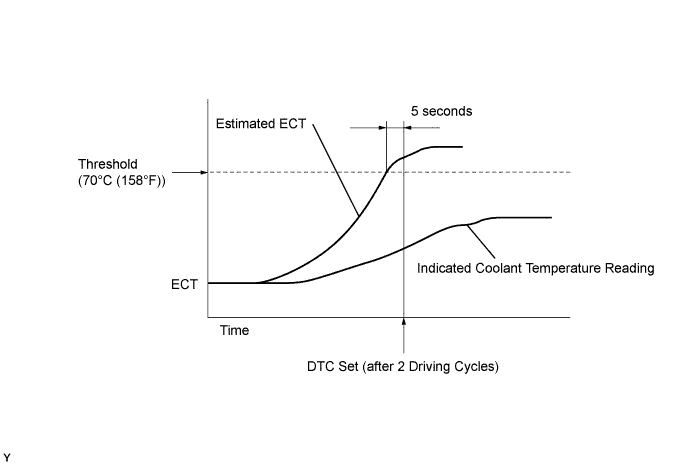
This DTC is stored when the engine coolant temperature does not reach 70°C (158°F) despite sufficient engine warm-up time.

DTC No.
DTC Detection Condition
Trouble Area
P0128
  1. Conditions (a), (b) and (c) met for 5 seconds (2 trip detection logic):
    1. (a) Cold start
    2. (b) Engine warmed up
    3. (c) Engine coolant temperature less than 70°C (158°F)
  1. Thermostat
  2. Cooling system
  3. Engine coolant temperature sensor
  4. ECM

MONITOR DESCRIPTION


A121605E01

The ECM estimates the engine coolant temperature based on the starting temperature, engine loads, and engine speeds. The ECM then compares the estimated temperature with the actual engine coolant temperature. When the estimated engine coolant temperature reaches 70°C (158°F), the ECM checks the actual engine coolant temperature. If the actual engine coolant temperature is less than 70°C (158°F), the ECM interprets this as a malfunction in the thermostat or the engine cooling system and stores the DTC.

MONITOR STRATEGY


Related DTCs
P0128: Coolant Thermostat
Required Sensors/Components (Main)
Thermostat
Required Sensor/Components (Related)
Engine coolant temperature sensor
Intake air temperature sensor
Vehicle speed sensor
Frequency of Operation
Once per driving cycle
Duration
900 seconds
MIL Operation
2 driving cycles
Sequence of Operation
None

TYPICAL ENABLING CONDITIONS


Monitor runs whenever following DTCs not present
P0010 (VVT Oil Control Valve)
P0011 (VVT System - Advance)
P0012 (VVT System - Retard)
P0016 (VVT System - Misalignment)
P0031, P0032 (Air Fuel Ratio Sensor Heater)
P0102, P0103 (Mass Air Flow Meter)
P0112, P0113 (Intake Air Temperature Sensor)
P0115, P0117, P0118 (Engine Coolant Temperature Sensor)
P0120, P0121, P0122, P0123, P0220, P0222, P0223, P2135 (Throttle Position Sensor)
P0171, P0172 (Fuel System)
P014C, P014D, P015A, P015B, P2195, P2196, P2237, P2238, P2239, P2252, P2253 (Air Fuel Ratio Sensor)
P0301 - P0304 (Misfire)
P0335 (Crankshaft Position Sensor)
P0340 (Camshaft Position Sensor)
P0351 - P0354 (Igniter)
P0500 (Vehicle Speed Sensor)
Battery voltage
11 V or more
Either of following conditions 1 or 2 met:
-
1. All of following conditions (a), (b) and (c) met:
-
(a) Engine coolant temperature at engine start - Intake air temperature at engine start
-15 to 7°C (-27 to 12.6°F)
(b) Engine coolant temperature at engine start
-10 to 51°C (14 to 133°F)
(c) Intake air temperature at engine start
-10 to 51°C (14 to 133°F)
2. All of following conditions (d), (e) and (f) met:
-
(d) Engine coolant temperature at engine start - Intake Air Temperature at engine start
More than 7°C (12.6°F)
(e) Engine coolant temperature at engine start
51°C (133°F) or less
(f) Intake air temperature at engine start
-10°C (14°F) or more
Accumulated time that vehicle speed is 80 mph (128 km/h) or more
Less than 20 seconds

TYPICAL MALFUNCTION THRESHOLDS


Duration that following conditions met
5 seconds or more
Estimated engine coolant temperature
70°C (158°F) or more
Engine coolant temperature sensor output
Less than 70°C (158°F)

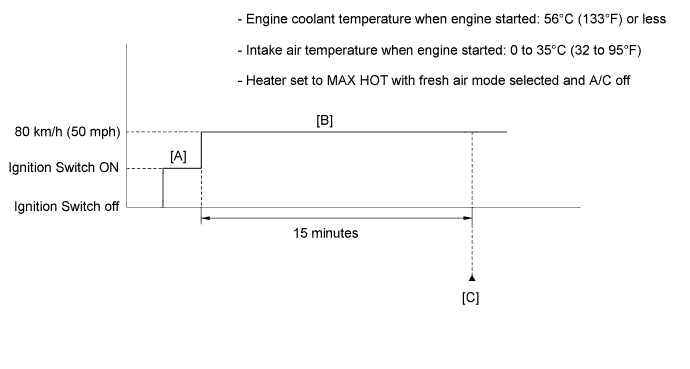
CONFIRMATION DRIVING PATTERN


A198821E93

  1. Stop the engine and allow it to soak.
  2. Connect the Techstream to the DLC3.
  3. Turn the ignition switch to ON and turn the Techstream on [A].
  4. Enter the following menus: Powertrain / Engine and ECT / Data List / Coolant Temp and Intake Air.
  5. Check that "Coolant Temp" is 56°C (133°F) or less and "Intake Air" is between 0 and 35°C (32 and 95°F).
  6. Set the heater to MAX HOT with fresh air mode selected and turn the A/C off.
  7. Start the engine and drive the vehicle at 80 km/h (50 mph) for 15 minutes [B].

    NOTICE:
    When performing the confirmation driving pattern, obey all speed limits and traffic laws.

    HINT:
    1. Data can be captured relatively easily by using the snapshot function in the Data List.
    2. Enter the following menus: Data List / Function / Snapshot configuration / Record time / 5 min.
    3. Data capture can be started by using the target point function. For example, setting the target point to an engine speed of 4000 rpm and then racing the engine, etc. to raise the engine speed to a speed of 4000 rpm or more will cause data capture to start.

  8. After "Coolant Temp" stabilizes, check that "Coolant Temp" is 75°C (167°F) or higher [C].

    HINT:
    If "Coolant Temp" is below 75°C (167°F) while driving the vehicle at 80 km/h (50 mph), inspect the cooling system and thermostat.


INSPECTION PROCEDURE

HINT:
  1. When the DTC is output, check the engine coolant temperature using the Techstream. Enter the following menus: Powertrain / Engine and ECT / Data List / Coolant Temp. If the Coolant Temp value is lower than the actual engine coolant temperature, the engine coolant temperature sensor circuit may be malfunctioning. In this case, check the wire harnesses and connectors (and those connections) between the ECM and the engine coolant temperature sensor first.
  2. Read freeze frame data using the Techstream. The ECM records vehicle and driving condition information as freeze frame data the moment a DTC is stored. When troubleshooting, freeze frame data can help determine if the vehicle was moving or stationary, if the engine was warmed up or not, if the air fuel ratio was lean or rich, and other data from the time the malfunction occurred.

1.CHECK ANY OTHER DTCS OUTPUT (IN ADDITION TO DTC P0128)
  1. Connect the Techstream to the DLC3.

  1. Turn the ignition switch to ON.

  1. Turn the Techstream on.

  1. Enter the following menus: Powertrain / Engine and ECT / Trouble Codes.

  1. Read DTCs.
    Result: 
    Result
    Proceed to
    DTC P0128 is output
    A
    P0128 and other DTCs
    B

    HINT:
    If any DTCs other than P0128 are output, troubleshoot those DTCs first.


B
GO TO DTC CHART (Click here)
A


2.CHECK COOLING SYSTEM
  1. Check for defects in the cooling system that might cause the system to be too cold, such as abnormal radiator fan operation or any modifications.


NG
REPAIR OR REPLACE COOLING SYSTEM
OK


3.INSPECT THERMOSTAT
  1. Check the valve opening temperature of the thermostat (Click here).


NG
REPLACE THERMOSTAT (Click here)
OK

REPLACE ECM (Click here)