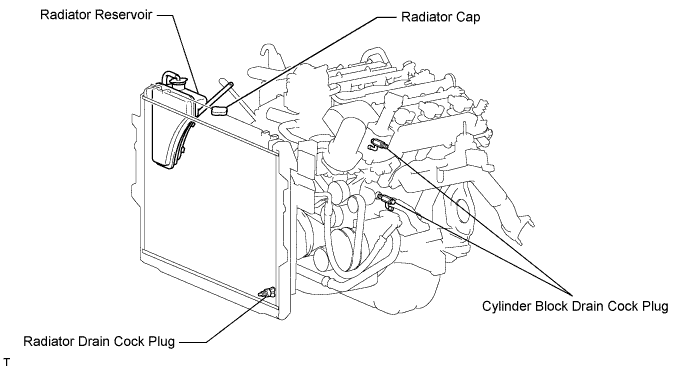
Tighten the 2 cylinder block drain cock plugs.
- Torque:
- 13 N*m{ 133 kgf*cm , 10 ft.*lbf }
WATER PUMP > ON-VEHICLE INSPECTION |
| 1. REMOVE NO. 1 ENGINE UNDER COVER |
Remove the 5 bolts, 3 screws and engine under cover.
| 2. DRAIN ENGINE COOLANT |
Loosen the radiator drain cock plug and 2 cylinder block drain cock plugs.
Remove the radiator cap. Then drain the coolant.
Tighten the 2 cylinder block drain cock plugs.
Tighten the radiator drain cock plug by hand.
| 3. REMOVE V-BANK COVER |
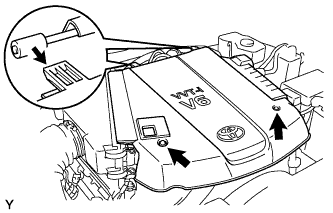 |
Remove the 2 nuts and V-bank cover.
| 4. DISCONNECT RADIATOR HOSE INLET |
| 5. DISCONNECT RADIATOR HOSE OUTLET |
| 6. REMOVE FAN SHROUD |
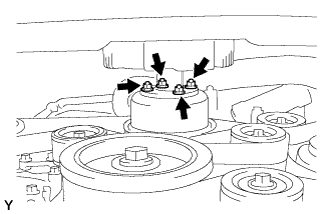 |
Loosen the 4 nuts holding the fluid coupling fan.
Remove the fan and generator V-belt (Click here).
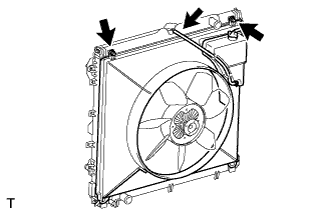 |
Disconnect the reservoir hose from the radiator tank upper.
Remove the 2 bolts holding the fan shroud.
Remove the 4 nuts of the fluid coupling fan, and then remove the shroud together with the coupling fan.
Remove the fan pulley from the water pump.
| 7. INSPECT WATER PUMP ASSEMBLY |
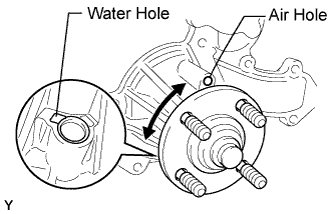 |
Visually check the air hole and water hole for coolant leakage.
If leakage is found, replace the water pump assembly.
Turn the pulley and check that the water pump bearing moves smoothly and quietly.
If necessary, replace the water pump assembly.
| 8. INSTALL FAN SHROUD |
Install the fan pulley to the water pump.
Place the shroud together with the coupling fan between the radiator and engine.
Install the fluid coupling fan to the water pump with the 4 nuts. Tighten the nuts as much as possible by hand.
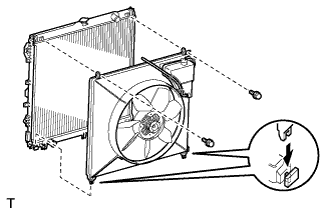 |
Attach the shroud's claws to the radiator as shown in the illustration.
Install the shroud with the 2 bolts.
Connect the reservoir hose to the radiator tank upper.
Install the fan and generator V-belt (Click here).
Tighten the 4 nuts of the fluid coupling fan.
| 9. CONNECT RADIATOR HOSE INLET |
| 10. CONNECT RADIATOR HOSE OUTLET |
| 11. ADD ENGINE COOLANT |
Add engine coolant.
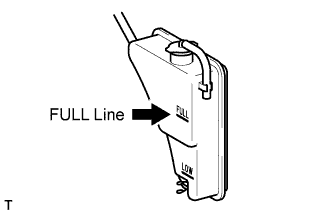 |
Slowly pour coolant into the radiator reservoir until it reaches the FULL line.
Install the reservoir cap.
Press the inlet and outlet radiator hoses several times by hand, and then check the coolant level. If the coolant level is low, add coolant.
Install the radiator cap.
Start the engine and warm it up until the thermostat opens.
Maintain the engine speed at 2000 to 2500 rpm.
Press the inlet and outlet radiator hoses several times by hand to bleed air.
Stop the engine, and wait until the engine coolant cools down to ambient temperature.
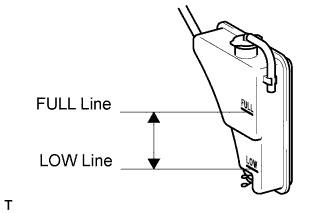 |
Check that the coolant level is between the FULL and LOW lines.
If the coolant level is below the LOW line, repeat all of the procedures above.
If the coolant level is above the FULL line, drain coolant so that the coolant level is between the FULL and LOW lines.
| 12. INSPECT FOR COOLANT LEAK |
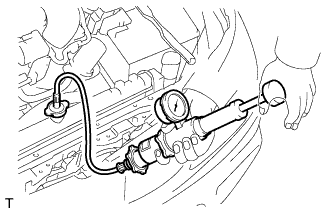 |
Fill the radiator with coolant and attach a radiator cap tester.
Warm up the engine.
Using the radiator cap tester, increase the pressure inside the radiator to 118 kPa (1.2 kgf/cm2, 17 psi), and check that the pressure does not drop.
If the pressure drops, check the hoses, radiator and water pump for leaks. If no external leaks are found, check the heater core, cylinder block and head.
| 13. INSTALL V-BANK COVER |
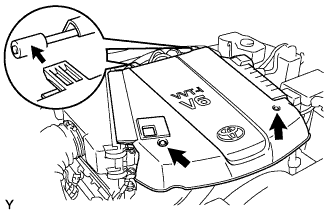 |
Install the V-bank cover with the 2 nuts.
| 14. INSTALL NO. 1 ENGINE UNDER COVER |
Install the engine under cover with the 5 bolts and 3 screws.