BODY ELECTRICAL SRS AIRBAG SYSTEM GENERAL/CONTROL/DETAILS AIRBAG FOR FRONTAL COLLISION
General
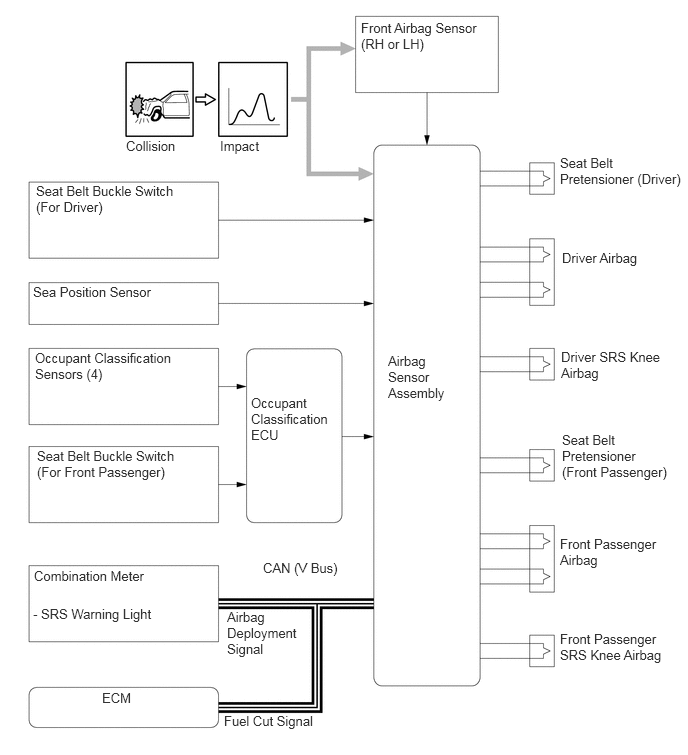
There are 4 airbags for frontal collisions: driver, front passenger, driver knee and front passenger knee. These airbags deploy simultaneously. The SRS driver and front passenger airbags use a dualstage control.
The Airbag Sensor Assembly detects the information indicated below from various sources in order to activate the dual-stage control.
| Airbag | Information | Source |
|---|---|---|
| Driver | Extent of Impact | ·
Front Airbag Sensor (RH or LH) ·
Airbag Sensor Assembly |
| Driver Seat Position | Seat Position Sensor | |
| Seat Belt Condition | Seat Belt Buckle Switch (Non-contact Type) | |
| Front Passenger | Extent of Impact | ·
Front Airbag Sensor (RH or LH) ·
Airbag Sensor Assembly |
| Occupant Classification | Occupant Classification Sensors (4) (Through the Occupant Classification ECU) | |
| Seat Belt Condition | Seat Belt Buckle Switch (Non-contact Type) (Through the Occupant Classification ECU) |
System Diagram
SRS Driver and Front Passenger Airbags
The SRS driver and front passenger airbags each contain a set of two initiators and propellants. The Airbag Sensor Assembly helps optimize the airbag inflation output by controlling the inflation timing of these initiators.
SRS Knee Airbags
The SRS knee airbags deploy simultaneously with the front airbags in a frontal collision. With the deployment of the SRS knee airbags, the driver's and front passenger's lower bodies are restricted, thus enhancing the excellent passenger protection provided by the seat belt and front airbags.
The SRS knee airbag consists of an airbag door, an inflator, and a bag.
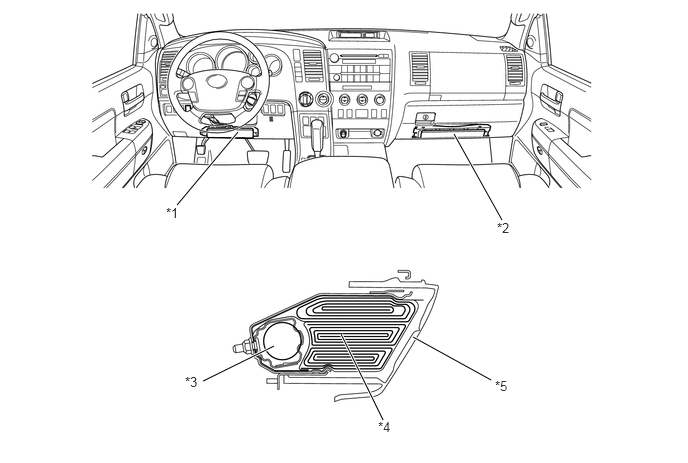
| *1 | Driver SRS Knee Airbag | *2 | Front Passenger SRS Knee Airbag |
| *3 | Inflator | *4 | Bag |
| *5 | Airbag Door | - | - |
Front Airbag Sensor
Front airbag sensor uses an electrical type deceleration sensor. Based on the deceleration of the vehicle during a front collision, a distortion is created in the sensor and converted into an electrical signal. Accordingly, the extent of the initial collision can be detected in detail.
Seat Belt Buckle Switch
The seat belt buckle switch detects if the seat belt is fastened.
A contact type and non-contact type switch is built in to the seat belt buckle on the driver side. The contact type switch is for the seat belt reminder system and the non-contact type switch is for the SRS airbag system.
A non-contact type switch is built in to the seat belt buckle on the front passenger side.
The non-contact type switch contains a Hall IC and two magnets, installed into the front seat inner belt assembly.
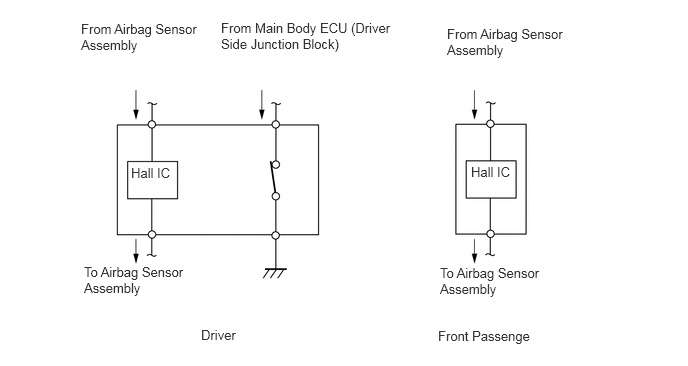
The ejector inside the front seat inner belt assembly and the plate installed to the ejector move when the seat belt is removed or inserted. The movement of the plate changes the magnetic flux density of the magnet.
The Hall IC detects changes in the magnetic flux density. These changes indicate that the seat belt is either fastened or unfastened, and the Hall IC outputs a signal to the Airbag Sensor Assembly (for driver) or Occupant Classification ECU (for front passenger).
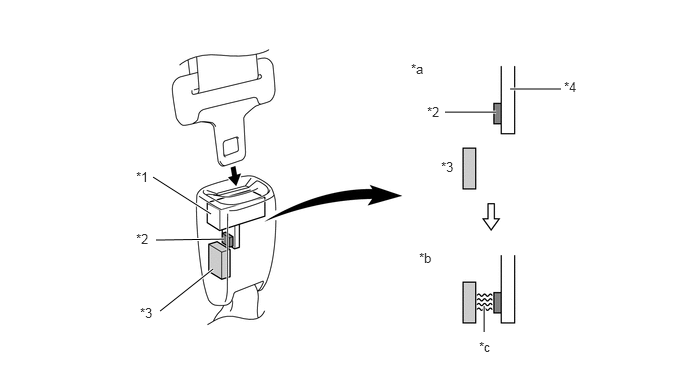
| *1 | Ejector | *2 | Hall IC |
| *3 | Magnet | *4 | Plate |
| *a | Seat belt not fastened | *b | Seat belt fastened |
| *c | Magnetic Flux | - | - |
Seat Position Sensor
The seat position sensor detects the slide position of the driver seat. This sensor, which uses a Hall IC, detects changes in the magnetic flux that occur due to the movement of the upper rail.
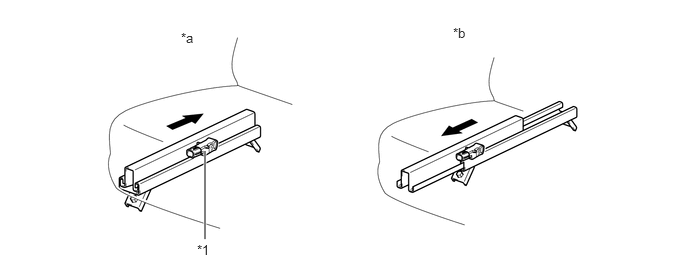
| *1 | Seat Position Sensor | - | - |
| *a | Seat position is rearward | *b | Seat position is frontward |
- HINT:
-
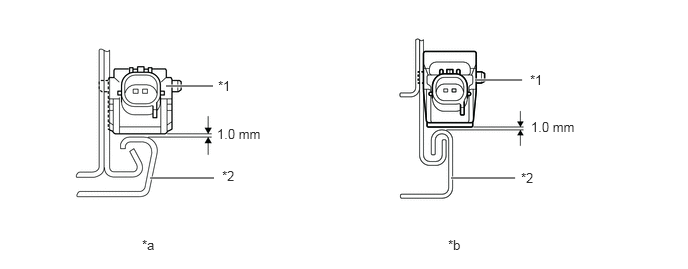
Follow the procedure indicated below to install the seat position sensor.
- 1.
Insert a 1.0 mm (0.04 in.) feeler gauge between the seat position sensor and the lower rail portion.
2.Tighten the mounting bolt to the specified torque with the seat position sensor pushed down as shown.
-
For details, refer to the Repair Manual.
 1.729,0.896 2.219,0.896 true 1.563,1.854 2.229,1.854 true 4.948,0.833 5.438,0.833 true 4.698,1.854 5.365,1.854 true 2.271,0.813 2.615,1.073 0.344,0.26 10 false *1 2.313,1.75 2.635,2 0.323,0.25 10 false *2 1.479,2.469 1.813,2.688 0.333,0.219 10 false *a 4.667,2.469 5.042,2.698 0.375,0.229 10 false *b 2.26,1.313 3.417,1.604 1.156,0.292 10 false 1.0 mm 5.531,1.24 6.688,1.531 1.156,0.292 10 false 1.0 mm 5.521,0.75 5.865,1.01 0.344,0.26 10 false *1 5.427,1.771 5.75,2.021 0.323,0.25 10 false *2
*1 Seat Position Sensor *2 Lower Rail *a For Manual Seat *b For Power Seat