BODY ELECTRICAL SRS AIRBAG SYSTEM GENERAL/CONTROL/DETAILS FRONT PASSENGER OCCUPANT CLASSIFICATION SYSTEM
General
The front passenger occupant classification system judges whether the front passenger seat is occupied by an adult or child (with child seat) or is unoccupied, in accordance with the load that is applied to the front passenger seat and whether the seat belt is buckled. Thus, it restricts the deployment of the front passenger airbag, front passenger side airbag, and the front passenger seat belt pretensioner. In addition, the system informs the driver of the result of the judgment through the use of the AIRBAG ON/OFF indicator lights.
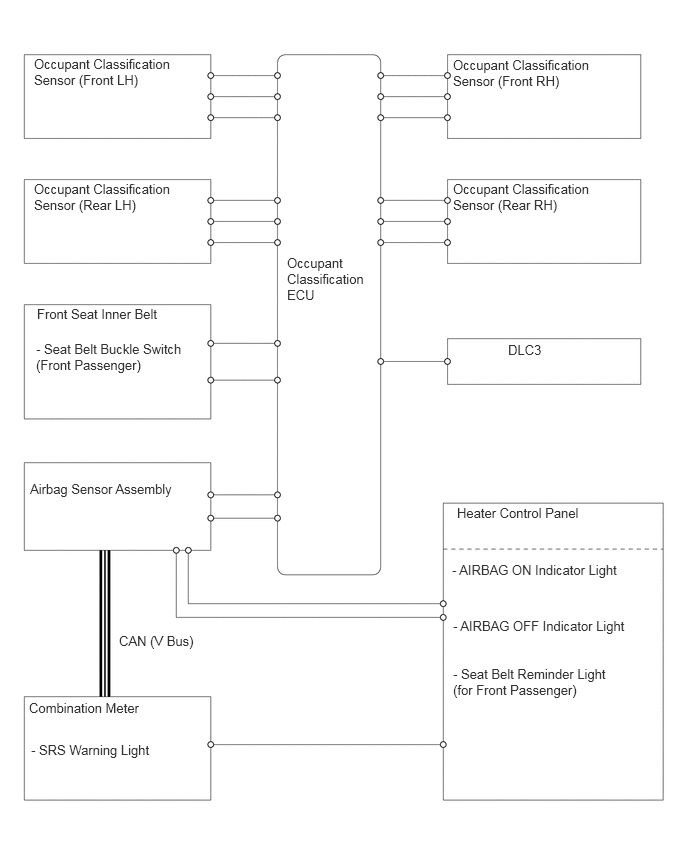
This system consists of the Occupant Classification ECU, four occupant classification sensors, AIRBAG ON/OFF indicator lights, seat belt buckle switch, and Airbag Sensor Assembly.
The front passenger SRS items and indicator lights operate as follows according to the occupant classification:
| Items | Occupant Classification | |||||
|---|---|---|---|---|---|---|
| Adult | Child | Child Seat | Unoccupied | Malfunction | ||
| Front Passenger SRS Items | Front Airbag | ● | - | - | - | - |
| Side Airbag | ● | - | - | - | - | |
| Curtain Shield Airbag | ● | ● | ● | ● | ● | |
| Seat Belt Pretensioner | ● | ● | ● | - | ● | |
| Indicator Light | AIRBAG ON Indicator Light | ON | OFF | OFF | OFF | OFF |
| AIRBAG OFF Indicator Light | OFF | ON | ON | OFF | ON | |
●: Deploys
-: Does Not Deploy
- HINT:
- ·
When installing items to the front passenger seat or removing/installing the front passenger seat, connect the hand-held tester or Techstream*, perform a system check and perform a zero-point calibration of the sensor load value.
·If performing maintenance due to the SRS warning light being on constantly or due to a collision, in addition to the above item, check that the hand-held tester or Techstream* display value indicates within the range of 30 kg (66 lb) +/- 3 kg (6.6 lb) when a 30 kg (66 lb) weight is placed on the front passenger seat.
·For Details, refer to the Repair Manual.
System Diagram
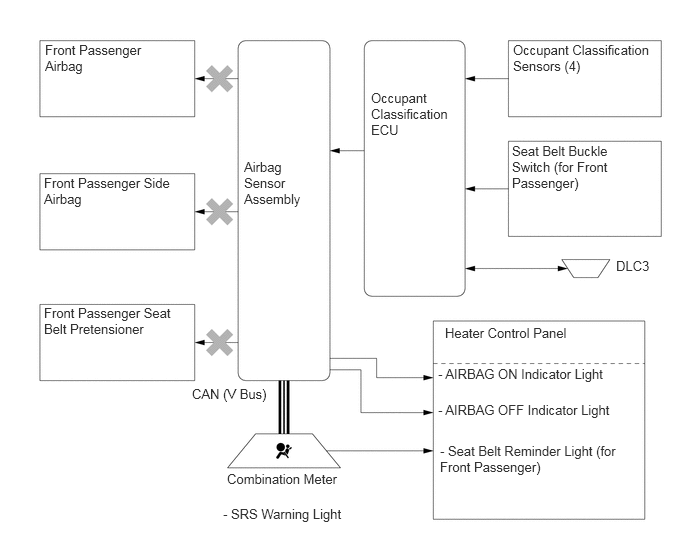
Wiring Diagram
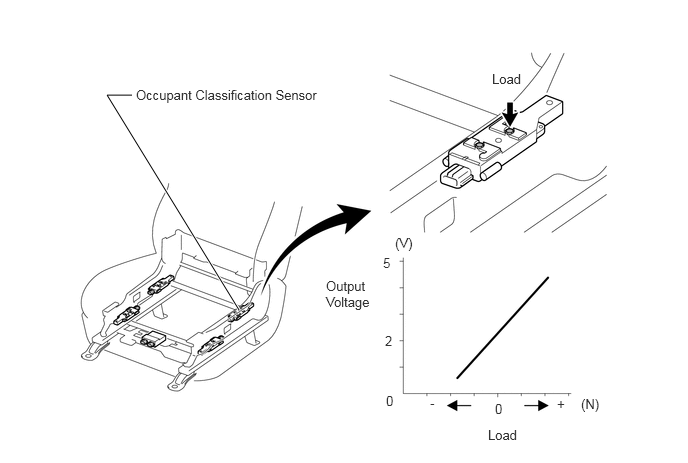
Occupant Classification Sensor
The occupant classification sensors are installed on four brackets connecting the seat rail and the seat frame. The resistance values of these sensors, which vary in accordance with the distortion that acts on the brackets, are output to the Occupant Classification ECU.
System Operation
General
This system makes the following judgments: unoccupied judgment, child seat judgment, child judgment, and adult judgment. In addition, it performs an initial check to check the circuit of the AIRBAG ON/OFF indicator lights when the ignition switch is ON.
The Occupant Classification ECU constantly monitors the weight on the front passenger seat, and makes a judgment in accordance with the signals from the occupant classification sensor and the state of the seat belt buckle switch.
The Occupant Classification ECU contains criteria value "A" to judge whether the seat is being occupied by a child or a child seat in accordance with the signals from the four occupant classification sensors and seat belt buckle switch, and criteria value "B" to judge whether the occupant is an adult or child (with child seat).
The Occupant Classification ECU makes an occupied or unoccupied judgment in accordance with the signals from the seat belt buckle switch.
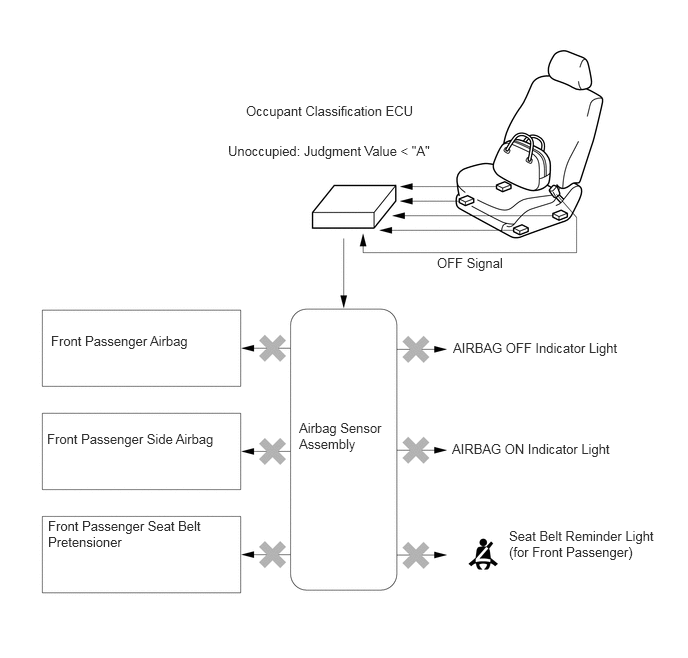
Unoccupied Judgment
The Occupant Classification ECU makes an unoccupied judgment when the judgment value is lower than criteria value "A" and the seat belt buckle switch is OFF.
If the ignition switch is turned ON in this state, the system performs an initial check, and does not illuminate the AIRBAG ON/OFF indicator lights. Then, the system prohibits the deployment of the front passenger airbag, front passenger side airbag, and the front passenger seat belt pretensioner, and does not blink the seat belt reminder light.
Child Seat or Child Judgment
If the judgment value is lower than criteria value "B" and the seat belt buckle switch is ON, the Occupant Classification ECU judges that a child seat is installed.
If the judgment value is higher than criteria value "A", but lower than criteria value "B", and the seat belt buckle switch is OFF, the Occupant Classification ECU judges that the seat is being occupied by a child.
When the ignition switch is turned ON under these conditions, the system performs an initial check and illuminates the AIRBAG OFF indicator light to indicate that the front passenger airbag and the front passenger side airbag have been deactivated.
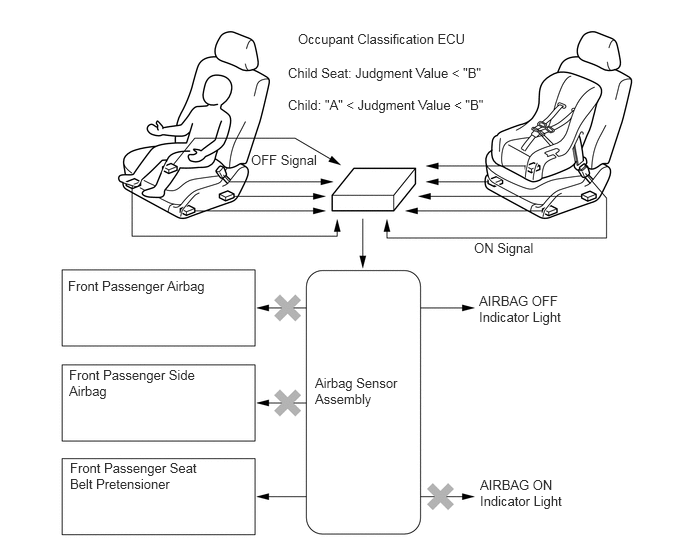
After the Occupant Classification ECU judges that a child seat is installed, the AIRBAG OFF indicator light does not go off unless the seat belt buckle switch is turned OFF.
Adult Judgment
When the judgment value is higher than criteria value "B", the Occupant Classification ECU judges that the seat is being occupied by an adult.
If the ignition switch is turned ON in this state, the system performs an initial check and illuminates the AIRBAG ON indicator light, indicating that the front passenger airbag and the front passenger side airbag are active.
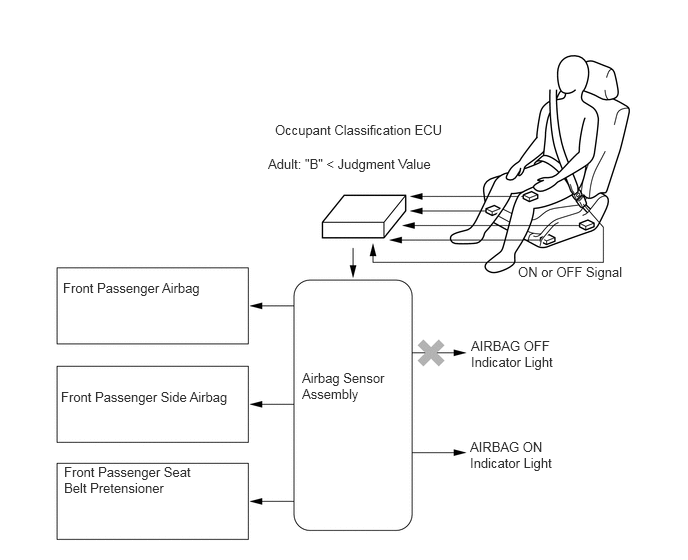
After the Occupant Classification ECU judges that the occupant is an adult, and if the judgment value is determined as criteria value "B" or less according to occupant load movement, the ECU continues adult judgment for approximately ten seconds before switching the child judgment.
Initial Check
After the ignition switch is tuned ON, the Occupant Classification ECU lights up the AIRBAG ON/OFF indicator lights via Airbag Sensor Assembly based on the timing chart below in order to check the indicator light circuits.
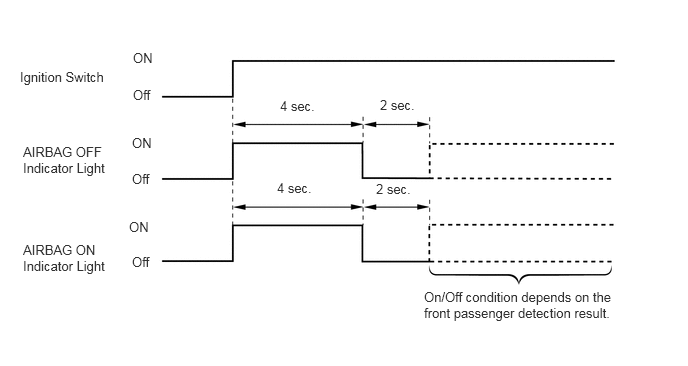
Precautions for Front Passenger Occupant Classification System Operation
To avoid potential death or serious injury when the front passenger occupant classification system does not detect the conditions correctly, observe the following.
Wear the seat belt properly.
Make sure that the front passenger's seat belt tab is not inserted into the buckle before someone sits in the front passenger seat.
Make sure the AIRBAG ON indicator light is illuminated when using a seat belt extender for the front passenger seat. If the AIRBAG OFF indicator light is illuminated, disconnect the extender tongue from the seat belt buckle, then reconnect the seat belt. Reconnect the seat belt extender after making sure the AIRBAG ON indicator light is illuminated. If you use the seat belt extender while the AIRBAG OFF indicator light is illuminated, the front passenger airbag and side airbag on the front passenger side may not activate correctly, which could cause death or serious injury in the event of collision (the seatbelt extender always needs to be connected to the seat mounted buckle after the occupant sits in the seat).
Do not put a heavy load in the front passenger seatback pocket or attach a seatback table to the front passenger seat seatback.
Do not put weight on the front passenger seat by putting your hands or feet on the front passenger seat seatback from the rear passenger seat.
Do not let a rear passenger lift the front passenger seat with their feet or press on the seatback with their legs.
Do not put objects under the front passenger seat.
Do not recline the front passenger seat seatback so far that it touches a rear seat. This may cause the AIRBAG OFF indicator light to be illuminated, which indicates that the passenger's airbags will not deploy in the event of a severe accident. If the seatback touches the rear seat, return the seatback to a position where it does not touch the rear seat.
Keep the front passenger seatback as upright as possible when the vehicle is moving. Reclining the seatback excessively may lessen the effectiveness of the seat belt system.
Make sure the AIRBAG ON indicator light is illuminated when an adult sits in the front passenger seat. If the AIRBAG OFF indicator light is illuminated, ask the passenger to sit properly with back upright and against the seat, with legs comfortably extended and wear the seat belt correctly. Nonetheless, if the AIRBAG OFF indicator light remains illuminated, let the passenger sit in the rear seat. When it is unavoidable to sit in the front passenger seat, ask the passenger to move the seat as far back as possible, and remain properly seated.
When installation of a forward facing child restraint system on the front seat is unavoidable, install the child restraint system on the front passenger seat in the proper sequence.
Do not kick the front passenger seat or subject it to severe impact. Otherwise, the SRS warning light may come on to indicate a malfunction of the detection system.
Child restraint systems installed on the rear seat should not contact the front seatbacks.