NAVIGATION / MULTI INFO DISPLAY NAVIGATION SYSTEM / MULTI INFORMATION SYSTEM GENERAL/CONTROL/DETAILS DETAILS
FUNCTION OF MAIN COMPONENTS
| Component | Function |
|---|---|
| Navigation Receiver Assembly | Receives and processes the data that is input from various components, displays various pieces of information and operating conditions on the screen, and provides voice guidance. |
| Navigation Antenna Assembly | Receives signals from the GPS satellites and transmits them to the navigation receiver assembly. |
| Amplifier Antenna Assembly | Amplifies radio broadcasting signals from the radio antenna and sends them to the navigation receiver assembly. |
| Combination Meter Assembly | Transmits vehicle speed signals to the navigation receiver assembly. |
| Steering Pad Switch Assembly | Enables the driver to operate the navigation system from the steering pad switches. |
| Amplifier Microphone Assembly | Transmits voice signals to the navigation receiver assembly. |
| Back-up Light Switch Assembly*1 | Transmits the on/off signal of the back-up light switch assembly to the navigation receiver assembly. |
| Park/Neutral Position Switch Assembly*2 | Transmits the R position signal to the navigation receiver assembly. |
| Parking Brake Switch Assembly | Transmits the on/off signal of the parking brake switch assembly to the navigation receiver assembly. |
| Rear Television Camera Assembly | Captures the view behind the vehicle and transmits the image to navigation receiver assembly. |
| No. 1 Stereo Jack Adapter Assembly | Transmits information about the portable audio player connected to the USB port or AUX port to the navigation receiver assembly. |
*1: Models with manual transaxle
*2: Models with automatic transaxle
FUNCTION
Navigation Screen
The navigation computer calculates the present position and direction of travel, then determines a route and calculates the driving distance based on the following information sources:
Map data in the micro SD card
Global Positioning System (GPS) satellites
Built-in gyro sensor
Vehicle speed signal
Reverse signal
Parking brake signal
Radio Data System Traffic Message Channel (RDS-TMC) signal
| Item | Function | |
|---|---|---|
| Map Display | Map Scroll | The map screen can be scrolled by flick or drag operation. |
| Taillight-interlocked Map Color Change | Changes the color of the map screen that is displayed when the taillights are turned on. | |
| North Up/Heading Up | ·
If North Up is selected, regardless of the direction of vehicle travel, north is always up. ·
If Heading Up is selected, the direction of vehicle travel is always up. |
|
| 3D Display | Displays a 3-dimensional (3D) view of the map. | |
| Zoom In/Zoom Out | Change the area of the map displayed on the screen. | |
| Footprint Map | Displays a major city in a scale of 75 m. | |
| Point of Interest Display | Displays selected types of points of interest as marks on the map. | |
| Current Position Display Function | Displays the latitude, longitude and altitude of the current position based on the GPS signals being received. | |
| Route Guidance Demonstration | Demonstrates the route guidance to the destination. | |
| Route Trace | By saving a traveled route automatically or saving it manually upon reaching the destination, the routes can be displayed and retraced. | |
| RDS Display | Displays RDS-TMC icons, arrows, popup messages and indicators when RDS-TMC service is being received. | |
| Destination Search | Preset Destination Memory Search | Sets a pre-registered point as a destination point while driving. |
| Address Search | A destination can be set by entering a country or state name, town/suburb name, street and house number. | |
| A destination can be set in 2 ways:
·
Information can be entered in the order of: city name, road name, and house number. |
||
| Point of Interest Search | A destination can be set in 4 ways:
·
Quick search ·
Preset search ·
Category search ·
Name search |
|
| Previous Destination Search | A destination can be set using the destination list in which previously set destinations are stored. | |
| Map Search | A destination can be set by using the cursor on the map. | |
| Route Search | Multiple Route Search | Searches for multiple routes. |
| Search Condition Designation | ·
Searches for the quick, short, and alternate routes. ·
Sets whether the following routes should be avoided during route search: -
Highways -
Toll Roads -
Ferries -
Unsealed Roads -
4WD Tracks |
|
| Adds Waypoints | Adds waypoints along with the set route to set the pass points. | |
| Traffic Congestion Information Consideration | Performs searches which consider traffic congestion information. | |
| Auto Avoid Traffic Search | Automatically changes to another route to avoid heavy congestion. | |
| Auto Re-route Search | Performs automatic re-route search if the vehicle deviates from the set route. | |
| Guidance | Voice Guidance | Provides voice guidance about the distance and the direction of travel to a destination point based on road conditions and vehicle speed. |
| Next Turn Guidance | Provides guidance about the distance to the next turn and indicates the direction of the turn using an arrow. | |
| Lane Information Guidance | Provides lane information and indicates the lane to be driven in when the vehicle is on a multiple lane road. | |
| Signposts Display | Displays lane information similar to overhead road traffic signs on the top of the map screen. | |
| Real Highway/Motorway Junction Display | Displays the junction and signage in 3D in the vicinity of a major junction while driving. | |
| Route Status Information Display | Displays route data items that the driver selects to display, such as the current vehicle speed or altitude, in the data fields at the corner of the map screen. Route data related to the destinations or next way points also can be displayed. | |
| Route Progress Bar Display | Displays the progress made on the current route using the route progress bar to the left of the map screen. | |
| Others | Voice Recognition | Recognizes pre-programmed system commands spoken to operate the navigation system. |
Setup Screen
The settings for the functions of the multi-display are available from the setup screen.
| Function | Outline |
|---|---|
| General Settings | ·
Time zones and the on/off setting of daylight saving time can be changed. ·
The beep sound can be turned off. ·
The color of the screen buttons can be changed. ·
Keyboard layout can be changed. ·
Automatic return from the audio screen to the map screen after audio operation can be changed. ·
Animations can be set to on/off. ·
The opening image can be changed. ·
The screen off image can be changed. ·
Registered information (personal data) can be cleared. ·
Navigation system program can be updated. ·
Third party software information used in the navigation system, such as notices, can be enlisted. |
| Home Screen Settings | The display items/area on the home screen can be changed. |
| Voice Settings | ·
The voice guidance volume can be adjusted or switched off. ·
Voice guidance during route guidance can be set. ·
Voice recognition prompts can be set. ·
Voice recognition prompt interruption can be set to on/off. |
| Display Settings | ·
Map Menu and Camera screen and be adjusted. ·
Depending on the position of the headlight switch, the screen changes to day or night mode. |
| Bluetooth Settings | ·
Bluetooth devices can be registered. ·
Bluetooth devices can be deleted. ·
Bluetooth devices can be selected. ·
Bluetooth devices can be edited. ·
Bluetooth system settings can be changed: -
Automatic connection to a Bluetooth device -
Bluetooth device name -
Bluetooth device PIN-code -
Bluetooth device address -
Display of Bluetooth device connection status -
Bluetooth device profile |
| Telephone Settings | ·
A Bluetooth phone can be registered or connected. ·
Telephone sound settings can be changed: -
Ring Tone -
Ring Tone Volume -
Message Readout volume -
SMS/MMS Incoming Tone -
SMS/MMS Incoming Tone Volume -
E-mail Incoming Tone -
E-mail Incoming Tone Volume -
In-call Volume ·
Contact/Call history settings can be changed: -
Automatic contact/history transfer function settings when a PBAP compatible Bluetooth phone is connected -
Contacts update -
Contacts sorting -
Favorites list registration -
Contacts deletion from the favorites list -
Contact image display -
Call history deletion* -
New contact addition to the contact list* -
Contact list editing* -
Contact deletion from the contact list* ·
Message function settings can be changed: -
Message forwarding from cellular phones -
Automatic message readout -
SMS/MMS notification popup -
E-mail notification popup -
Vehicle signature on outgoing messages -
Message read status on phone update -
Incoming SMS/MMS display when an SMS/MMS message is received "Full Screen": The incoming SMS/MMS display screen is displayed and can be operated on the screen. "Drop-Down": A message is displayed on the upper side of the screen and can be operated only via the steering wheel switches. -
Incoming E-mail display when an E-mail is received "Full Screen": The incoming E-mail display screen is displayed and can be operated on the screen. "Drop-Down": A message is displayed on the upper side of the screen and can be operated only via the steering wheel switches. -
Display of messaging account names on the inbox tab ·
Telephone display settings can be changed: -
Incoming call display -
Display of the automatic contact/history transfer completion message |
| Audio Settings | ·
FM radio settings can be changed: -
Refreshing of station list -
Radio text display on/off settings ·
Cover art settings can be changed. |
| Toyota Link | ·
The voice guidance volume can be adjusted or switched off. ·
The pop up reminder for cellular phone data usage can be set. |
| Vehicle | Customizable vehicle settings can be changed. |
| Screen Off | The screen can be turned off. |
*: For PBAP compatible Bluetooth phones, this function is available when "Automatic transfer" is set to off.
Fuel Consumption Screen
The fuel consumption screen is displayed as illustrated below. This screen has the display functions listed below:
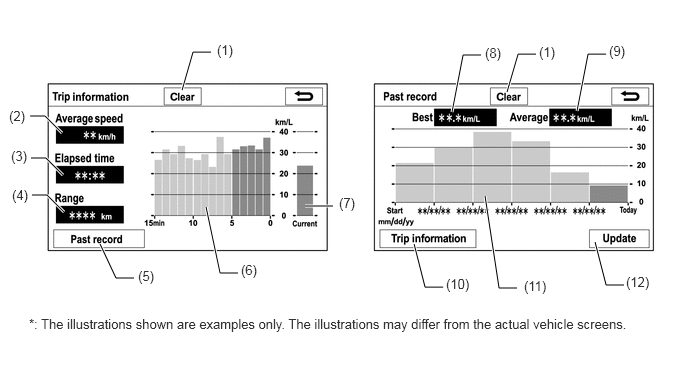
| Item | Outline | |
|---|---|---|
| (1) | Clear Switch | Clears all past information. |
| (2) | Average Speed | Displays an average speed value that has been calculated by the combination meter assembly, which is based on the distance driven and time elapsed since the ignition switch was turned to ON. |
| (3) | Elapsed Time | Displays an elapsed time value that has been calculated by the combination meter assembly, which is based on the time elapsed since the ignition switch was turned to ON. |
| (4) | Range | Displays the approximate drivable distance. |
| (5) | Past Record Switch | Changes to the Past record (per trip) fuel consumption screen. |
| (6) | Average Per Minute Fuel Consumption | ·
Displays the value that has been calculated by the combination meter assembly, which is based on the driven distance and the volume of fuel consumed (fuel injection signal) since the ignition switch was turned to ON. ·
Displays the average fuel consumption for the last minute, or since clear was last selected. |
| (7) | Current Per Minute Fuel Consumption | Displays the instantaneous (current) fuel consumption value that has been calculated by the combination meter assembly, which is based on the driven distance and the volume of fuel consumed (fuel injection signal) since the ignition switch was turned to ON. |
| (8) | Best Fuel Consumption | Displays the best (most economical) per trip fuel consumption. |
| (9) | Average Fuel Consumption | Displays the average fuel consumption for this trip and the previous 5 trips. |
| (10) | Trip Information Switch | Changes to the average per minute fuel consumption screen. |
| (11) | Average Per Trip Fuel Consumption | ·
Displays the current record and the last 5 average per trip fuel consumption records or the current record and those since clear was last selected. ·
Starts calculating the average fuel consumption when the average fuel consumption displayed on the combination meter assembly is reset. |
| (12) | Update Switch | ·
Restarts calculation of the average fuel consumption value. ·
Sends the average fuel consumption reset signal to the combination meter assembly to update the graph. |
DIAGNOSIS
For details on the procedure required to enter the Service Menu screen, refer to the Repair Manual.