Home › Brake › BRAKE CONTROL / DYNAMIC CONTROL SYSTEMS › ANTI-LOCK BRAKE SYSTEM (for Hatchback)

DTC    C1417    High Power Supply Voltage Malfunction


DESCRIPTION

If a malfunction is detected in the power supply circuit, the skid control ECU (brake actuator assembly) stores this DTC and the fail-safe function prohibits ABS operation.
This DTC is stored when the IG1 terminal voltage deviates from the DTC detection condition due to a malfunction in the power supply or charging circuit such as the battery or generator circuit, etc.
The DTC is cancelled when the IG1 terminal voltage returns to normal.

DTC No.
DTC Detection Condition
Trouble Area
C1417
The IG1 terminal voltage is 17.4 V or more for 0.8 seconds or more.
  1. Battery
  2. Charging system
  3. Power source circuit
  4. Internal power supply circuit of the skid control ECU

WIRING DIAGRAM

Refer to DTC C1241 (Click here).

INSPECTION PROCEDURE

NOTICE:
Inspect the fuses for circuits related to this system before performing the following inspection procedure.

1.INSPECT BATTERY
  1. Check the battery voltage.

    Standard voltage:
    11 to 14 V


NG
CHECK OR REPLACE CHARGING SYSTEM OR BATTERY (Click here)
OK


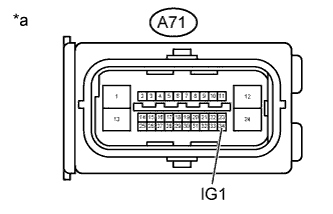
2.CHECK TERMINAL VOLTAGE (IG1 TERMINAL)
  1. Disconnect the skid control ECU (brake actuator assembly) connector.

  1. Turn the ignition switch to ON.


    C231272E35
  1. Measure the voltage according to the value(s) in the table below.

    Standard Voltage:
    Tester Connection
    Switch Condition
    Specified Condition
    A71-34 (IG1) - Body ground
    Ignition switch ON
    11 to 14 V

    Text in Illustration 
    *a
    Front view of wire harness connector
    (to Skid control ECU)

  1. Turn the ignition switch off.


NG
REPAIR OR REPLACE HARNESS OR CONNECTOR (IG1 CIRCUIT)
OK


3.RECONFIRM DTC
  1. Clear the DTCs (Click here).

  1. Check if the same DTC is recorded (Click here).

Result 
Result
Proceed to
DTC C1417 is not output
A
DTC C1417 is output
B


B
REPLACE BRAKE ACTUATOR ASSEMBLY (Click here)
A

CHECK FOR INTERMITTENT PROBLEMS (SYMPTOM SIMULATION) (Click here)