P0900 Clutch Actuator Circuit
Diagnostic trouble codes · Vehicles built from Nov 2005
DESCRIPTION
The clutch actuator is operated by the transmission control ECU and engages and disengages the clutch by the pull rod movement of the clutch actuator. An electric motor moves the pull rod, and the clutch stroke sensor, which is mounted on the clutch actuator assembly, detects the pull rod position. The transmission control ECU monitors the electrical current and clutch motor output terminal voltage, and detects malfunctions in the clutch motor circuit.| DTC No. |
DTC Detection Conditions |
Trouble Areas |
| P0900 |
The transmission control ECU detects the following conditions: (1 trip detection logic)
|
|
| P0900 |
The transmission control ECU detects the following conditions: (1 trip detection logic)
|
|
| P0900 |
The transmission control ECU detects the following conditions: (1 trip detection logic)
|
|
-
*1: A short between the clutch motor circuit and the body ground is suspected.
-
*2: A short between the clutch motor circuit and the +B circuit is suspected.
-
*3: An open in the clutch motor circuit is suspected. When the motor current does not flow to the ECU terminals despite the ECU ordering the clutch motor to operate, the ECU sets the DTC.
-
*4: An open in the clutch motor circuit is suspected. When the difference is more than the threshold despite the ECU not ordering the clutch motor to operate, the ECU sets the DTC.
WIRING DIAGRAM
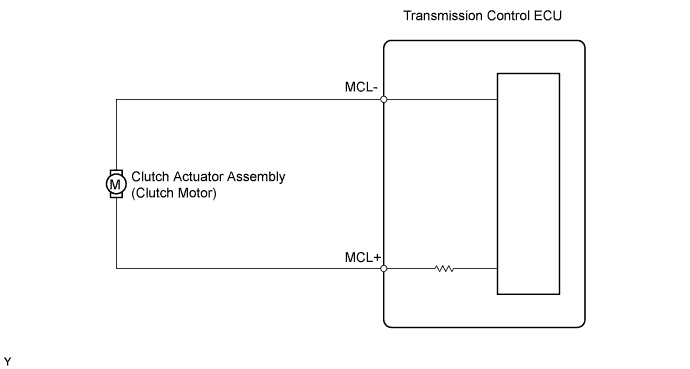

INSPECTION PROCEDURE
- NOTICE:
- In new clutch actuator assembly installation, perform Clamp Position Adjustment before installing the actuator (Click here). The pull rods of new clutch actuator assemblies (service supply parts) are not set to the clutch clamp position.
- In clutch actuator assembly replacement, perform Initialization and Learning of the multi-mode manual transmission system after installing the actuator (Click here). If the actuator is installed without the initialization and learning, it may cause driving performance degradation or system component breakage.
- In new clutch actuator assembly installation, perform Clamp Position Adjustment before installing the actuator (Click here). The pull rods of new clutch actuator assemblies (service supply parts) are not set to the clutch clamp position.
| 1. INSPECT CLUTCH ACTUATOR ASSEMBLY |

Disconnect the clutch motor connector.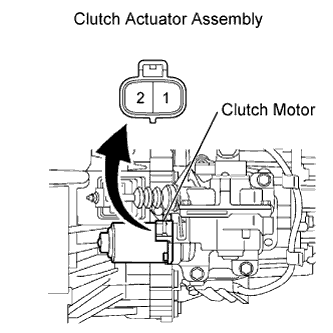
Measure the clutch motor resistance.
- Standard resistance:
Tester Connections
Specified Conditions
1 - 2
0.1 to 100 Ω
Reconnect the clutch motor connector.
|
|
||||

| OK | |
 |
| 2. CHECK HARNESS AND CONNECTOR (CLUTCH ACTUATOR - TRANSMISSION CONTROL ECU) |
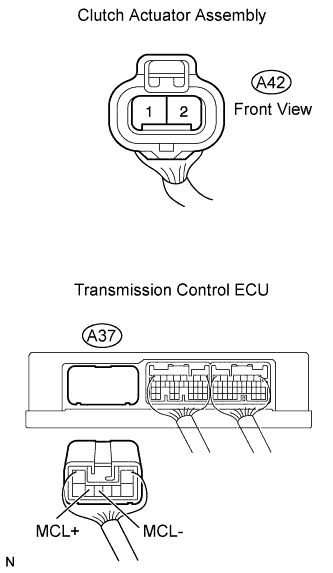 |
Disconnect the clutch actuator assembly connector.
Disconnect the transmission control ECU connector.
Check the resistance.
- Standard resistance:
Tester Connections
Specified Conditions
MCL- (A37-6) - (A42-1)
Below 1 Ω
MCL+ (A37-7) - (A42-2)
Below 1 Ω
MCL- (A37-6) - Body ground
10 kΩ or higher
MCL+ (A37-7) - Body ground
10 kΩ or higher
Reconnect the clutch actuator assembly connector.
Reconnect the transmission control ECU connector.
|
|
||||
| OK | ||
 |
||
| ||