STANDARD PROCEDURE
DRAINING FUEL TANK
WARNING: The fuel system may be under constant fuel pressure even with the engine off. This pressure must be released before servicing fuel tank (Refer to 14 - FUEL SYSTEM/FUEL DELIVERY - STANDARD PROCEDURE).
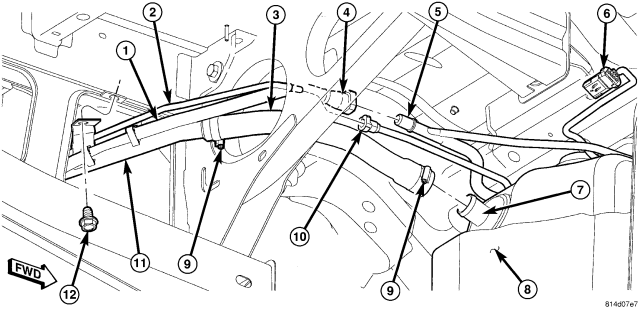
Two different procedures may be used to drain fuel tank: through the fuel fill fitting on tank, or using a diagnostic scan tool.
The quickest draining procedure involves removing the rubber fuel fill hose (3) from fuel tank fitting (7).
As an alternative procedure, the electric fuel pump may be activated allowing tank to be drained at fuel rail connection. Refer to scan tool for fuel pump activation procedures. Before disconnecting fuel line at fuel rail, release fuel pressure. (Refer to 14 - FUEL SYSTEM/FUEL DELIVERY - STANDARD PROCEDURE) Attach end of Fuel Pressure Test Adapter 6539 at fuel rail disconnection (tool number 6631 is used on 5/16” fuel lines. Position opposite end of this hose tool to an approved gasoline draining station. Activate fuel pump and drain tank until empty.
If electric fuel pump is not operating, fuel must be drained through fuel fill fitting at tank. Refer to following procedures.
1. Release fuel system pressure. (Refer to 14 - FUEL SYSTEM/FUEL DELIVERY - STANDARD PROCEDURE).
2. Raise vehicle.
3. Thoroughly clean area around fuel fill fitting (7) and rubber fuel fill hose (3) at rear of fuel tank (8).
4. Loosen clamp (9) at tank fitting (7) and disconnect rubber fuel fill hose at fuel tank fitting.
5. Position a drain hose into fitting (7). Using an approved gasoline draining station, drain fuel from tank.
FUEL SYSTEM PRESSURE RELEASE
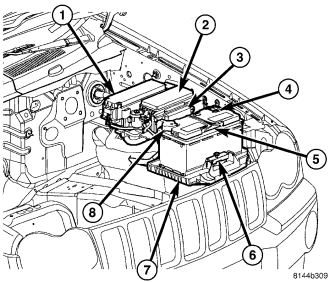
Use following procedure if the fuel injector rail is, or is not equipped with a fuel pressure test port.
1. Remove fuel fill cap.
2. Remove fuel pump relay from Power Distribution Center (PDC) (1). For location of relay, refer to label on underside of PDC cover (1).
3. Start and run engine until it stalls.
4. Attempt restarting engine until it will no longer run.
5. Turn ignition key to OFF position.
CAUTION: Steps 1, 2, 3, and 4 must be performed to relieve high pressure fuel from within fuel rail. Do not attempt to use following steps to relieve this pressure as excessive fuel will be forced into a cylinder chamber.
6. Unplug connector from any fuel injector.
7. Attach one end of a jumper wire with alligator clips (18 gauge or smaller) to either injector terminal.
8. Connect other end of jumper wire to positive side of battery.
9. Connect one end of a second jumper wire to remaining injector terminal.
CAUTION: Powering an injector for more than a few seconds will permanently damage the injector.
10. Momentarily touch other end of jumper wire to negative terminal of battery for no more than a few seconds.
11. Place a rag or towel below fuel line quick-connect fitting at fuel rail.
12. Disconnect quick-connect fitting at fuel rail. (Refer to 14 - FUEL SYSTEM/FUEL DELIVERY/QUICK CONNECT FITTING - STANDARD PROCEDURE).
13. Return fuel pump relay to PDC.
14. One or more Diagnostic Trouble Codes (DTC's) may have been stored in PCM memory due to fuel pump relay removal. A diagnostic scan tool must be used to erase a DTC.