RAIL - FUEL
DESCRIPTION
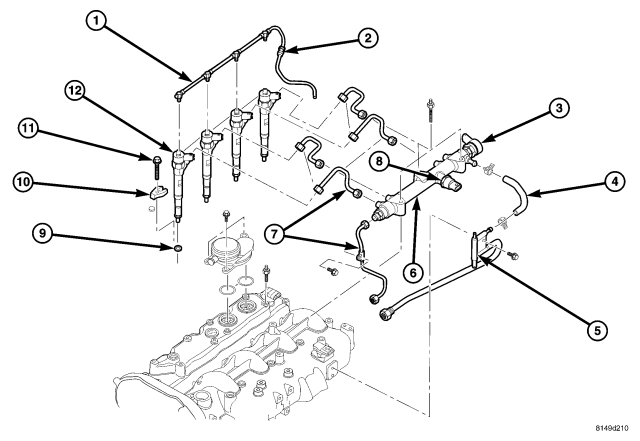
WARNING: High - pressure fuel line deliver diesel fuel under extreme pressure from the injection pump to the fuel injectors. This may be as high as 1600 bar (23,200 psi). Use extreme caution when inspecting for high - pressure fuel leaks. Fuel under this amount of pressure can penetrate skin causing personal injury or death. Inspect for high - pressure leaks with a sheet of cardboard. Wear safety goggles and adequate protective clothing when servicing fuel system.
The fuel rail is mounted to the cylinder head cover/intake manifold. The rail supplies constant high fuel pressure to the fuel injectors .
OPERATION
WARNING: High - pressure lines deliver diesel fuel under extreme pressure from the injection pump to the fuel injectors. This may be as high as 1600bar (23,200 psi.). Use extreme caution when inspecting for high - pressure fuel leaks. Fuel under this amount of pressure can penetrate skin causing personal injury or death. Inspect for high - pressure fuel leaks with a sheet of cardboard. Wear safety goggles and adequate protective clothing when servicing fuel system.
The fuel rail stores the fuel for the injectors at high pressure. At the same time, the pressure oscillations which are generated due to the high-pressure pump delivery and the injection of fuel are dampened by the rail volume.
The fuel rail is common to all cylinders, hence it's name “common rail”. Even when large quantities of fuel are extracted, the fuel rail maintains a constant inner pressure. This ensures that the injection pressure remains constant from the moment the injector opens.
REMOVAL
WARNING: High - pressure lines deliver diesel fuel under extreme pressure from the injection pump to the fuel injectors. This may be as high as 1600 bar (23,200 psi.). Use extreme caution when inspecting for high - pressure fuel leaks. Fuel under this amount of pressure can penetrate skin causing personal injury or death. Inspect for high - pressure fuel leaks with a sheet of cardboard. Wear safety goggles and adequate protective clothing when servicing fuel system.
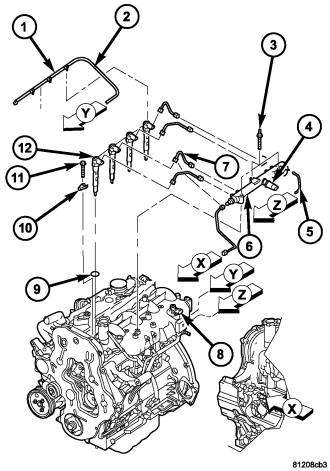
1. Disconnect negative battery cable.
2. Remove engine cover and bracket assembly (Refer to 9 - ENGINE COVER - REMOVAL) .
3. Disconnect fuel pressure sensor electrical connector .
NOTE: If fuel rail is being replaced it is necessary to replace the fuel rail solenoid.
4. Disconnect the fuel rail solenoid electrical connector.
5. Disconnect fuel rail return line at fuel rail .
6. Disconnect fuel high pressure line from injection pump to fuel rail at fuel rail.
7. Disconnect fuel high pressure line from fuel rail to fuel injector at fuel rail .
8. Remove fuel rail retaining bolts and remove rail from cylinder head cover/intake manifold .
INSTALLATION
WARNING: High - pressure lines deliver diesel fuel under extreme pressure from the injection pump to the fuel injectors. This may be as high as 1600 bar (23,200 psi.). Use extreme caution when inspecting for high - pressure fuel leaks. Fuel under this amount of pressure can penetrate skin causing personal injury or death. Inspect for high - pressure fuel leaks with a sheet of cardboard. Wear safety goggles and adequate protective clothing when servicing fuel system.
NOTE: The fuel rail solenoid must be replaced upon removal. When replacing fuel lines or solenoid it is necessary to counterhold and correctly torque the fitting. Refer to the proper procedure.
1. Replace the fuel rail solenoid (Refer to 14 - FUEL SYSTEM/FUEL INJECTION/FUEL PRESSURE SOLENOID - REMOVAL).
2. Install the fuel pressure sensor (Refer to 14 - FUEL SYSTEM/FUEL INJECTION/FUEL PRESSURE SENSOR - INSTALLATION).
3. Install fuel rail on cylinder head cover/intake manifold . Torque retaining bolts to 24.5 N·m (18 ft. lbs.).
4. Connect injector high pressure fuel lines at fuel rail .
5. Connect fuel rail high pressure fuel line at fuel rail.
6. Connect fuel rail fuel return line at fuel rail .
7. Connect fuel pressure sensor electrical connector .
8. Install engine cover and bracket assembly (Refer to 9 - ENGINE COVER - INSTALLATION) .
9. Connect negative battery cable.