BELT TENSION SENSOR
DESCRIPTION
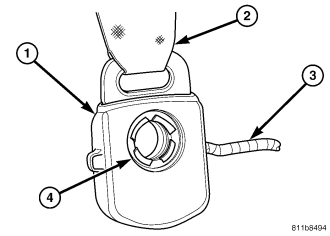
Vehicles equipped with the Occupant Classification System (OCS) include a belt tension sensor (1). This sensor is integral to the passenger side front seat belt (2) lower anchor which is secured to the outboard side of the passenger side front seat cushion frame. The lower anchor and belt tension sensor are concealed beneath an access cover on the outboard seat cushion side shield on the passenger side front seat.
The belt tension sensor consists of a molded plastic housing with a central mounting hole (4), a metal seat belt anchor loop, and a short pigtail wire. The electronic circuitry of the belt tension sensor is concealed and protected within the molded plastic housing. The sensor is connected to the vehicle electrical system through its pigtail wire (3) to a dedicated take out of the passenger side front seat wire harness with a keyed and latching molded plastic connector insulator to ensure a proper and secure connection.
The belt tension sensor cannot be repaired and, if ineffective or damaged, the entire passenger side front seat belt and retractor unit must be replaced. (Refer to 8 - ELECTRICAL/RESTRAINTS/FRONT SEAT BELT AND RETRACTOR - REMOVAL).
OPERATION
The belt tension sensor unit is designed to sense the relative cinch load applied to the passenger side front seat belt, which provides a logic input to the microprocessor of the Occupant Classification Module (OCM). When a load is applied to the seat belt, the changes in the load are measured by the belt tension sensor through the seat belt lower anchor. As the load changes, the circuitry of the belt tension sensor changes the output voltage of the sensor.
The belt tension sensor receives a nominal five volts and a ground through dedicated hard wired circuits from the OCM. The OCM then monitors the belt tension sensor output voltage on a dedicated hard wired data communication circuit. The OCM also monitors the condition of the sensor circuits and will store a Diagnostic Trouble Code (DTC) for any fault that is detected, then send messages to the Airbag Control Module (ACM) (also known as the Occupant Restraint Controller/ORC) to illuminate the airbag indicator in the ElectroMechanical Instrument Cluster (EMIC).
The hard wired circuits between the belt tension sensor and the OCM may be diagnosed using conventional diagnostic tools and procedures. Refer to the appropriate wiring information. However, conventional diagnostic methods will not prove conclusive in the diagnosis of the belt tension sensor or the electronic controls and communication between other modules and devices that provide features of the Occupant Classification System (OCS). The most reliable, efficient, and accurate means to diagnose the belt tension sensor or the electronic controls and communication related to belt tension sensor operation requires the use of a diagnostic scan tool. Refer to the appropriate diagnostic information.