AIR BAG, Driver
DESCRIPTION
DESCRIPTION
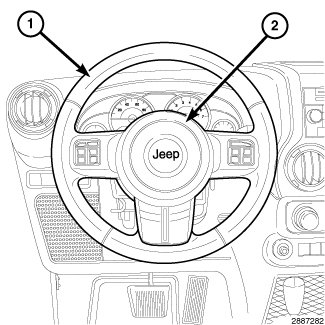 |
The injection molded, thermoplastic driver airbag protective trim
cover (2) is the most visible part of the Driver AirBag (DAB). The
DAB is located in the center of the steering wheel (1), where it is
secured with screws to the floating horn switch within the hub cavity
of the three-spoke steering wheel. An injection molded, bright emblem
with the Jeep® logo is applied to the center of the trim cover.
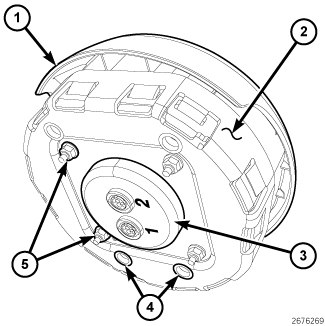 |
Concealed beneath the DAB trim cover (1) are the folded airbag cushion, the airbag housing (2), the airbag inflator (3) and the retainers (5) that secure the inflator to the housing. The airbag cushion, housing and inflator are secured within an integral receptacle molded into the back of the trim cover. The vertical walls of this receptacle have numerous integral window features that are engaged by numerous tab features that are bent inward around the perimeter of the DAB housing. Once the trim cover is fully seated in the housing, it can only be removed by cutting it off, and will have to be replaced with a new trim cover. The DAB housing also has four well nuts (4) which are used to secure the floating horn switch to the back of the housing.
The DAB used in this vehicle is a multistage-type that complies with revised federal airbag standards to deploy with less force than those used in some prior vehicles. A radial deploying 67.3 centimeter (26.5 inch) diameter fabric airbag cushion with internal tethers is used. The airbag inflator is a dual-initiator, non-azide, pyrotechnic-type unit and is secured to the stamped metal airbag housing using four flanged hex nuts. Two keyed and color-coded connector receptacles on the DAB inflator connect the two inflator initiators to the vehicle electrical system through two jacketed, two-wire pigtail harnesses from the clockspring.
The DAB cannot be repaired, and must be replaced if deployed, ineffective
or in any way damaged. The DAB trim cover and the floating horn switch
are available for individual service replacement.
OPERATION
OPERATION
The multistage Driver AirBag (DAB) is deployed by electrical signals generated by the Occupant Restraint Controller (ORC) through the DAB squib 1 and squib 2 circuits to the two initiators in the airbag inflator. By using two initiators, the airbag can be deployed at multiple levels of force. The force level is controlled by the ORC to suit the monitored impact conditions by providing one of several delay intervals between the electrical signals provided to the two initiators. The longer the delay between these signals, the less forcefully the airbag will deploy.
When the ORC sends the proper electrical signals to each initiator, the electrical energy generates enough heat to initiate a small pyrotechnic charge which, in turn ignites chemical pellets within the inflator. Once ignited, these chemical pellets burn rapidly and produce a large quantity of inert gas. The inflator is sealed to the back of the DAB housing and a diffuser in the inflator directs all of the inert gas into the airbag cushion, causing the cushion to inflate. As the cushion inflates, the DAB trim cover will split at predetermined breakout lines, then fold back out of the way. Following a deployment, the airbag cushion quickly deflates by venting the inert gas towards the instrument panel through vent holes within the fabric used to construct the back (steering wheel side) panel of the cushion.
Some of the chemicals used to create the inert gas may be considered hazardous while in their solid state before they are burned, but they are securely sealed within the airbag inflator. Typically, both initiators are used and all potentially hazardous chemicals are burned during an airbag deployment event. However, it is possible for only one initiator to be used during a deployment due to a Supplemental Restraint System (SRS) fault; therefore, it is necessary to always confirm that both initiators have been used in order to avoid the improper disposal of potentially live pyrotechnic or hazardous materials. (Refer to 10 - Restraints - Standard Procedure) .
The inert gas that is produced when the chemicals are burned during a deployment is harmless. However, a small amount of residue from the burned chemicals may cause some temporary discomfort if it contacts the skin, eyes, or breathing passages. If skin or eye irritation is noted, rinse the affected area with plenty of cool, clean water. If breathing passages are irritated, move to another area where there is plenty of clean, fresh air to breath. If the irritation is not alleviated by these actions, contact a physician.
Proper diagnosis of the DAB inflator and squib circuits requires the use of a diagnostic scan tool and may also require the use of the SRS Load Tool special tool along with the appropriate Load Tool Jumpers and Adapters. Refer to the appropriate diagnostic information.
REMOVAL
REMOVAL
To avoid serious or fatal injury on vehicles equipped with airbags, disable the Supplemental Restraint System (SRS) before attempting any steering wheel, steering column, airbag, seat belt tensioner, impact sensor or instrument panel component diagnosis or service. Disconnect and isolate the battery negative (ground) cable, then wait two minutes for the system capacitor to discharge before performing further diagnosis or service. This is the only sure way to disable the SRS. Failure to take the proper precautions could result in accidental airbag deployment.
WARNING:
To avoid serious or fatal injury when removing a deployed airbag, rubber gloves, eye protection, and a long-sleeved shirt should be worn. There may be deposits on the airbag cushion and other interior surfaces. In large doses, these deposits may cause irritation to the skin and eyes.
WARNING:
 |
| NOTE: |
The following procedure is for replacement of an ineffective or damaged Driver AirBag (DAB). If the airbag is ineffective or damaged, but not deployed, review the recommended procedures for Handling Non-Deployed Supplemental Restraints. (Refer to 10 - Restraints - Standard Procedure) . If the DAB has been deployed, review the recommended procedures for Service After A Supplemental Restraint Deployment before removing the airbag from the vehicle. (Refer to 10 - Restraints - Standard Procedure) . |
- Disconnect and isolate the battery negative cable. Wait two minutes for the system capacitor to discharge before further service.
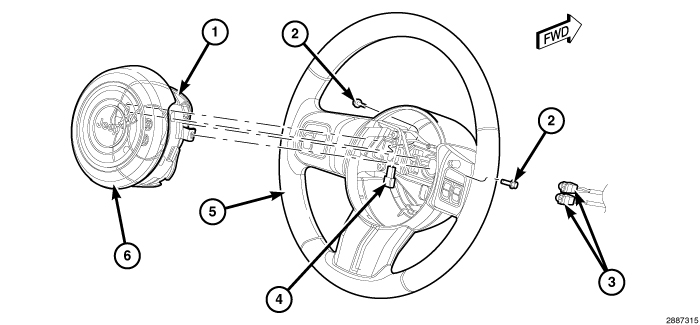
- Working through the access holes in each side of the steering wheel (5) rear trim cover, remove the two screws (2) that secure the floating horn switch (1) and Driver AirBag (DAB) (6) unit to the steering wheel armature.
- Pull the DAB and floating horn switch unit away from the steering wheel far enough to access the electrical connections (3 and 4) at the back of the airbag housing and switch unit.
-
Disconnect the steering
wheel wire harness connector from the floating horn switch connector
on the back of the switch.
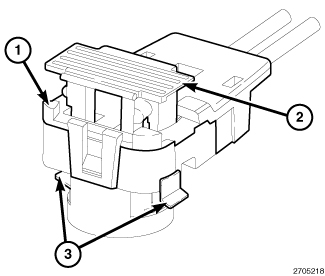
CAUTION: Do not pull on the clockspring pigtail wires or pry on the connector insulators to disengage them from the Driver AirBag (DAB) inflator initiator connector receptacles. Improper removal of these pigtail wires and their connector insulators can result in damage to the airbag circuits or the connector insulators.
- The clockspring DAB pigtail wire connector insulators (1) are secured by integral latches (3) and a Connector Position Assurance (CPA) lock (2) to the airbag inflator connector receptacles, which are located on the back of the DAB housing. Pull the lock straight out from the connector insulator, then pull the insulators straight out from the airbag inflator to disengage the latches and disconnect them from the connector receptacles.
- Remove the driver airbag from the steering wheel.
-
If the driver airbag
has been deployed, the clockspring and the steering column must be
replaced.
DISASSEMBLY
DISASSEMBLY
To avoid serious or fatal injury on vehicles equipped with airbags, disable the Supplemental Restraint System (SRS) before attempting any steering wheel, steering column, airbag, seat belt tensioner, impact sensor or instrument panel component diagnosis or service. Disconnect and isolate the battery negative (ground) cable, then wait two minutes for the system capacitor to discharge before performing further diagnosis or service. This is the only sure way to disable the SRS. Failure to take the proper precautions could result in accidental airbag deployment.
WARNING:
To avoid serious or fatal injury, service of this unit should be performed only by Chrysler-trained and authorized dealer service technicians. Failure to take the proper precautions or to follow the proper procedures could result in accidental, incomplete, or improper airbag deployment and possible occupant injuries.
WARNING:
To avoid serious or fatal injury, use extreme care to prevent any foreign material from entering the Driver AirBag (DAB), or becoming entrapped between the DAB cushion and the DAB trim cover. Failure to observe this warning could result in occupant injuries upon airbag deployment.
WARNING:
To avoid serious or fatal injury, the Driver AirBag (DAB) trim cover must never be painted. Replacement trim covers are serviced in the original colors. Paint may change the way in which the material of the trim cover responds to an airbag deployment. Failure to observe this warning could result in occupant injuries upon airbag deployment.
WARNING:
 |
| NOTE: |
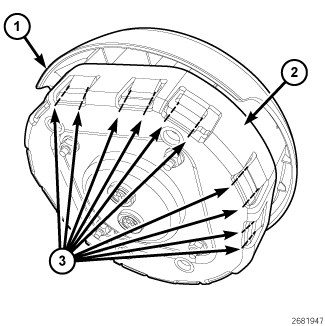
The following procedures can be used to replace the Driver AirBag (DAB) trim cover for service of cosmetic damage issues. If the DAB is ineffective or deployed, the entire DAB and trim cover must be replaced as a unit. The trim cover will be irreparably damaged if it is removed from the DAB housing and MUST be replaced with a new trim cover. |
- Disconnect and isolate the battery negative cable. Wait two minutes for the system capacitor to discharge before further service.
- Remove the Driver AirBag (DAB) from the steering wheel. (Refer to 10 - Restraints/AIR BAG, Driver - Removal) .
- Place the DAB on a suitable clean and dry work surface.
- Using a sharp utility knife, carefully cut through the lower edge of each of the twelve trim cover (1) windows at the cut lines (3) on each side of the twelve inward pointing hooks of the airbag housing (2). Use extreme care to prevent any scraps from entering and becoming lost within the airbag housing or cushion.
-
With all of the windows
cut open, separate the remainder of the trim cover from the DAB housing
by pulling it away from the top of the housing around the perimeter.
Discard the removed trim cover.
ASSEMBLY
ASSEMBLY
To avoid serious or fatal injury on vehicles equipped with airbags, disable the Supplemental Restraint System (SRS) before attempting any steering wheel, steering column, airbag, seat belt tensioner, impact sensor or instrument panel component diagnosis or service. Disconnect and isolate the battery negative (ground) cable, then wait two minutes for the system capacitor to discharge before performing further diagnosis or service. This is the only sure way to disable the SRS. Failure to take the proper precautions could result in accidental airbag deployment.
WARNING:
To avoid serious or fatal injury, service of this unit should be performed only by Chrysler-trained and authorized dealer service technicians. Failure to take the proper precautions or to follow the proper procedures could result in accidental, incomplete, or improper airbag deployment and possible occupant injuries.
WARNING:
To avoid serious or fatal injury, use extreme care to prevent any foreign material from entering the Driver AirBag (DAB), or becoming entrapped between the DAB cushion and the DAB trim cover. Failure to observe this warning could result in occupant injuries upon airbag deployment.
WARNING:
To avoid serious or fatal injury, the Driver AirBag (DAB) trim cover must never be painted. Replacement trim covers are serviced in the original colors. Paint may change the way in which the material of the trim cover responds to an airbag deployment. Failure to observe this warning could result in occupant injuries upon airbag deployment.
WARNING:
 |
| NOTE: |
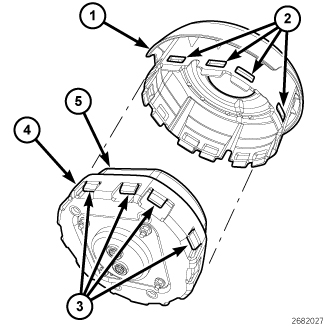
The following procedures can be used to replace the Driver AirBag (DAB) trim cover for service of cosmetic damage issues. If the DAB is ineffective or deployed, the entire DAB and trim cover must be replaced as a unit. The trim cover will be irreparably damaged if it is removed from the DAB housing and MUST be replaced with a new trim cover. |
- Place the Driver AirBag housing (4) on a suitable clean and dry work surface with the cushion (5) facing up.
- Position the DAB trim cover (1) over the housing. Be certain that the twelve windows (2) of the trim cover are aligned with the twelve inward pointing hooks (3) of the airbag housing. All of the trim cover windows will align with all of the housing hooks correctly only in one position.
- Insert the edges of the trim cover between the airbag cushion and the airbag housing. Be certain that the trim cover and housing are still properly aligned.
- Using hand pressure, push the trim cover firmly and evenly down into the housing far enough that each of the inward pointing hooks of the housing is engage through a window in the trim cover.
- Inspect around the entire perimeter of the unit being certain each of the twelve hooks on the DAB housing is engaged through the appropriate window in the trim cover.
- After the DAB has been assembled, try pulling the perimeters of the trim cover and the airbag housing away from each other. This action will fully seat the housing hooks into the trim cover windows.
-
Reinstall the driver
airbag onto the steering wheel. (Refer to 10 - Restraints/AIR BAG, Driver - Installation)
.
INSTALLATION
INSTALLATION
To avoid serious or fatal injury on vehicles equipped with airbags, disable the Supplemental Restraint System (SRS) before attempting any steering wheel, steering column, airbag, seat belt tensioner, impact sensor or instrument panel component diagnosis or service. Disconnect and isolate the battery negative (ground) cable, then wait two minutes for the system capacitor to discharge before performing further diagnosis or service. This is the only sure way to disable the SRS. Failure to take the proper precautions could result in accidental airbag deployment.
WARNING:
To avoid serious or fatal injury, use extreme care to prevent any foreign material from entering the Driver AirBag (DAB), or becoming entrapped between the DAB cushion and the DAB trim cover. Failure to observe this warning could result in occupant injuries upon airbag deployment.
WARNING:
To avoid serious or fatal injury, the driver airbag trim cover must never be painted. Replacement airbags are serviced with trim covers in the original colors. Paint may change the way in which the material of the trim cover responds to an airbag deployment. Failure to observe this warning could result in occupant injuries upon airbag deployment.
WARNING:
|
| NOTE: |
The following procedure is for replacement of an ineffective or damaged Driver AirBag (DAB). If the airbag is ineffective or damaged, but not deployed, review the recommended procedures for Handling Non-Deployed Supplemental Restraints. (Refer to 10 - Restraints - Standard Procedure) . If the DAB has been deployed, review the recommended procedures for Service After A Supplemental Restraint Deployment before removing the airbag from the vehicle. (Refer to 10 - Restraints - Standard Procedure) . |
- Position the Driver AirBag (DAB) (6) and floating horn switch (1) unit close enough to the steering wheel (5) to reconnect the electrical connections (3 and 4) to the back of the airbag housing.
- Reconnect the steering wheel wire harness connector to the floating horn switch connector on the back of the switch.
- Reconnect the wire connectors to the airbag inflator connector receptacles by pressing straight in on the connector insulator. Be certain to engage each keyed and color-coded connector to the matching connector receptacle. You can be certain that each connector is fully engaged in its receptacle by listening carefully for a distinct, audible click as the connector latches snap into place.
- Push each of the Connector Position Assurance (CPA) locks firmly into the DAB connector insulator until it is flush with the upper surface of the insulator.
- Carefully position the DAB and floating horn switch unit into the steering wheel hub while tugging lightly upward on the clockspring pigtail wires for the airbag and tucking the wires into the upper hub cavity of the steering wheel. Be certain that none of the steering wheel wiring is pinched between the airbag housing or the horn switch and the steering wheel armature or the steering wheel damper.
- Working through the access holes in each side of the steering wheel rear trim cover, install and tighten the two screws (2) that secure the floating horn switch and DAB unit to the steering wheel armature. Tighten the screws to 13 N·m (10 ft. lbs.).
- Do not reconnect the battery negative cable at this time. The Supplemental Restraint System (SRS) Verification Test procedure should be performed following service of any SRS component. (Refer to 10 - Restraints - Standard Procedure) .