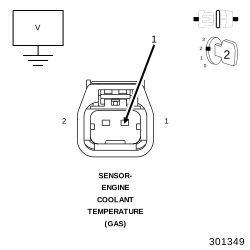
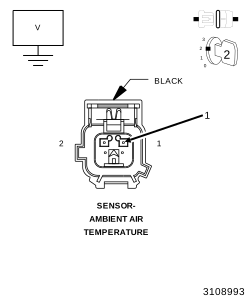
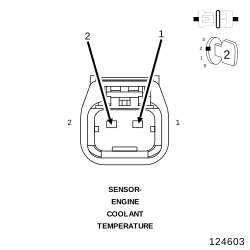
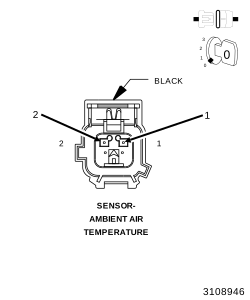
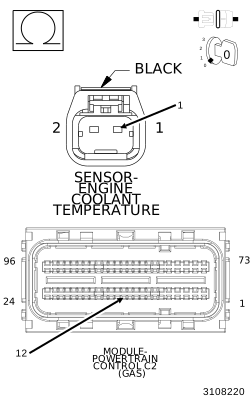
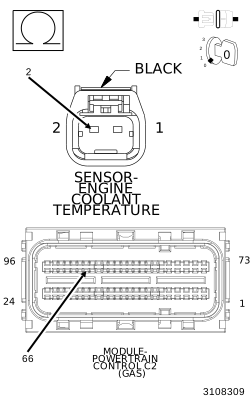
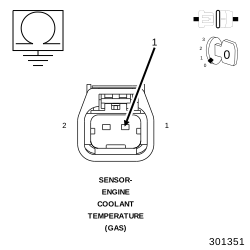
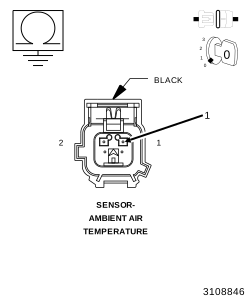
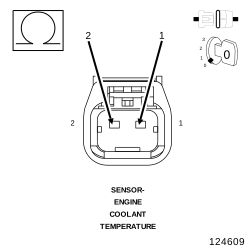
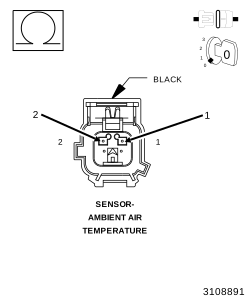
For a complete wiring diagram, refer to the Wiring Information.
Theory of Operation
The Powertrain Control Module (PCM) predicts what the engine coolant temperature should be, based on the engine coolant temperature at start-up, ambient temperature and how the vehicle is subsequently driven. The predicted engine coolant temperature is compared to the Engine Coolant Temperature Sensor reading. The error between the two is calculated and integrated with respect to time. When the Thermostat diagnostic runs, the integrated error is compared to a calibrated threshold and pass/fail is determined. Separate pass and fail thresholds are used in order to improve accuracy of the diagnostic.
When Monitored:
With the engine running, ambient temperature between -8°C (17.6°F) and 50°C (122°F), start up coolant temperature less than 50°C (122°F) and average vehicle speed greater than 16 kph (10 mph) until coolant temperature reaches 85°C (185°F).
Set Condition:
The PCM detects that the actual engine coolant temperature falls too far below the predicted engine coolant temperature and the predicted coolant temperature reaches the predicted target value before the actual coolant temperature reaches the actual coolant temperature target value. Two trip fault. Three good trips to turn off the MIL.
Possible Causes
LOW COOLANT LEVEL
THERMOSTAT OPERATION
SIGNAL CIRCUIT SHORTED TO VOLTAGE
TEMPERATURE SENSOR
SIGNAL CIRCUIT OPEN
SENSOR GROUND CIRCUIT OPEN
SIGNAL CIRCUIT SHORTED TO GROUND
SIGNAL CIRCUIT SHORTED TO THE SENSOR GROUND CIRCUIT
If any ECT, AAT, CMP or CKP sensor DTCs have set along with P0128, diagnose them before continuing.
NOTE:
Make sure that the Pinion Factor has been programmed correctly into the PCM.
1.
Start the engine.
2.
Allow the engine to reach normal operating temperature.
3.
With the scan tool, select View DTCs.
NOTE:
It may be necessary to drive the vehicle to meet the conditions to set this DTC, try to repeat the conditions in which the fault originally set by reviewing the Freeze Frame data.
If an Engine Coolant Temperature (ECT) DTC is set along with this code, diagnose the ECT DTC first.
NOTE:
Inspect the ECT terminals and related PCM terminals. Make sure the terminals are free from corrosion and damage.
NOTE:
The best way to diagnose this DTC is to allow the vehicle to sit overnight outside in order to have a totally cold soaked engine.
NOTE:
Extremely cold outside ambient temperatures may have caused this DTC to set.
WARNING:
Never open the cooling system when
the engine is hot. The system is under pressure. Failure to follow
these instructions can result in personal injury including extreme
burns, scalding, or fatal injury. Allow the engine to cool before
opening the cooling system.
This test works best if performed on a cold engine (cold soak).
1.
Ignition on, engine not running.
2.
With the scan tool, read the Engine Coolant Temp Degree value. If the engine was allowed to sit overnight (cold soak), the temperature value should be a value that is somewhere close to the ambient temperature.
NOTE:
If engine coolant temperature is above 82°C (180°F), allow the engine to cool until 65°C (150°F) is reached.
3.
Start the Engine.
4.
During engine warm-up, monitor the Engine Coolant Temp Degree value. The temp deg value change should be a smooth transition from start up to normal operating temp 82°C (180°F). Also monitor the actual coolant temperature with a thermometer.
NOTE:
As the engine warms up to operating temperature, the actual coolant temperature (thermometer reading) and the scan tool, ECT Temperature value should stay relatively close to each other.
5.
Using the appropriate Service Information, determine the proper opening temperature of the thermostat.
Did the thermostat open at the proper temperature?
Make sure the engine cooling system
is cool before removing the pressure cap or any hose. The cooling
system is pressurized when hot. Failure to follow these instructions
can result in possible serious or fatal injury.
1.
With the scan tool, read and record the ECT Sensor Temperature value.
2.
Monitor the actual coolant temperature with a thermometer.
Is the ECT Sensor value within -15°C (5°F) of the thermometer reading?
Make sure the Temperature Sensors are properly installed.
4.
Make sure the CMP and CKP sensors are installed properly. Check the connectors for any signs of damage.
WARNING:
When the engine is operating, do
not stand in direct line with the fan. Do not put your hands near
the pulleys, belts or fan. Do not wear loose clothing. Failure to
follow these instructions may result in possible serious or fatal
injury.
5.
Perform any Technical Service Bulletins (TSBs) that may apply.
6.
With the engine running at normal operating temperature, monitor the Temperature sensor parameters while wiggling the wire harness. Look for parameter values to change.
7.
Visually inspect the related wire harness. Look for any chafed, pierced, pinched, partially broken wires and broken, bent, pushed out or corroded terminals.
8.
Inspect and clean all PCM, engine and chassis grounds.
Were any problems found during the above inspections?
Using the wiring diagram/schematic as a guide, inspect the wiring and connectors between the Temperature Sensors and the Powertrain Control Module (PCM).
2.
Look for any chafed, pierced, pinched or partially broken wires.
3.
Look for broken, bent, pushed out or corroded terminals. Verify that there is good pin to terminal contact in the Sensor and Powertrain Control Module connectors.
4.
Perform any Technical Service Bulletins that may apply.