CONDENSER, A/C
DESCRIPTION
DESCRIPTION
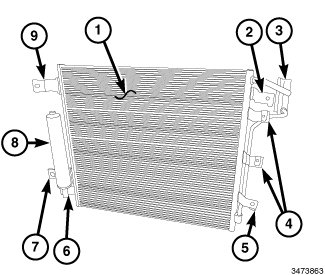 |
The A/C condenser (1) is located in the front of the engine compartment behind the grille. The A/C condenser is a heat exchanger that allows the high-pressure refrigerant gas being discharged by the A/C compressor to give up its heat to the air passing over the condenser fins, which causes the refrigerant to cool and change to a liquid state.
The A/C condenser is equipped with four mounting tabs (2, 5, 7 and 9), a tapping block (3) for the refrigerant lines, a tapping block (6) for the receiver/drier (8) and mounting brackets for the automatic transmission cooler (4), when equipped with automatic transmission,
OPERATION
OPERATION
When air passes through the fins of the A/C condenser, the high-pressure refrigerant gas within the A/C condenser gives up its heat. The refrigerant then condenses as it leaves the A/C condenser and becomes a high-pressure liquid. The volume of air flowing over the condenser fins is critical to the proper cooling performance of the A/C system. Therefore, it is important that there are no objects placed in front of the radiator grille openings at the front of the vehicle or foreign material on the condenser fins that might obstruct proper air flow. Also, any factory-installed air seals or shrouds must be properly reinstalled following radiator or A/C condenser service.
The A/C receiver/drier must be
replaced if an internal failure of the A/C compressor has occurred .
Failure to replace the A/C receiver drier can cause serious damage
to the replacement A/C compressor.
CAUTION:
| NOTE: |
Replacement of the refrigerant line O-ring seals and gaskets is required anytime a refrigerant line is disconnected. Failure to replace the rubber O-ring seals and metal gaskets could result in a refrigerant system leak. |
The A/C condenser has no serviceable parts except for the O-ring seals and gaskets. The O-ring seals used on the connections are made from a special type of rubber not affected by R-134a refrigerant. The O-ring seals and gaskets must be replaced whenever a refrigerant line is disconnected from the A/C condenser.
The A/C condenser cannot be repaired and must be replaced if leaking or damaged.
REMOVAL
REMOVAL
Refer to the applicable Warnings and Cautions for this system before performing the following operation and . Failure to follow these instructions may result in possible serious or fatal injury.
WARNING:
The A/C receiver/drier must be
replaced if an internal failure of the A/C compressor has occurred .
Failure to replace the A/C receiver drier can cause serious damage
to the replacement A/C compressor.
CAUTION:
| NOTE: |
Before removing the A/C condenser, note the location of each of the radiator and condenser air seals. These seals are used to direct air through the A/C condenser and the radiator. The air seals must be reinstalled in their proper locations in order for the A/C and engine cooling systems to perform as designed. |
 |
- Disconnect and isolate the negative battery cable.
- Recover the refrigerant from the refrigerant system (Refer to 24 - Heating and Air Conditioning/Plumbing - Standard Procedure) .
- Drain the engine cooling system (Refer to 07 - Cooling - Standard Procedure) .
- Remove the engine cover
- Remove the air intake hose and air cleaner housing.
- Remove the coolant recovery container (Refer to 07 - Cooling/Engine/BOTTLE, Coolant Recovery - Removal) .
- On 2.8L engine models, disconnect the charge air cooler outlet hose from the Charge Air Cooler (CAC) and position the hose out of the way (Refer to 09 - Engine/Turbocharger System/COOLER and HOSES, Charge Air - Removal) .
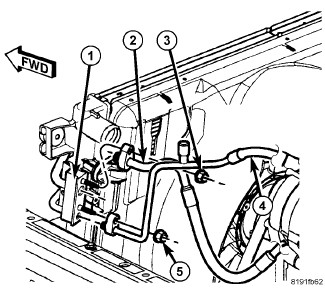
- Remove the nuts (3 and 5) that secure the A/C discharge line (2) and A/C liquid line (4) to the A/C condenser (1).
- Disconnect the A/C discharge and liquid line from the A/C condenser and remove and discard the O-ring seals and gaskets.
-
Install plugs in, or tape over the opened refrigerant line fittings and condenser ports.
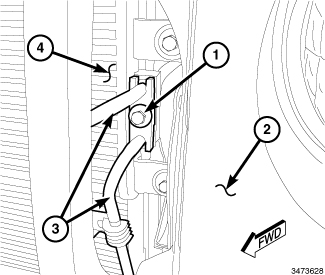
- Remove the grille (2) (Refer to 23 - Body/Exterior/GRILLE - Removal) .
-
When equipped with automatic transmission, remove the bolt (1) and disconnect the transmission cooler lines (3) from the transmission cooler (4) (Refer to 07 - Cooling/Transmission/COOLER, Transmission Oil - Removal)
.
- Remove the radiator fan and shroud assembly (Refer to 07 - Cooling/Engine/FAN, Cooling - Removal) .
- On 2.8L engine models, remove the bolts that secure the Charge Air Cooler (CAC) to the front of the radiator (Refer to 09 - Engine/Turbocharger System/COOLER and HOSES, Charge Air - Removal) .
- Remove the push-pin retainers that secure the radiator air seals to the radiator support.
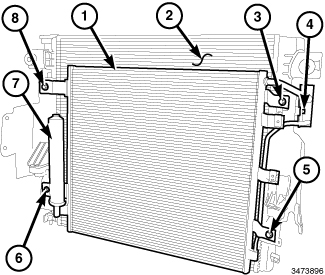
- Remove the radiator (2), A/C condenser (1) and transmission oil cooler (when equipped) as an assembly and place on a workbench (Refer to 07 - Cooling/Engine/RADIATOR, Engine Cooling - Removal) .
- When equipped with automatic transmission, remove the transmission cooler from the front of the A/C condenser (Refer to 07 - Cooling/Transmission/COOLER, Transmission Oil - Removal) .
- Remove the five bolts (3, 4, 5, 6 and 8) that secure the A/C condenser to the radiator and separate the condenser from the radiator.
-
If required, remove the A/C receiver/drier (7) from the A/C condenser (Refer to 24 - Heating and Air Conditioning/Plumbing/DRIER, A/C Receiver - Removal)
.
INSTALLATION
INSTALLATION
Be certain to adjust the refrigerant
oil level when servicing the A/C refrigerant system .
Failure to properly adjust the refrigerant oil level will prevent
the A/C system from operating as designed and can cause serious A/C
compressor damage.
CAUTION:
The A/C receiver/drier must be
replaced if an internal failure of the A/C compressor has occurred .
Failure to replace the A/C receiver drier can cause serious damage
to the replacement A/C compressor.
CAUTION:
| NOTE: |
When replacing multiple A/C system components, see the Refrigerant Oil Capacities chart to determine how much oil should be added to the refrigerant system (Refer to 24 - Heating and Air Conditioning/Plumbing/OIL, Refrigerant - Standard Procedure) . |
| NOTE: |
If the A/C condenser is being replaced, add 60 milliliters (2 fluid ounces) of refrigerant oil to the refrigerant system. Use only refrigerant oil of the type recommended for the A/C compressor in the vehicle. |
| NOTE: |
Replacement of the refrigerant line O-ring seals and gaskets is required anytime a refrigerant line disconnected. Failure to replace the rubber O-ring seals and metal gaskets may result in a refrigerant system leak. |
| NOTE: |
Be certain that the radiator air seals are installed in their proper locations. These air seals are required for the A/C and engine cooling systems to perform as designed. |
|
- If required, install the A/C receiver/drier (7) onto the right side of the A/C condenser (1) (Refer to 24 - Heating and Air Conditioning/Plumbing/DRIER, A/C Receiver - Installation) .
- Position the A/C condenser to the front of the radiator (2) and install the five retaining bolts (3, 4, 5, 6 and 8). Tighten the bolts to 5 N·m (45 in. lbs.).
- When equipped with automatic transmission, install the transmission cooler onto the front of the A/C condenser (Refer to 07 - Cooling/Transmission/COOLER, Transmission Oil - Installation) .
- Install the radiator, A/C condenser and transmission oil cooler (when equipped) as an assembly (Refer to 07 - Cooling/Engine/RADIATOR, Engine Cooling - Installation) .
- Position the radiator air seals to the radiator support and install the push-pin retainers.
- On 2.8L engine models, install the bolts that secure the Charge Air Cooler (CAC) to the front of the radiator (Refer to 09 - Engine/Turbocharger System/COOLER and HOSES, Charge Air - Installation) .
-
Install the radiator fan and shroud assembly (Refer to 07 - Cooling/Engine/FAN, Cooling - Installation)
.
- When equipped with automatic transmission, connect the transmission cooler lines (3) to the transmission cooler (4) using new O-ring seals and install the retaining bolt (1) (Refer to 07 - Cooling/Transmission/COOLER, Transmission Oil - Installation) .
-
Install the grille (2) (Refer to 23 - Body/Exterior/GRILLE - Installation)
.
- Remove the tape or plugs from the opened refrigerant line fittings and condenser ports.
- Lubricate new rubber O-ring seals with clean refrigerant oil and install them and new gaskets onto the refrigerant line fittings. Use only the specified O-ring seals as they are made of a special material for the R-134a system. Use only refrigerant oil of the type recommended for the A/C compressor in the vehicle.
- Connect the A/C discharge line (2) and the A/C liquid line (4) to the A/C condenser (1). Install the retaining nuts (3 and 5). Tighten the nuts to 23 N·m (17 ft. lbs.).
- On 2.8L engine models, connect the air outlet hose to the CAC (Refer to 09 - Engine/Turbocharger System/COOLER and HOSES, Charge Air - Installation) .
- Install the coolant recovery container (Refer to 07 - Cooling/Engine/BOTTLE, Coolant Recovery - Installation) .
- Install the air cleaner housing and air intake hose.
- Reconnect the negative battery cable.
- Refill the engine cooling system (Refer to 07 - Cooling - Standard Procedure) .
- Install the engine cover.
- Evacuate the refrigerant system (Refer to 24 - Heating and Air Conditioning/Plumbing - Standard Procedure) .
- If the A/C condenser is being replaced, add 60 milliliters (2 fluid ounces) of refrigerant oil to the refrigerant system. When replacing multiple A/C system components, see the Refrigerant Oil Capacities chart to determine how much oil should be added to the refrigerant system (Refer to 24 - Heating and Air Conditioning/Plumbing/OIL, Refrigerant - Standard Procedure) . Use only refrigerant oil of the type recommended for the A/C compressor in the vehicle.
- Charge the refrigerant system (Refer to 24 - Heating and Air Conditioning/Plumbing - Standard Procedure) .
-
If equipped with automatic transmission, check the automatic transmission fluid level and fill as required.