Pump
DESCRIPTION
GAS ENGINE
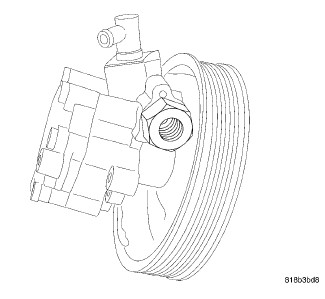 |
Hydraulic pressure for the power steering system is provided by a belt driven power steering pump. The pump shaft has a pressed-on high strength plastic drive pulley that is belt driven by the crankshaft pulley. The reservoir is a remote reservoir located by the battery. The power steering pump is connected to the steering gear by the pressure and return hoses.
DIESEL ENGINE
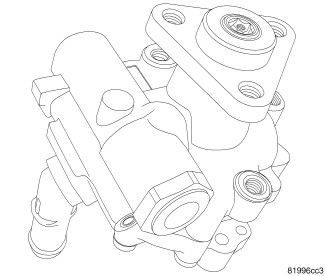 |
Hydraulic pressure for the power steering system is provided by a belt driven power steering pump. The pump shaft has a bolt on steel drive pulley that is belt driven by the crankshaft pulley. The reservoir is a remote reservoir located by the battery. The power steering pump is connected to the steering gear by the pressure and return hoses.
OPERATION
The power steering pump is a droop flow rate and displacement, vane-type pump. The pump internal parts operate submerged in fluid. The flow control orifice is part of the high pressure line fitting. The pressure relief valve inside the flow control valve limits the pump pressure.
| NOTE: |
Power steering pumps have different pressure rates and are not interchangeable with other pumps. |
POWER STEERING PUMP AND HOSES
| NOTE: |
This information is designed to be used in conjunction with the diagnostic charts at the beginning of the Steering section. (Refer to 19 - Steering - Diagnosis and Testing) |
CHECKING FOR WEAR OF POWER STEERING PUMP INTERNAL COMPONENTS
- Place gear selector in PARK (or NEUTRAL) with wheels chalked.
- With the engine idling, have a helper turn the steering wheel.
- Using an electronic listening tool, determine if noise is coming from the pump.
- Increase the engine speed and have a helper turn the steering wheel. Does the noise change with load?
- Replace the power steering pump if excessive noise is present. (Refer to 19 - Steering/Pump - Removal)
CHECKING FOR POWER STEERING HOSES TOUCHING BODY OR FRAME OF VEHICLE
Check hoses and hose tubes as following:
- Inspect hoses and hose tubes for witness marks. If witness marks are present, adjust hose(s) to the proper position by loosening, repositioning and tightening attachments to the specified torque (Refer to 19 - Steering/Pump - Specifications) . Do not bend tubing to adjust. Replace the hose assembly if damaged.
- Check fastener torque of hose mounting brackets and tube nuts. (Refer to 19 - Steering/Pump - Specifications)
- Have a helper bump the steering gear off of the stops to induce pressure fluctuations which may move the hose. If hose contact is made, adjust hose(s) to the proper position by loosening, repositioning and tightening attachments to the specified torque (Refer to 19 - Steering/Pump - Specifications) . Do not bend tubing to adjust. Replace the hose assembly if damaged.
TORQUE
| DESCRIPTION | N·m |
Ft. Lbs. |
In. Lbs. |
|---|---|---|---|
|
Power Steering Pump Bracket to Engine, Gas |
24 |
18 |
— |
|
Power Steering Pump to Bracket, Gas |
24 |
18 |
— |
|
Power Steering Pump/Bracket to Engine, Diesel |
28 |
21 |
— |
|
Power Steering Pump Pulley, Diesel |
28 |
21 |
— |
|
Pressure Line to Gear |
28 |
21 |
— |
|
Pressure Line to Pump |
31 |
23 |
— |
|
Pressure Line Routing Bracket to Frame |
7 |
— |
62 |
|
Return Line to Gear |
28 |
21 |
— |
|
Reservoir to Bracket |
8 |
— |
71 |
|
Reservoir Bracket to Body |
8 |
— |
71 |
3.6L
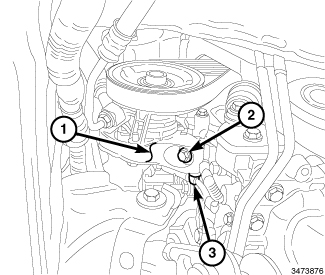 |
- Remove the drive belt (Refer to 07 - Cooling/Accessory Drive/BELT, Serpentine - Removal) .
- Remove cap from power steering fluid reservoir.
- Siphon as much fluid as possible from the power steering fluid reservoir.
- Raise and support the vehicle (Refer to 04 - Vehicle Quick Reference/Hoisting - Standard Procedure) .
- Disconnect the wiring harness routing retainer (3) from the power steering pump bracket (1).
-
Remove the lower power steering pump retaining bolt (2).
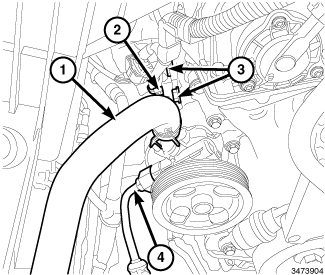
- Remove the supports and lower the vehicle.
- Remove the pressure hose (4) at the pump.
- Remove the supply hose (1) from the pump.
- Disconnect the wiring harness routing retainer (2) from the power steering pump bracket.
- Remove the upper power steering pump bracket retaining bolts (3).
-
Remove the pump (with bracket).
NOTE: The pump to bracket bolts are torqued to 24 N·m (18 ft. lbs.).
-
Remove and transfer necessary components.
2.8L- DIESEL
 |
- Siphon out as much power steering fluid as possible.
- Remove the air cleaner box (Refer to 09 - Engine/Air Intake System/BODY, Air Cleaner - Removal) .
-
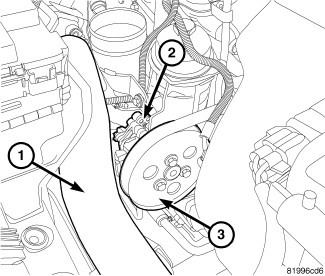
Remove the turbo air
inlet tube (1).
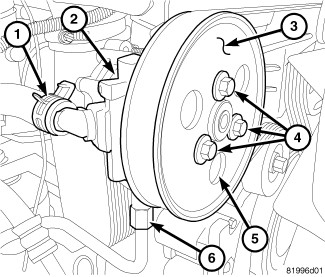
- Remove the serpentine drive belt.
- Remove the three bolts (4) securing the pulley (3) to the pump (2).
-
Remove the power steering
hoses (1, 6).
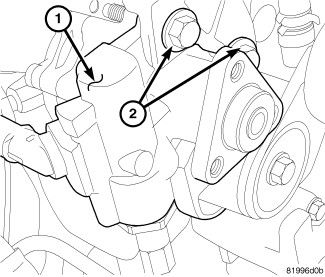
- Remove the three bolts (2) securing the pump (1) to the engine.
-
Remove the pump (1)
from the vehicle.
3.6L
|
- Position the pump and install the upper power steering pump bracket retaining bolts (3). Do not tighten at this time.
- Connect the wiring harness routing retainer (2) to the power steering pump bracket.
- Install the pressure line (4) on the pump and tighten to 31 N·m (23 ft. lbs.).
-
Install the supply hose (1) on the pump.
- Raise and support the vehicle (Refer to 04 - Vehicle Quick Reference/Hoisting - Standard Procedure) .
- Connect the wiring harness routing retainer (3) to the power steering pump bracket (1).
- Install the lower power steering pump retaining bolt (2) and tighten all three retaining bolts to 24 N·m (18 ft. lbs.).
- Install the drive belt (Refer to 07 - Cooling/Accessory Drive/BELT, Serpentine - Installation) .
- Fill and bleed the power steering system (Refer to 19 - Steering - Standard Procedure) .
-
Check for leaks.
2.8L-DIESEL
|
- Install the pump to the vehicle.
-
Install the three bolts
(2) securing the pump (1) to the engine and tighten to 47 N·m (35
ft. lbs.).
- Install the power steering hoses (1, 6). Tighten to 28 N·m (21 ft. lbs.).
- Install the power steering pulley to the pump.
- Install the three bolts (4) securing the pulley (3) to the pump (2).
-
Install the serpentine
belt.
- Install the air inlet tube (1).
- Install the air cleaner box (Refer to 09 - Engine/Air Intake System/BODY, Air Cleaner - Installation) .
-
Refill the power steering
fluid and bleed the system (Refer
to 19 - Steering - Standard Procedure)
.