DRIER, A/C Receiver
DESCRIPTION
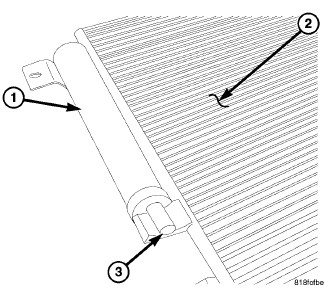 |
The A/C receiver/drier (1) stores unnecessary refrigerant, filters the refrigerant, helps remove moisture from the refrigerant and retains any refrigerant vapor that may leave the A/C condenser (2) until it becomes a liquid. The A/C receiver/drier is installed on the high-side of the A/C system and is connected directly to the right end of the A/C condenser by a bolt (3). The A/C receiver/drier can be serviced separately from the A/C condenser.
OPERATION
The A/C receiver/drier performs a filtering action to prevent foreign material in the refrigerant from contaminating the A/C expansion valve. Refrigerant enters the A/C receiver/drier as a high-pressure, low temperature liquid. Desiccant inside the A/C receiver/drier absorbs any moisture which may have entered and become trapped within the refrigerant system. In addition, during periods of high demand operation of the A/C system, the A/C receiver/drier acts as a reservoir to store surplus refrigerant.
The A/C receiver/drier must be
replaced if an internal failure of the A/C compressor has occurred .
Failure to replace the A/C receiver drier can cause serious damage
to the replacement A/C compressor.
CAUTION:
| NOTE: |
Replacement of the refrigerant line O-ring seals and gaskets is required anytime a refrigerant line is disconnected. Failure to replace the rubber O-ring seals and metal gaskets could result in a refrigerant system leak. |
The A/C receiver/drier has no serviceable parts except for the O-ring seals. The O-ring seals used on the connections are made from a special type of rubber not affected by R-134a refrigerant. The O-ring seals must be replaced whenever the A/C receiver/drier is removed.
The A/C receiver/drier cannot be repaired and must be replaced if leaking or damaged, or if an internal failure of the A/C compressor has occurred.
REMOVAL
Review the warnings and cautions
for this system before performing the procedure. Failure to follow
these instructions may result in serious injury or death.
WARNING:
The A/C receiver/drier must be
replaced if an internal failure of the A/C compressor has occurred .
Failure to replace the A/C receiver drier can cause serious damage
to the replacement A/C compressor.
CAUTION:
|
| NOTE: |
Illustration shown with A/C condenser removed from vehicle for clarity. |
- Disconnect and isolate the negative battery cable.
- Recover the refrigerant from the refrigerant system (Refer to 24 - Heating and Air Conditioning/Plumbing - Standard Procedure) .
- Remove the grille (Refer to 23 - Body/Exterior/GRILLE - Removal) .
- Remove the bolt (3) that secures the A/C receiver/drier (1) to the right side A/C condenser (2).
- Disconnect the A/C receiver/drier from the A/C condenser and remove and discard the O-ring seals.
-
Install plugs in, or
tape over the opened receiver/drier fittings and the condenser ports.
INSTALLATION
Be certain to adjust the refrigerant
oil level when servicing the A/C refrigerant system .
Failure to properly adjust the refrigerant oil level will prevent
the A/C system from operating as designed and can cause serious A/C
compressor damage.
CAUTION:
The A/C receiver/drier must be
replaced if an internal failure of the A/C compressor has occurred .
Failure to replace the A/C receiver drier can cause serious damage
to the replacement A/C compressor.
CAUTION:
| NOTE: |
When replacing multiple A/C system components, see the Refrigerant Oil Capacities chart to determine how much oil should be added to the refrigerant system (Refer to 24 - Heating and Air Conditioning/Plumbing/OIL, Refrigerant - Standard Procedure) . |
| NOTE: |
If only the A/C receiver/drier is being replaced, add 30 milliliters (1 fluid ounce) of refrigerant oil to the refrigerant system. Use only refrigerant oil of the type recommended for the A/C compressor in the vehicle. |
| NOTE: |
Replacement of the refrigerant line O-ring seals and gaskets is required anytime a refrigerant line is disconnected. Failure to replace the rubber O-ring seals and metal gaskets could result in a refrigerant system leak. |
|
| NOTE: |
Illustration shown with A/C condenser removed from vehicle for clarity. |
- Remove the tape or plugs from the receiver/drier fittings and the condenser ports.
- Lubricate new O-ring seals with clean refrigerant oil and install them onto the receiver/drier fittings. Use only the specified O-rings as they are made of a special material for the R-134a system. Use only refrigerant oil of the type recommended for the A/C compressor in the vehicle.
- Connect the receiver/drier (1) to the right end of the A/C condenser (2).
- Install the bolt (3) that secures the receiver/drier to the A/C condenser. Tighten the bolt to 22 N·m (16 ft. lbs.).
- Install the grille (Refer to 23 - Body/Exterior/GRILLE - Installation) .
- Reconnect the negative battery cable.
- Evacuate the refrigerant system (Refer to 24 - Heating and Air Conditioning/Plumbing - Standard Procedure) .
- Add 30 milliliters (1 fluid ounce) of refrigerant oil to the refrigerant system (Refer to 24 - Heating and Air Conditioning/Plumbing/OIL, Refrigerant - Standard Procedure) .
-
Charge the refrigerant system (Refer to 24 - Heating and Air Conditioning/Plumbing - Standard Procedure)
.