Immediately after the head is removed from the engine, the old gasket material should be removed from the head and block. Stuff the cylinders with newspaper or rags to prevent accumulation of foreign matter, but don't press down on the pistons too hard. If a piston moves, the crankshaft will turn and the timing relationship will be lost. (This is particularly important if the belt is still attached to the camshaft gear.)
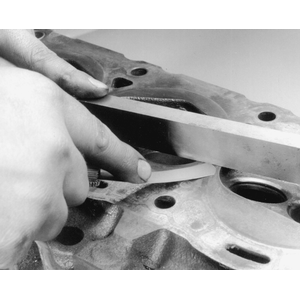
| Fig. 1: Check the head surface in all directions and
take several measurements
|
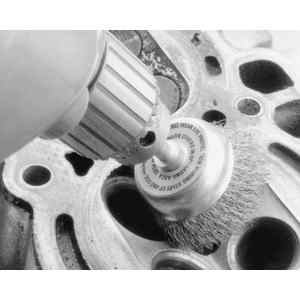
| Fig. 2: With the valves removed, a wire wheel may be
used to clean the combustion chambers of carbon deposits
|
Remove as much of the old gasket as possible from the block with your fingers. The rest must be scraped with a tool which will not damage the metal by scoring or scratching. A hardwood or plastic scraper is highly recommended. Take extreme care not to get any of the scrappings into the water and oil passages or the bolt holes in the head. This common error carries very expensive penalties.
Once the head is on the work bench, the manifolds and other external components should be removed for all but the simplest of cleaning. The head is easier to manipulate and removed items are less likely to be damaged. Unless the head is to be fully stripped, the cam and rockers may stay in place, but take measures to protect the valve train from dust and impact during repairs.
The head surface should be scraped with the non-marring scraper, again observing the protection of oil and water passages. The combustion chamber and valves will have carbon deposits in them. Attempt to remove as much of the deposit as possible with the scraper. The remaining deposits will need to be removed with a rotary wire brush mounted in a drill. Make sure that the brush is actually removing the deposit and not just polishing it into invisibility.
After the head surface is completely clean and free of any debris, place a quality straightedge across the gasket surface of the cylinder head. Using feeler gauges, determine the clearance at the center of the straightedge and at other locations on either side. Measure along the diagonals of the head, along the longitudinal center line and across the head at several locations. Keep a written record of the thickest feeler which will pass between the straightedge and the head at every location.
Acceptable warpage is at or below 0.0020 in. (0.05mm) at EVERY location measured. If all the measurements are at or below this specification, the head may be reused as is. If any one measurement is greater than this limit, the head must be resurfaced or replaced. Maximum allowable warpage is 0.0080 in. (0.20mm). Warpage exceeding this requires replacement of the head. Measure the engine block surface (deck) in the same fashion. Look for clearance under the straightedge to be 0.0020 in. (0.05mm) or less. Any reading over this value requires replacement or resurfacing of the block.