Previous Next

INSPECTION

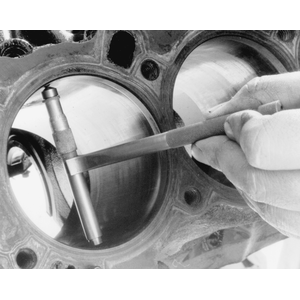
  1. Measure the bore of the cylinder at three levels and in two dimensions (fore-and-aft and side-to-side). That's six measurements for each cylinder. By comparing the three vertical readings, the taper of the cylinder can be determined and by comparing the front–rear and left–right readings the out–of–round can be determined. The block should be measured: at the level of the top piston ring at the top of piston travel; in the center of the cylinder; and at the bottom. Compare your readings with the specifications in the chart.
  2. If the cylinder bore is within specifications for taper and out-of-round, and the wall is not scored or scuffed, it need not be bored. If not, it should be bored oversize as necessary to ensure elimination of out-of-round and taper. Under these circumstances, the block should be taken to a machine shop for proper boring by a qualified machinist using the specialized equipment required.

    NOTE: If the cylinder is bored, oversize pistons and rings must be installed. Since all pistons must be the same size (for correct balance within the engine) ALL cylinders must be re-bored if any one is out of specification.

  3. Even if the cylinders need not be bored, they should be fine honed for proper break-in by a qualified machine shop. A de-glazing tool may be used in a power drill to remove the glossy finish on the cylinder walls. Use only the smooth stone type, not the beaded or bottle–brush type.
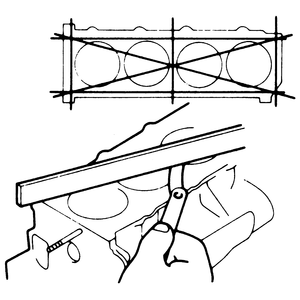
  4. The cylinder head top deck (gasket surface) should be inspected for warpage. Run a straightedge along all four edges of the block, across the center, and diagonally. If you can pass a feeler gauge of 0.004 in. (0.1mm) under the straightedge, the top surface of the block should be machined.
  5. The rings should be removed from the pistons with a ring expander. Keep all rings in order and with the piston from which they were removed. The rings and piston ring grooves should be cleaned thoroughly with solvent and a brush as deposits will alter readings of ring wear.
  6. Before any measurements are begun, visually examine the piston for any signs of cracks, particularly in the skirt area or scratches in the metal. Anything other than light surface scoring disqualifies the piston from further use. The metal will become unevenly heated and the piston may break apart during use.

    Fig. 1: Measure the inside bore of the cylinders

    Fig. 2: Inspect the top deck of the block in the directions shown

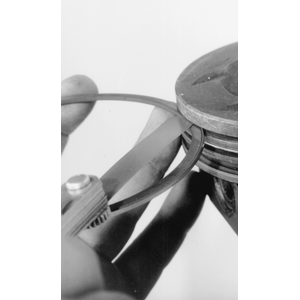
    Fig. 3: Measuring piston ring side clearance

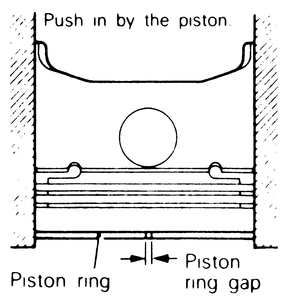
    Fig. 4: Use an inverted piston to seat a ring in the cylinder — measure the end-gap with a feeler gauge

  7. Piston diameter should be measured at the skirt, at right angles to the piston pin. Compare either with specified piston diameter or subtract the diameter from the cylinder bore dimension to get clearance, depending upon the information in the specifications.If clearance is excessive, the piston should be replaced. If a new piston still does not produce piston-to-wall clearance within specifications, use an oversize piston and bore out the cylinder accordingly.
  8. Compression ring side clearance should be measured by using a ring expander to put cleaned rings back in their original positions on the pistons. Measure side clearance on one side by attempting to slide a feeler gauge of the thickness specified between the ring and the edge of the ring groove. If the gauge will not pass into the groove, the ring may be re-used. If the gauge will pass, but a gauge of slightly greater thickness representing the wear limit will not, the piston may be re-used, but new rings must be installed.
  9. Ring end-gap must be measured for all three rings in the cylinder by using a piston top (upside down) to press the ring squarely into the top of the cylinder. The rings must be at least 0.59 in. (15mm) from the bottom of the bore. Use a feeler gauge to measure the end-gap and compare it with specifications.If cylinder bore wear is very slight, you may use new rings to bring the end-gap to specification without boring the cylinder. Measure the gap with the ring located near the minimum dimension at the bottom of the cylinder, not nearer the top where wear is greatest.
  10. The connecting rods must be free from wear, cracking and bending. Visually examine the rod, particularly at its upper and lower ends. Look for any sign of metal stretching or wear. The piston pin should fit cleanly and tightly through the upper end, allowing no side-play or wobble. The bottom end should also be an exact half-circle, with no deformity of shape. The bolts must be firmly mounted and parallel.The rods may be taken to a machine shop for exact measurement of twist or bend.

Previous Next