NOTE: The piston and pin are a matched set and must be kept
together. Label everything and store parts in identified containers.The use
of the correct special tools or their equivalent is very important for this
procedure. You will need tool set MD 998184–01 for removing and installing
the piston pin. You will also need access to a hydraulic press, capable of delivering
up to 4000 lbs. (17,792 N) of force.
- Remove the pistons from the engine and remove the rings from the pistons.
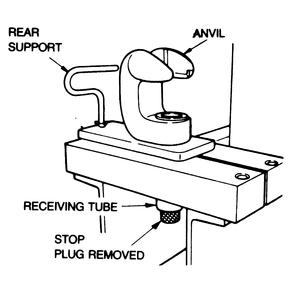
- Set up the tool set with the pin pusher on the press bed. Make certain the
press plates are securely fastened to the press frame.
- Fit the piston and rod assembly onto the body of the special tool, with
the front marks on the rod and piston facing up. The numbers or letters on
the side of the rod serve as the front mark for the rod; the piston usually
has an arrowhead pointing to the front. The V6 pistons are marked "L'' and
"R''; if the piston came from the left (firewall) side, the "L'' designates
the front. If from the right bank, use the "R'' as the front marker.
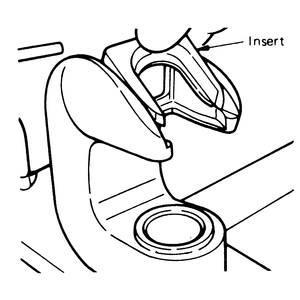
- Position the piston so that the lip of the tool insert fits between the
connecting rod boss and the inside of the piston. The boss should contact
as much of the tool insert as possible to support it.
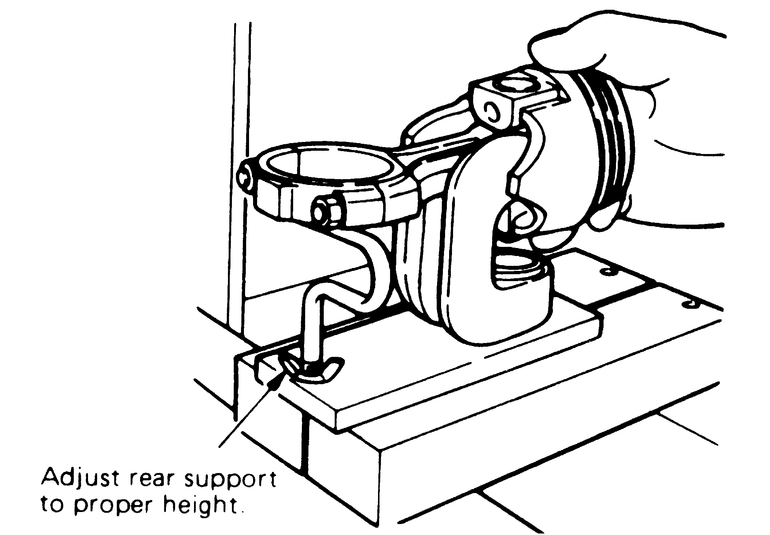
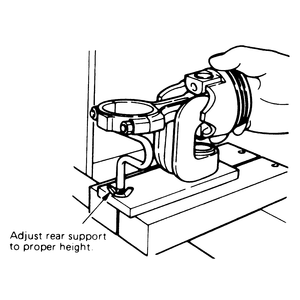
- Adjust the support at the rear of the connecting rod until the rod is horizontal
(level) to the press bed. Misalignment of the pin and receiving tube may occur
if the rod is crooked.
- Position the pin pusher on the pin and use the press to drive the pin out.
As the pin is removed, it must pass through the receiving tube. Adjust the
alignment as necessary.
- Remove the rod and piston from the press. Check the pin for obvious wear
or damage. A quick check of piston pin wear is to push the pin into the piston
(without the rod) with your thumb. The pin should fit with slight resistance.
If the pin is too loose or has any play, either the pin or piston is worn;
both should be replaced.
| Fig. 1: Assemble the piston pin tools onto hydraulic
press
|
| Fig. 2: The insert will support the rod during removal
and installation
|
| Fig. 3: Adjust the rear support so the rod is horizontal
and parallel to the press bed
|
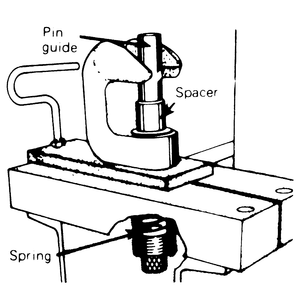
| Fig. 4: Install the spring, spacer and guide into
the receiving tube
|
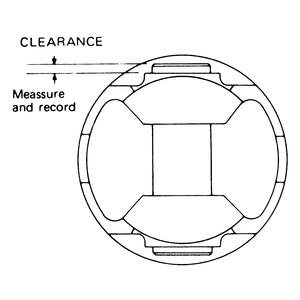
| Fig. 5: The clearance measurement is important — the
pin must be centered after installation
|
- To reinstall, set up the special press tools with the stop plug threaded
about halfway into the bottom of the receiving tube.
- Select the largest piston pin guide that will pass through the piston and
rod. Install the spring, spacer and guide into the receiving tube.
- With the connecting rod removed from the piston, insert the piston pin into
the piston so that it is centered in the piston. Accurately measure the amount
of protrusion (or recess) between the pin and piston and make certain the
measurement is the same on the opposite side. Record the measurement.
- Place the connecting rod and piston over the special tool on the press with
the front marks facing up. The spring loaded piston guide will pass through
the piston and rod and align them.
- Coat the piston pin with fresh motor oil and install it into the piston.
Place the pin pusher on the piston pin and use the press to insert it through
the connecting rod and opposite side of the piston.
- Continue pressing until the pin projection (or recess) is equal to that
measured in Step 10. apply pressure to the pin and adjust the stop plug until
it comes into contact with the spacer.
- Remove the piston assembly from the press and check the piston pin for centering.
If it is not centered, adjust the stop plug up or down to obtain the correct
position. The pin stop is now set for any remaining pistons.
WARNING
Installation pressure on the press ranges from about 1100 lbs. (4,893 N)
to about 3600 lbs. (16,013 N). If the pin cannot be installed within this
range, replace the rod and/or pin. Pressure extremes will break the piston
or rod.