Automatic transmissions transmit engine torque and power to to the rear wheels. Through gear ratios and torque multiplication, the transmission helps to adjust the engine rpm at various speeds. In the highest gear, the transmission is at 1:1 gear ratio, and in overdrive transmissions the final drive ratio is typically 0.75:1 allowing less rpm to accomplish the same vehicle speed. Automatic transmissions use a low viscosity fluid as the power transmission. Automatic transmission fluid (ATF) operates various hydraulic components within the transmission and acts as a lubricant between components to reduce the coefficient of friction (heat) and prevent unusual wear in metallic components. Since this fluid travels throughout the entire transmission, it is easy for damaged components and small metal particles to affect other circuits within the component. A filter, located in the drain pan of the transmission helps to remove these particulates. Improper maintenance or a clogged filter, however, will typically fail and allow contamination throughout the transmission.
Torque Converter
Torque converter replaces the conventional, manual transmission clutch and has three functions:
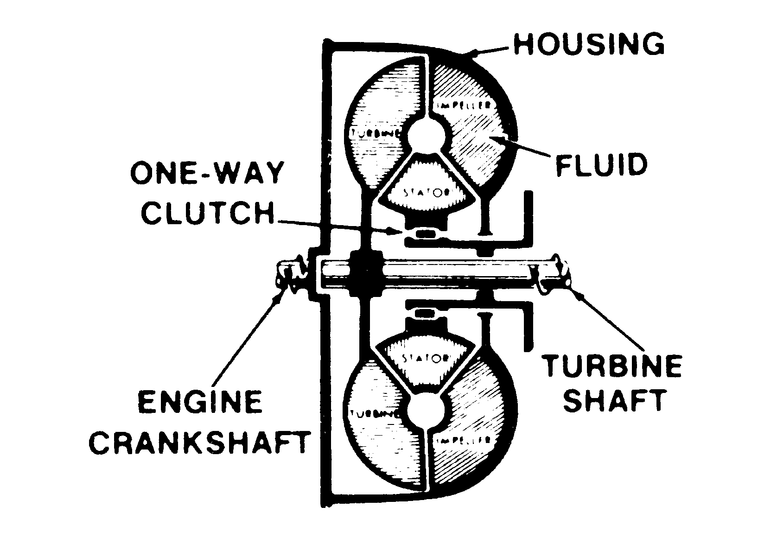
The torque converter is a metal case that is shaped like a sphere that has been flattened on opposite sides. It is bolted to the rear of the engine's crankshaft. The entire metal case rotates as the engine rotates, and serves as the engine's flywheel.
There are three sets of blades within the case of the converter. One set is attached directly to the case. This set forms the torus or pump. Another set is directly connected to the output shaft, and forms the turbine. The third set is mounted on a hub which, in turn, is mounted on a stationary shaft through a one-way clutch. This third set is known as the stator.
A pump that is driven by the converter hub, keeps the torque converter full of transmission fluid at all times. Fluid flows continuously through the unit to provide cooling.
Under low speed acceleration, the torque converter functions as follows:
| The torque converter housing is rotated by the engine's crankshaft, and turns the impeller<em dash>The impeller then spins the turbine, which gives motion to the turbine shaft, driving the gears
|
The torus is turning faster than the turbine. It picks up fluid at the center of the converter and, through centrifugal force, slings it outward. Since the outer edge of the converter moves faster than the portions at the center, the fluid increases velocity.
The fluid then enters the outer edge of the turbine blades. It travels back toward the center of the converter case along the turbine blades. Contact with the turbine blades, dissipates energy picked up in the torus.
If the fluid was now returned directly into the torus, both halves of the converter would need to turn at approximately the same speed at all times, and torque input and output would be similar.
Flowing through the torus and turbine, the fluid picks up two types of flow, or flows in two separate directions. It flows through the turbine blades, and spins with the engine. The stator, whose blades are stationary when the vehicle is being accelerated at low speeds, converts one type of flow into another. Instead of allowing the fluid to flow straight back into the torus, the stator's curved blades turn the fluid almost 90 degrees toward the direction of rotation of the engine. Thus the fluid does not flow as fast toward the torus, but is already spinning when the torus picks it up. This has the effect of allowing the torus to turn much faster than the turbine. The difference in speed may be compared to the difference in speed between the smaller and larger gears in any gear train. The result is that engine power output is higher, and engine torque is multiplied.
As turbine speed increases, the fluid spins faster in the direction of engine rotation. As a result, the ability of the stator to redirect the fluid flow is reduced. Under cruising conditions, the stator is eventually forced to rotate on its one-way clutch in the direction of engine rotation. Under these conditions, the torque converter begins to behave almost like a solid shaft, with torus and turbine speeds being almost equal.
The torque converter's ability to multiply engine torque is limited. Also, the unit tends to be more efficient when the turbine is rotating at relatively high speeds. Therefore, a planetary gearbox is used to carry the power output of the turbine to the driveshaft.
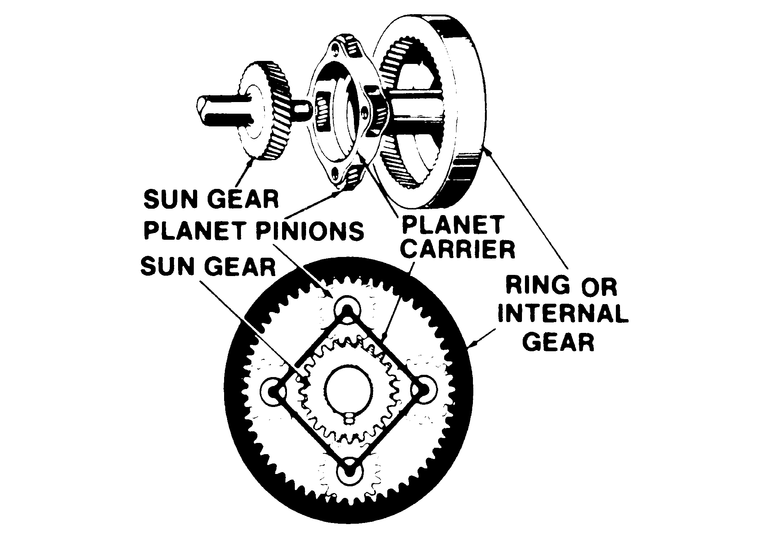
| Planetary gears work in a similar fashion to manual transmission gears, but are composed of three parts
|
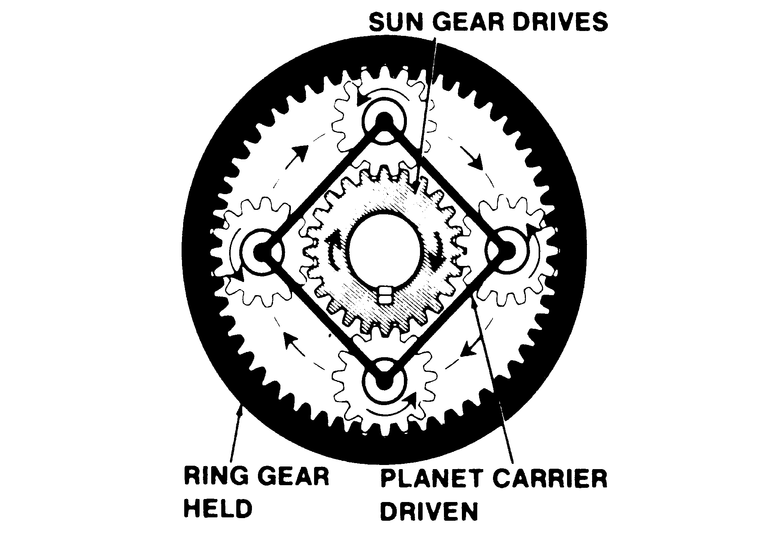
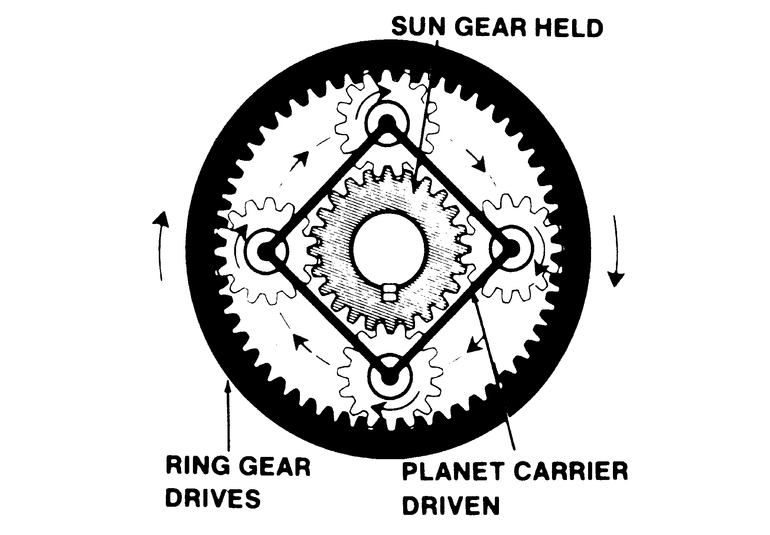
Planetary gears are similar to conventional transmission gears. However, their construction is different in that three elements make up one gear system, and, in that all three elements are different from one another. The outer gear is shaped like a hoop, with teeth cut into the inner surface. A sun gear is mounted on a shaft and located at the very center of the outer gear; and a set of three planet gears, held by pins in a ring-like planet carrier, meshing with both the sun gear and the outer gear. Either the outer gear or the sun gear may be held stationary, providing more than one possible torque multiplication factor for each set of gears. Also, if all three gears are forced to rotate at the same speed, the gear-set forms, in effect, a solid shaft.
| Planetary gears in the maximum reduction (low) range. The ring gear is held and a lower gear ratio is obtained
|
| Planetary gears in the minimum reduction (drive) range. The ring gear is allowed to revolve, providing a higher gear ratio
|
Most automatics use the planetary gears to provide various reduction ratios. Bands and clutches are used to hold various portions of the gear-sets to the transmission case or to the shaft on which they are mounted. Shifting is accomplished by changing the portion of each planetary gear-set that is held to the transmission case or to the shaft.
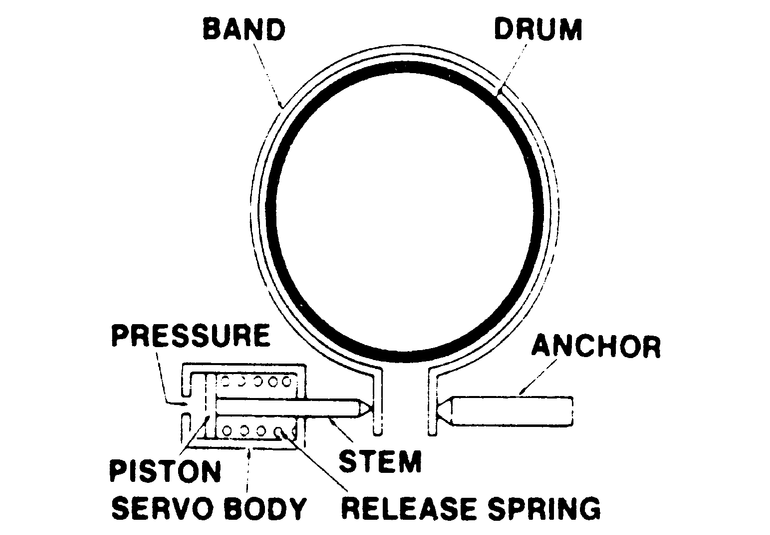
The servos are hydraulic pistons and cylinders. They resemble the hydraulic actuators used on many other machines, such as bulldozers. Hydraulic fluid enters the cylinder, under pressure, and forces the piston to move to engage the bands or clutches.
| Servos, operated by pressure, are used to apply or release the bands, to either hold the ring gear or allow it to rotate
|
Accumulators are used to cushion the engagement of the servos. The transmission fluid must pass through the accumulator on the way to the servo. The accumulator housing contains a thin piston that is sprung away from the discharge passage of the accumulator. When fluid passes through the accumulator (on the way to the servo) it must move the piston against spring pressure. This action smoothes out the action of the servo.
Hydraulic pressure used to operate the servos comes from the main transmission oil pump. Fluid is channeled to the various servos through the shift valves. There is generally a manual shift-valve that is operated by the transmission selector lever and an automatic shift valve for each up-shift the transmission provides.
CAUTION
Many new transmissions are electronically controlled. On these models, electrical solenoids are used to better control the hydraulic fluid. The solenoids are regulated by an electronic control module.
There are two pressures that affect the operation of these valves. One is the governor pressure that is effected by vehicle speed. The other is the modulator pressure that is effected by intake manifold vacuum or throttle position. Governor pressure rises with an increase in vehicle speed, and modulator pressure rises as the throttle is opened wider. By responding to these two pressures, the shift valves cause the up-shift points to be delayed with increased throttle opening to make the best use of the engine's power output.
Most transmissions also make use of an auxiliary circuit for downshifting. This circuit may be actuated by the throttle linkage, vacuum that actuates the modulator, by a cable, or by a solenoid. It applies pressure to a special downshift surface on the shift valve or valves.
The transmission modulator also governs line pressure used to actuate the servos. In this way, the clutches and bands will be actuated with a force matching the torque output of the engine.