INSTALLATION
Removal / installation · Vehicles built from Oct 2014
| 1. INSTALL FUEL SENDER GAUGE ASSEMBLY |

Install the fuel hose grommet onto the fuel tank assembly.
Install a new fuel suction tube set gasket, the fuel pump gauge retainer and the fuel sender gauge assembly with the 8 bolts.
- Torque:
- 6.0 N*m{ 61 kgf*cm , 53 in.*lbf }
Install the fuel tank wire, No. 1 fuel evaporation tube sub-assembly, fuel tank main tube sub-assembly and fuel tank return tube sub-assembly onto the fuel sender gauge assembly.
| 2. INSTALL FUEL TANK ASSEMBLY |
Using the transmission jack, install the 2 fuel tank band sub-assemblies and fuel tank assembly with the 6 bolts.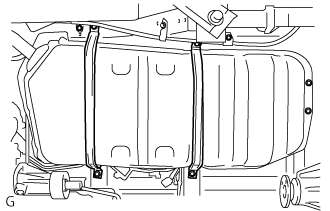

- Torque:
- 45 N*m{ 459 kgf*cm , 32 ft.*lbf }
Connect the No. 3 parking brake cable with the bolt.
- Torque:
- 15 N*m{ 153 kgf*cm , 11 ft.*lbf }
| 3. CONNECT NO. 3 FUEL HOSE |
Connect the No. 3 fuel hose, and tighten the clamp bolt.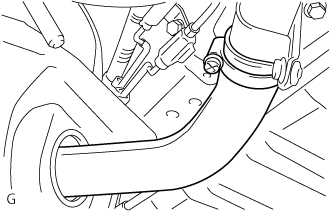
| 4. INSTALL FUEL HOSE PROTECTOR |
Install the fuel hose protector to the fuel tank to filler pipe hose and attach the 2 claws.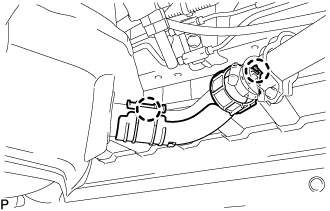
| 5. CONNECT FUEL TANK BREATHER TUBE |
Connect the fuel tank breather tube and clip.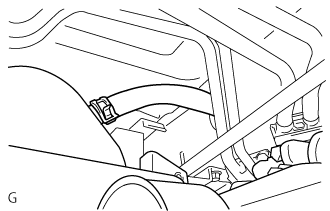
| 6. CONNECT FUEL TANK MAIN TUBE SUB-ASSEMBLY |
Connect the fuel tank main tube sub-assembly with the clip.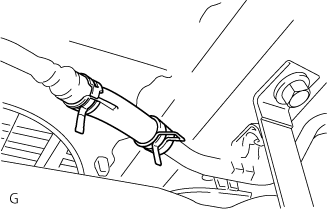
| 7. CONNECT FUEL TANK RETURN TUBE |
Connect the fuel return tube (Click here).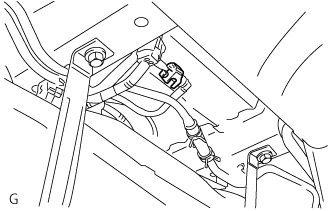
| 8. CONNECT FUEL TANK WIRE |
Connect the fuel tank wire.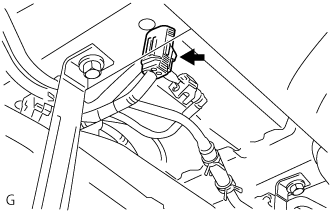
| 9. INSTALL PROPELLER SHAFT ASSEMBLY |
- HINT:
- Propeller shaft assembly for Super Long Wheelbase (Click here)
- Propeller shaft assembly for Long Wheelbase (Click here)
- Propeller shaft assembly for Super Long Wheelbase (Click here)
| 10. INSPECT FOR FUEL LEAK |
Perform the Active Test.
Connect the GTS to the DLC3.
Turn the ignition switch to ON.
Turn the GTS on.
Enter the following menus: Powertrain / Engine and ECT / Active Test.
Perform the Active Test.
Tester Display
Test Part
Control Range
Diagnostic Notes
Test the Fuel Leak
Pressurize common rail interior and check for fuel leaks
Stop/Start
- Fuel pressure inside common rail increased to specified value and engine speed increased to 2000 rpm when Active Test is performed
- Above conditions preserved while Active Test is being performed
- Fuel pressure inside common rail increased to specified value and engine speed increased to 2000 rpm when Active Test is performed