ON-VEHICLE INSPECTION
Inspection · Vehicles built from Aug 2013
Versions by build date: Jun 2011 – Jul 2013 from Aug 2013
| CHECK SPEEDOMETER |

Check the speedometer operation.
- NOTICE:
- Do not use worn, underinflated or overinflated tires, as the speedometer reading will be inaccurate.
-
For Australian speedometers, check that the meter indication is within the acceptable ranges specified for the ID number on the meter (for the location of the ID number, refer to the illustration).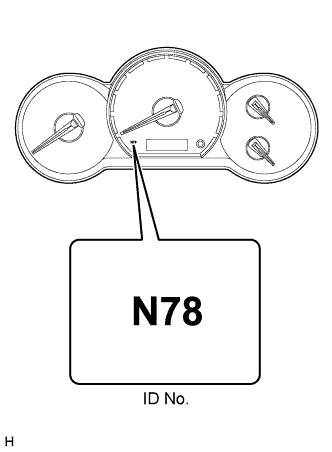

- Do not use worn, underinflated or overinflated tires, as the speedometer reading will be inaccurate.
Connect the intelligent tester to the DLC3.
Turn the ignition switch to ON.
Turn the intelligent tester on.
Enter the following menus: Powertrain / Engine and ECT / Data List.
*: except 5L-EReference (km/h, except Australia) Standard Indication
Acceptable Range
20 km/h
21 to 25 km/h
40 km/h
41.7 to 46.2 km/h
60 km/h
62.7 to 67.2 km/h
80 km/h
83.4 to 88.4 km/h
100 km/h
104.3 to 109.3 km/h
120 km/h
125.1 to 130.6 km/h
140 km/h
145.8 to 151.8 km/h
160 km/h
166.2 to 173.2 km/h
180 km/h*
186.9 to 194.5 km/h
Reference (for Australia, ID No. N73, N76) Standard Indication
Acceptable Range
20 km/h
19.9 to 22.9 km/h
40 km/h
39.8 to 43.3 km/h
60 km/h
59.6 to 63.1 km/h
80 km/h
79.5 to 83.5 km/h
100 km/h
99.4 to 103.4 km/h
120 km/h
119.3 to 123.3 km/h
140 km/h
139.2 to 143.2 km/h
160 km/h
159.0 to 163.0 km/h
180 km/h
178.9 to 182.9 km/h
Reference (for Australia, ID No. N72, N89) Standard Indication
Acceptable Range
20 km/h
20.6 to 23.6 km/h
40 km/h
41.3 to 44.8 km/h
60 km/h
61.9 to 65.4 km/h
80 km/h
82.5 to 86.5 km/h
100 km/h
103.2 to 107.2 km/h
120 km/h
123.8 to 127.8 km/h
140 km/h
144.4 to 148.4 km/h
160 km/h
165.0 to 169.0 km/h
180 km/h
185.7 to 189.7 km/h
Reference (for Australia, ID No. N74, N74-A, N77, N90) Standard Indication
Acceptable Range
20 km/h
20.4 to 23.4 km/h
40 km/h
40.8 to 44.3 km/h
60 km/h
61.2 to 64.7 km/h
80 km/h
81.6 to 85.6 km/h
100 km/h
102.0 to 106.0 km/h
120 km/h
122.4 to 126.4 km/h
140 km/h
142.8 to 146.8 km/h
160 km/h
163.2 to 167.2 km/h
180 km/h
183.6 to 187.6 km/h
Reference (for Australia, ID No. N75, N79) Standard Indication
Acceptable Range
20 km/h
20.1 to 23.1 km/h
40 km/h
40.1 to 43.6 km/h
60 km/h
60.2 to 63.7 km/h
80 km/h
80.2 to 84.2 km/h
100 km/h
100.3 to 104.3 km/h
120 km/h
120.4 to 124.4 km/h
140 km/h
140.4 to 144.4 km/h
160 km/h
160.5 to 164.5 km/h
180 km/h
180.5 to 184.5 km/h
Reference (for Australia, ID No. N80) Standard Indication
Acceptable Range
20 km/h
20.7 to 24.7 km/h
40 km/h
41.4 to 45.9 km/h
60 km/h
62.1 to 66.6 km/h
80 km/h
82.8 to 87.8 km/h
100 km/h
103.6 to 107.6 km/h
120 km/h
124.3 to 129.3 km/h
140 km/h
145.0 to 150.0 km/h
160 km/h
165.7 to 170.7 km/h
180 km/h
186.4 to 191.4 km/h
Reference (for Australia, ID No. N78, N81) Standard Indication
Acceptable Range
20 km/h
21 to 25 km/h
40 km/h
42.0 to 46.5 km/h
60 km/h
63.0 to 67.5 km/h
80 km/h
84.1 to 89.1 km/h
100 km/h
105.1 to 109.1 km/h
120 km/h
126.1 to 131.1 km/h
140 km/h
147.1 to 152.1 km/h
160 km/h
168.1 to 173.1 km/h
180 km/h
189.1 to 194.1 km/h
Reference (for Australia, ID No. N86, N88) Standard Indication
Acceptable Range
20 km/h
20.1 to 23.7 km/h
40 km/h
40.5 to 44.6 km/h
60 km/h
61.0 to 65.1 km/h
80 km/h
81.4 to 86.0 km/h
100 km/h
102.1 to 105.5 km/h
120 km/h
122.2 to 126.7 km/h
140 km/h
142.4 to 147.2 km/h
160 km/h
163.0 to 167.6 km/h
180 km/h
183.5 to 188.1 km/h
Reference (mph) Standard Indication
Acceptable Range
20 mph
21.0 to 23.5 mph
40 mph
42.0 to 44.5 mph
60 mph
62.5 to 66.0 mph
80 mph
83.1 to 87.1 mph
100 mph
103.9 to 108.4 mph
Check the deflection width of the speedometer indicator.
- Reference:
- Within 0.3°
| CHECK OUTPUT SIGNAL OF VEHICLE SPEED SENSOR |
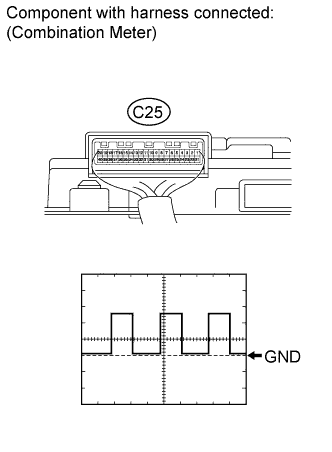 |
Check the output signal waveform
Remove the combination meter, but do not disconnect the connector.
Using an oscilloscope, check the waveform of the combination meter.
Item
Content
Tester Connection
C25-6 (+S) - Body ground
Tool Setting
5 V/DIV., 20 msec./DIV.
Vehicle Condition
Driving at approx. 20 km/h (12 mph)
- OK:
- Refer to the illustration.
- HINT:
- As vehicle speed increases, the wavelength shortens.
- If the result is not as specified, the speedometer may have a malfunction.
- As vehicle speed increases, the wavelength shortens.
| CHECK TACHOMETER (w/ Tachometer) |
Check the tachometer operation.
Connect the intelligent tester to the DLC3.
Turn the ignition switch to ON.
Turn the intelligent tester on.
Enter the following menus: Powertrain / Engine and ECT / Data List.
*1: for 1TR-FE, 2TR-FE, 1GR-FEReference Standard Tachometer Indication (rpm)
Acceptable Range (rpm)
Data in ( ) are for reference only
700
630 to 770
1000
(900 to 1100)
2000
(1850 to 2150)
3000
2800 to 3200
4000
(3800 to 4200)
5000
4800 to 5200
6000*1
(5750 to 6250)
7000*2
6700 to 7300
*2: for 1TR-FE
If the result is not as specified, the tachometer may have a malfunction.
| CHECK FUEL SUCTION WITH PUMP AND GAUGE OR FUEL TANK VENT TUBE SUB-ASSEMBLY |
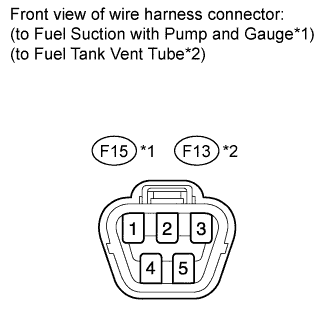 |
Disconnect the F15 fuel suction with pump and gauge connector*1 or F13 fuel tank vent tube connector*2.
*1: for 1TR-FE, 2TR-FE, 1GR-FE
*2: for 1KD-FTV, 2KD-FTV, 5L-E
Turn the ignition switch ON, and then check the position of the receiver gauge needle.
- OK:
- Fuel receiver gauge indicates E.
Connect terminals 2 and 3 of the wire harness side connector.
Turn the ignition switch ON, and then check the position of the receiver gauge needle.
- OK:
- Fuel receiver gauge indicates F.
| CHECK FUEL WARNING LIGHT |
|
|
Disconnect the F15 fuel suction with pump and gauge connector*1 or F13 fuel tank vent tube connector*2.
*1: for 1TR-FE, 2TR-FE, 1GR-FE
*2: for 1KD-FTV, 2KD-FTV, 5L-E
Turn the ignition switch ON, and then check that the fuel receiver gauge indicates E and that the FUEL warning light turns on.
- OK:
- FUEL warning light turns on.
| CHECK OIL PRESSURE WARNING LIGHT |
for 1TR-FE, 2TR-FE, 1GR-FE, 1KD-FTV, 2KD-FTV: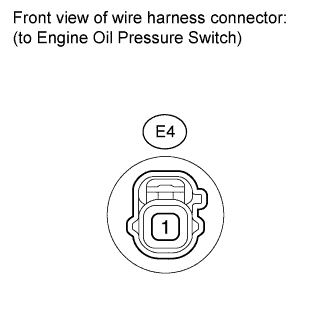
Disconnect the E4 switch connector.
Connect terminal 1 of the wire harness side connector to the body ground.
Turn the ignition switch ON, and then check that the OIL PRESSURE warning light turns on.
- OK:
- OIL PRESSURE warning light turns on.
for 5L-E: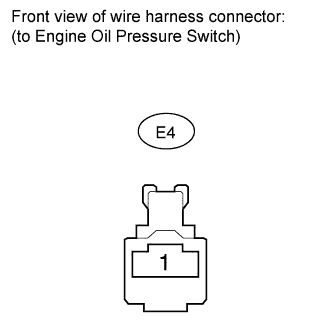
Disconnect the E4 switch connector.
Connect terminal 1 of the wire harness side connector to the body ground.
Turn the ignition switch ON, and then check that the OIL PRESSURE warning light turns on.
- OK:
- OIL PRESSURE warning light turns on.
| CHECK BRAKE WARNING LIGHT |
Check the parking brake warning light.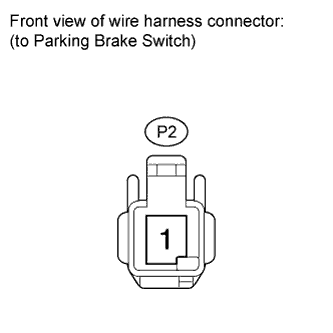
Disconnect the P2 switch connector.
Connect terminal 1 of the wire harness side connector to the body ground.
Turn the ignition switch ON, and then check that the BRAKE warning light turns on.
- OK:
- BRAKE warning light turns on.
Check the brake fluid level warning light.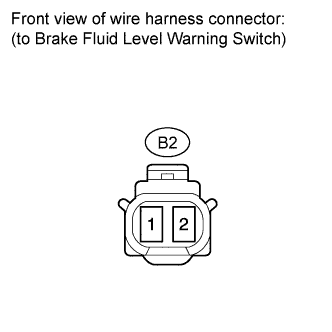
Disconnect the B2 switch connector.
Connect terminals 1 and 2 of the wire harness side connector.
Turn the ignition switch ON, and then check that the BRAKE warning light turns on.
- OK:
- BRAKE warning light turns on.
for 1KD-FTV (w/ VSC):
Check the vacuum pump warning light.
Disconnect the B9 switch connector.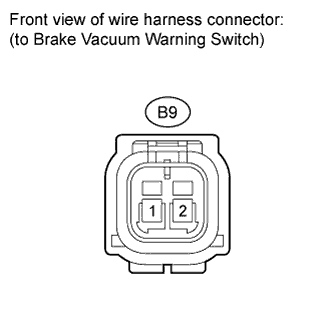
Connect terminals 1 and 2 of the wire harness side connector.
Turn the ignition switch ON, and then check that the BRAKE warning light turns on.
- OK:
- BRAKE warning light turns on.
for 1KD-FTV, 2KD-FTV, 5L-E (w/o VSC):
Check the vacuum pump warning light.
Disconnect the B3 switch connector.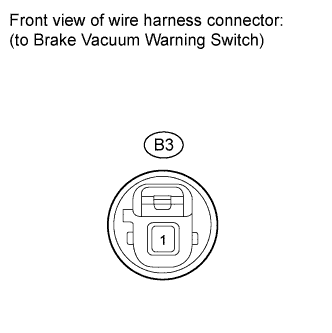
Connect terminal 1 of the wire harness side connector to the body ground.
Turn the ignition switch ON, and then check that the BRAKE warning light turns on.
- OK:
- BRAKE warning light turns on.
| CHECK FRONT PASSENGER SEAT BELT WARNING LIGHT (w/ Front Passenger Seat Belt Warning System) |
Disconnect the F17 belt connector.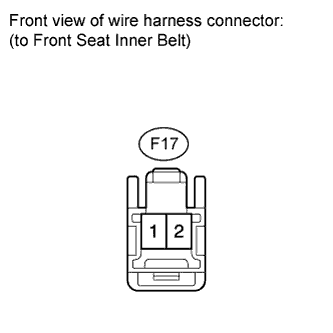
Connect terminals 1 and 2 of the wire harness side connector.
Turn the ignition switch ON, and then check that the warning light blinks.
- OK:
- Seat belt warning light for passenger side blinks.
*1: w/ Multi-display
*2: w/o Multi-display