AUDIO / VIDEO REAR SEAT ENTERTAINMENT SYSTEM Mute Signal Circuit between Radio Receiver and Television Display Assembly
DESCRIPTION
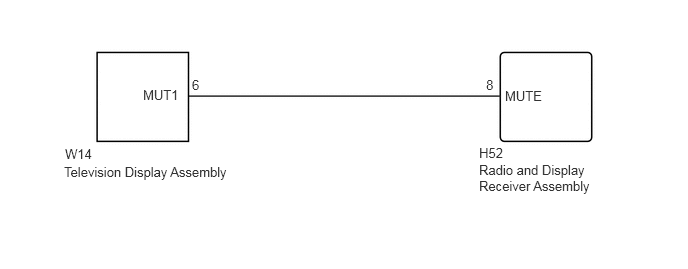
This circuit sends a signal to the television display assembly to mute noise. Because of that, the noise produced by changing the sound source ceases.
If there is an open in the circuit, noise can be heard from the speakers when changing the sound source.
If there is a short in the circuit, even though the television display assembly is normal, no sound, or only an extremely small sound, can be produced.
WIRING DIAGRAM
PROCEDURE
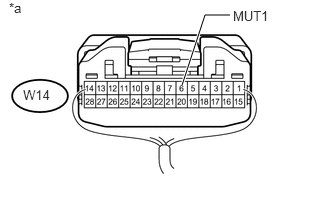
Remove the television display assembly connector still connected (See page Audio / Visual / Telematics>AUDIO / VIDEO>TELEVISION DISPLAY>REMOVAL).
Measure the voltage according to the value(s) in the table below.
- Standard Voltage:
Tester Connection Condition Specified Condition W14-6 (MUT1) - Body ground Television display playing Above 3.5 V Television display changing modes Below 1 V
| *a | Component with harness connected
(Television Display Assembly) |
OK
(See pageAudio / Visual / Telematics>AUDIO / VIDEO>REAR SEAT ENTERTAINMENT SYSTEM>PROBLEM SYMPTOMS TABLE)
NG
Disconnect the H52 radio and display receiver assembly connector.
Disconnect the W14 television display assembly connector.
Measure the resistance according to the value(s) in the table below.
- Standard Resistance:
Tester Connection Condition Specified Condition H52-8 (MUTE) - W14-6 (MUT1) Always Below 1 Ω H52-8 (MUTE) - Body ground Always 10 kΩ or higher
OK
NG
Temporarily replace the television display assembly with a new or known good one (See page Audio / Visual / Telematics>AUDIO / VIDEO>TELEVISION DISPLAY>REMOVAL).
Check that the mute signal circuit functioning normally.
- OK:
The mute signal circuit functioning normally.
OK
NG
(See pageAudio / Visual / Telematics>AUDIO / VIDEO>RADIO RECEIVER (for Radio and Display Type)>REMOVAL)