AJA0F AUTOMATIC TRANSMISSION / TRANSAXLE AUTOMATIC TRANSMISSION SYSTEM(for F33A-FTV) P07407E Torque Converter Clutch Actuator Stuck On
DESCRIPTION
By turning the solenoid (SL) valve ON or OFF, the TCM controls the fluid pressure to the lock-up relay valve, turning the lock-up ON or OFF.
- HINT:
-
Actual gear when a malfunction occurs in solenoid (SL) valve (without fail-safe control): TCM Commanded Gear Actual Gear during SL Stuck ON Malfunction 1st 1st 2nd 2nd 3rd 3rd 4th 4th 5th 5th 6th 6th 7th 7th 8th 8th 9th 9th 10th 10th
| DTC No. | Detection Item | DTC Detection Condition | Trouble Area | MIL | Memory | Note |
|---|---|---|---|---|---|---|
| P07407E | Torque Converter Clutch Actuator Stuck On | When driving with the shift lever in D, the TCM commands lock-up ON, the difference between the turbine speed (NT) and the engine speed (NE) is 70 rpm or more for 2 seconds or more (2-trip detection logic). |
·
Solenoid (SL1) valve
·
Solenoid (SL2) valve
·
Solenoid (SL3) valve
·
Solenoid (SL4) valve
·
Solenoid (SL5) valve
·
Solenoid (SL6) valve
·
Solenoid (SC1) valve
·
Solenoid (SL) valve
·
Solenoid (SR) valve
·
Solenoid (SLU) valve
·
Solenoid (SLT) valve
·
Transmission valve body assembly
·
Torque converter assembly
·
Automatic transmission assembly (clutch, brake, gear, etc.) |
Comes on | DTC stored | SAE: P0741 |
MONITOR DESCRIPTION
Torque converter lock-up is controlled by the TCM based on the transmission revolution sensor (NT), engine speed, engine load, engine coolant temperature, vehicle speed, transmission fluid temperature, and gear selection. The TCM determines the lock-up status of the torque converter by comparing the engine speed (NE) to the input turbine speed (NT). The TCM calculates the actual transmission gear by comparing the input turbine speed (NT) to the output shaft speed (SP2). When conditions are appropriate, the TCM requests "lock-up" by applying control voltage to the solenoid (SL) valve. When the solenoid (SL) valve is turned off, it applies pressure to the lock-up relay valve and locks the torque converter assembly.
If the TCM detects no lock-up after lock-up has been requested, the TCM interprets this as a malfunction of the solenoid (SL) valve, illuminates the MIL and stores this DTC.
- HINT:
-
Example:
-
When the following condition is met, the system judges it to be a malfunction.
-
There is a difference in speed between the input side (engine speed) and output side (input turbine speed) of the torque converter when the TCM commands lock-up. (Engine speed is at least 70 rpm more than input turbine speed.)
CONFIRMATION DRIVING PATTERN
- HINT:
-
After repair has been completed, clear the DTC and then check that the vehicle has returned to normal by performing the following All Readiness check procedure.
Clear the DTCs (even if no DTCs are stored, perform the clear DTC procedure).
Turn the ignition switch off and wait for at least 30 seconds.
Perform the Lock-up Function in Road Test.
Enter the following menus: Powertrain / Transmission / Utility / All Readiness.
Input the DTC: P07407E.
Check the DTC judgment result.
| GTS Display | Description |
|---|---|
| NORMAL |
·
DTC judgment completed
·
System normal |
| ABNORMAL |
·
DTC judgment completed
·
System abnormal |
| INCOMPLETE |
·
DTC judgment not completed
·
Perform driving pattern after confirming DTC enabling conditions |
| N/A |
·
Unable to perform DTC judgment
·
Number of DTCs which do not fulfill DTC preconditions has reached ECU memory limit |
- HINT:
-
·
If the judgment result shows NORMAL, the system is normal.
·If the judgment result shows ABNORMAL, the system has a malfunction.
·If the judgment result shows INCOMPLETE or N/A, perform the Confirmation Driving Pattern and check the DTC judgment result again.
CAUTION / NOTICE / HINT
- NOTICE:
-
Perform registration and/or initialization when parts related to the automatic transmission are replaced.
PROCEDURE
Read the DTCs using the GTS.
- Powertrain > Transmission > Trouble Codes
- 50001 373
- Result:
-
Result Proceed to DTC P07407E and DTC P07457F, P076A71, P07707F, P07757F, P07957F, P08BA7F, P27137F, P27567F, P28077F and/or P28167F are output A Only DTC P07407E is output B DTCs other than P07407E, P07457F, P076A71, P07707F, P07757F, P07957F, P08BA7F, P27137F, P27567F, P28077F and P28167F are also output C
- HINT:
-
If any DTCs other than P07407E, P07457F, P076A71, P07707F, P07757F, P07957F, P08BA7F, P27137F, P27567F, P28077F and P28167F are output, perform troubleshooting for those DTCs first.
A
B
C
Clear the DTCs.
- HINT:
-
Write down the currently output DTCs before clearing them.
- Powertrain > Transmission > Clear DTCs
- 50002 373
Perform the stall speed test.
- Result:
-
Test Condition Proceed to Stall speed test can be performed A Stall speed test cannot be performed B
A
B
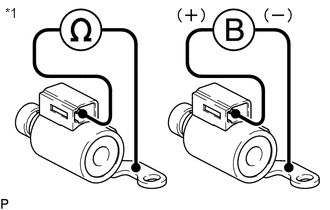
| *1 | Solenoid (SL) and (SR) Valves |
Remove the solenoid (SL) and (SR) valves.
Click hereDrivetrain>AJA0F (AUTOMATIC TRANSMISSION / TRANSAXLE)>VALVE BODY ASSEMBLY>DISASSEMBLY
Measure the resistance according to the value(s) in the table below.
- Standard Resistance:
-
Tester Connection Condition Specified Condition Terminal of solenoid (SL) valve connector - Solenoid (SL) valve body 20°C (68°F) 11 to 15 Ω Terminal of solenoid (SR) valve connector - Solenoid (SR) valve body 20°C (68°F) 11 to 15 Ω
Connect a positive (+) lead from the battery to the terminal of the solenoid valve connector, and a negative (-) lead to the solenoid body. Check that the valve moves and makes an operating sound.
- OK:
-
Valve moves and makes an operating sound.
- Result:
-
Proceed to OK NG
OK
NG
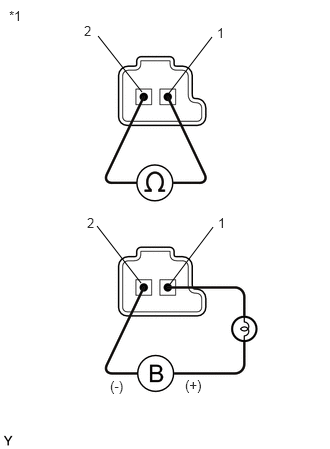
| *1 | Solenoid (SL1), (SL2), (SL3), (SL4), (SL5), (SL6) and (SLU) Valves |
Remove the solenoid (SL1), (SL2), (SL3), (SL4), (SL5), (SL6) and (SLU) valves.
Click hereDrivetrain>AJA0F (AUTOMATIC TRANSMISSION / TRANSAXLE)>VALVE BODY ASSEMBLY>DISASSEMBLY
Measure the resistance according to the value(s) in the table below.
- Standard Resistance:
-
Tester Connection Condition Specified Condition Solenoid (SL1) valve connector terminal 1 - terminal 2 20°C (68°F) 5.0 to 5.6 Ω Solenoid (SL2) valve connector terminal 1 - terminal 2 20°C (68°F) 5.0 to 5.6 Ω Solenoid (SL3) valve connector terminal 1 - terminal 2 20°C (68°F) 5.0 to 5.6 Ω Solenoid (SL4) valve connector terminal 1 - terminal 2 20°C (68°F) 5.0 to 5.6 Ω Solenoid (SL5) valve connector terminal 1 - terminal 2 20°C (68°F) 5.0 to 5.6 Ω Solenoid (SL6) valve connector terminal 1 - terminal 2 20°C (68°F) 5.0 to 5.6 Ω Solenoid (SLU) valve connector terminal 1 - terminal 2 20°C (68°F) 5.0 to 5.6 Ω
Connect a positive (+) lead from the battery with a 21 W bulb to terminal 1 and a negative (-) lead to terminal 2 of the solenoid valve connector. Check that the valve moves and makes an operating sound.
- OK:
-
Valve moves and makes an operating sound.
- Result:
-
Proceed to OK NG
OK
NG
| *1 | Solenoid (SC1) Valve |
Remove the solenoid (SC1) valve.
Click hereDrivetrain>AJA0F (AUTOMATIC TRANSMISSION / TRANSAXLE)>VALVE BODY ASSEMBLY>DISASSEMBLY
Measure the resistance according to the value(s) in the table below.
- Standard Resistance:
-
Tester Connection Condition Specified Condition Terminal of solenoid (SC1) valve connector - Solenoid (SC1) valve body 20°C (68°F) 11 to 15 Ω
Connect a positive (+) lead from the battery to the terminal of the solenoid valve connector, and a negative (-) lead to the solenoid body. Check that the valve moves and makes an operating sound.
- OK:
-
Valve moves and makes an operating sound.
- Result:
-
Proceed to OK NG
OK
NG
| *1 | Solenoid (SLT) Valve |
Remove the solenoid (SLT) valve.
Click hereDrivetrain>AJA0F (AUTOMATIC TRANSMISSION / TRANSAXLE)>VALVE BODY ASSEMBLY>DISASSEMBLY
Measure the resistance according to the value(s) in the table below.
- Standard Resistance:
-
Tester Connection Condition Specified Condition 1 - 2 20°C (68°F) 5.0 to 5.6 Ω
Connect a positive (+) lead from the battery with a 21 W bulb to terminal 1 and a negative (-) lead to terminal 2 of the solenoid valve connector. Check that the valve moves and makes an operating sound.
- OK:
-
Valve moves and makes an operating sound.
- Result:
-
Proceed to OK NG
OK
NG
Click hereDrivetrain>AJA0F (AUTOMATIC TRANSMISSION / TRANSAXLE)>VALVE BODY ASSEMBLY>REMOVAL
- OK:
-
There is no foreign matter on each valve and they operate smoothly.
- Result:
-
Proceed to OK NG
OK
NG
Click hereDrivetrain>AJA0F (AUTOMATIC TRANSMISSION / TRANSAXLE)>TORQUE CONVERTER AND DRIVE PLATE>INSPECTION
- OK:
-
The torque converter operates normally.
- Result:
-
Proceed to OK NG
OK
NG