 |
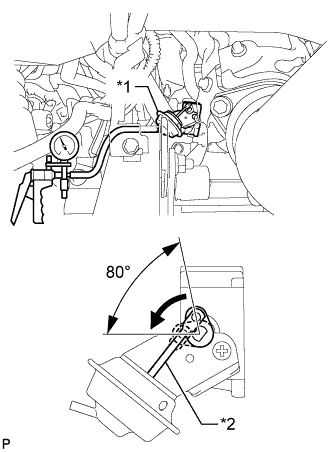
Apply vacuum and check that the rod of the No. 2 EGR valve operates as shown in the illustration.
| *1 | No. 2 EGR Valve |
| *2 | Rod |
EMISSION CONTROL SYSTEM > ON-VEHICLE INSPECTION |
| 1. CHECK SEATING OF EGR VALVE |
Check that the engine starts and idles.
Stop the engine.
| 2. CHECK EGR VALVE OPERATION |
Connect the intelligent tester to the DLC3.
Turn the ignition switch to ON.
Enter the following menus: Powertrain / Control the EGR Step Position.
Check the Data List / Target EGR Position and Actual EGR valve pos.
| Control Range Condition | Specified Condition |
| Active Test performed (Set EGR position to 0% → 30% → 60% → 90% → 60% → 30% → 0%) | Actual EGR valve opening percentage changes according to Active Test operation |
| 3. CHECK NO. 2 EGR VALVE ASSEMBLY |
Disconnect the vacuum hose from the No. 2 EGR valve.
|
Apply vacuum and check that the rod of the No. 2 EGR valve operates as shown in the illustration.
| *1 | No. 2 EGR Valve |
| *2 | Rod |
| 4. VISUALLY INSPECT HOSES, CONNECTIONS AND GASKETS |
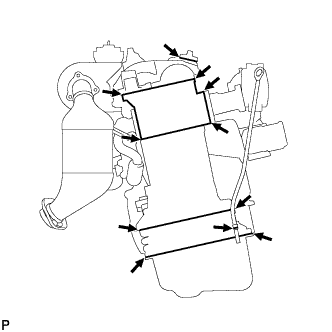 |
Visually check that the hoses, connections and gaskets have no cracks, leaks or damage.