
ECD SYSTEM > Turbocharger Noise |
| Noise Type | Noise Description | Main Trouble Area |
| Whistling noise | The volume and pitch of this noise is proportional to turbocharger speed or engine speed. Therefore, the noise level will become more obvious when engine speed increases. |
|
| Whining noise | This noise has a lower pitch than whistling noise. It generally occurs in the engine speed range of 1500 to 2500 rpm, and has a relatively constant pitch, independent of engine speed and vehicle speed. | Turbocharger
|
| Faults and Symptoms of Diesel Engine Components |
| Main fault | Turbocharger turbine shaft imbalance | |
| Symptoms | High-pitched whistling noise
| |
| Main fault | Leakage | |
| Symptoms | Leak flow noise | |
| Symptoms | Gear noise
| |
| Symptoms | Gear noise
| |
| 1.CONFIRM CONDITION IN WHICH NOISE OCCURRED |
Confirm with the customer the condition when noise occurred.
| Item | Note |
| Engine speed | Engine speed range |
| Vehicle speed | Vehicle speed range |
| Transmission gear | Which gear? |
| Accelerator pedal position | During acceleration or deceleration? |
| Temperature |
|
| Road conditions |
|
| Noise level |
|
| Other symptoms |
|
| Noise recognition | What made the customer determine the noise to be abnormal? |
| NEXT | |
|
| 2.CONFIRM NOISE CUSTOMER MENTIONED (PROCEDURE 2) |
Check for the noise described by the customer.
| Result | Proceed to |
| Obvious abnormal noise matching noise described by customer is confirmed | A |
| Obvious abnormal noise matching noise described by customer is not confirmed | B |
|
| ||||
| A | |
|
| 3.CHECK INTAKE SYSTEM |
Check for air leakage between the air cleaner and turbocharger, and between the turbocharger and intake manifold.
|
| ||||
| OK | |
|
| 4.DISCONNECT THE TURBOCHARGER ACTUATOR HOSE AND CONFIRM THE NOISE |
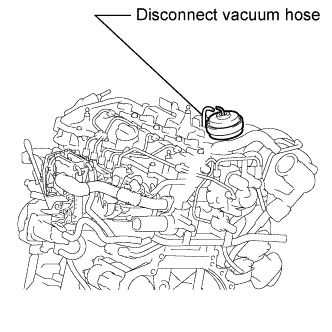 |
Disconnect the vacuum hose from the turbocharger actuator.
Confirm that the noise is reduced when checking under the same conditions as Procedure 2.
Connect the vacuum hose to the turbocharger actuator.
| Result | Proceed to |
| The noise is reduced (or disappears) | A |
| The noise is the same as in Procedure 2 (The noise does not change) | B |
|
| ||||
| A | |
|
| 5.CONFIRM THE NOISE TYPE |
Check whether the noise can be heard even when the engine speed is more than 3000 rpm, and whether the noise gradually gets louder as the engine speed increases.
| Result | Proceed to |
| Yes (The noise is likely to be whistling noise) | A |
| No (The noise is likely to be whining noise) | B |
|
| ||||
| A | ||
 | ||
| ||
| 6.PERFORM ALIGNMENT OF EXHAUST PIPE AND CONFIRM THE NOISE |
Disconnect the exhaust pipe at the ball joint and from each exhaust pipe support, and then realign the exhaust pipe and reconnect it to each exhaust pipe support and at the ball joint (Click here).
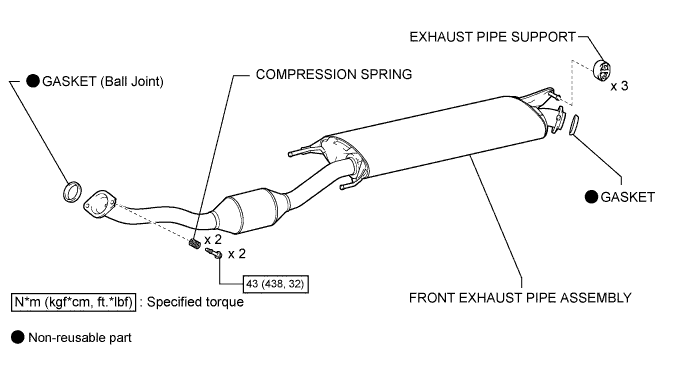
Confirm whether the noise problem is solved or not.
| Result | Proceed to |
| The noise problem is solved | A |
| The noise problem remains | B |
|
| ||||
| A | ||
| ||
| ||
| 7.CHECK FOR NOISE FROM SOURCE OTHER THAN TURBOCHARGER (PROCEDURE 7) |
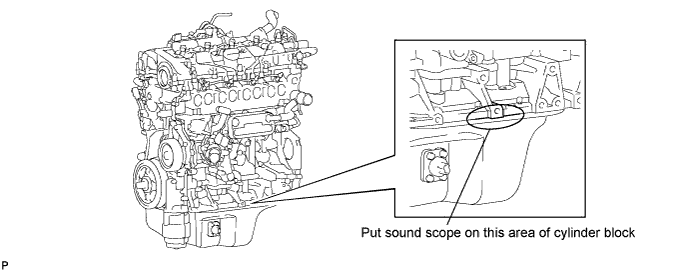
Check for the noise source with a sound scope.
| NEXT | |
|
| 8.REPLACE THE PARTS DETECTED IN PROCEDURE 7 |
Replace the parts detected in Procedure 7 as the noise source.
| NEXT | |
|
| 9.CONFIRM WHETHER THE NOISE PROBLEM HAS BEEN SUCCESSFULLY SOLVED |
Check whether the noise problem has been successfully solved.
| NEXT | ||
| ||
| ||
| 10.EXPLAIN TO THE CUSTOMER THAT THE NOISE IS NORMAL |
Explain to the customer that the noise the customer mentioned is not abnormal.
| NEXT | ||
| ||
| ||

