NETWORKING CAN COMMUNICATION SYSTEM(for RHD with Central Gateway ECU) Television Camera ECU Communication Stop Mode
DESCRIPTION
| Detection Item | Symptom | Trouble Area |
|---|---|---|
| Television Camera ECU Communication Stop Mode | Either condition is met:
·
"Parking Assist Monitor System" is not displayed on "CAN Bus Check". ( ·
Communication system DTCs (DTCs that start with U) that are output correspond to "Television Camera ECU Communication Stop Mode" in "DTC Combination Table". ( |
·
Power source circuit of television camera assembly ·
Television camera assembly CAN branch wire or connector ·
Television camera assembly |

WIRING DIAGRAM
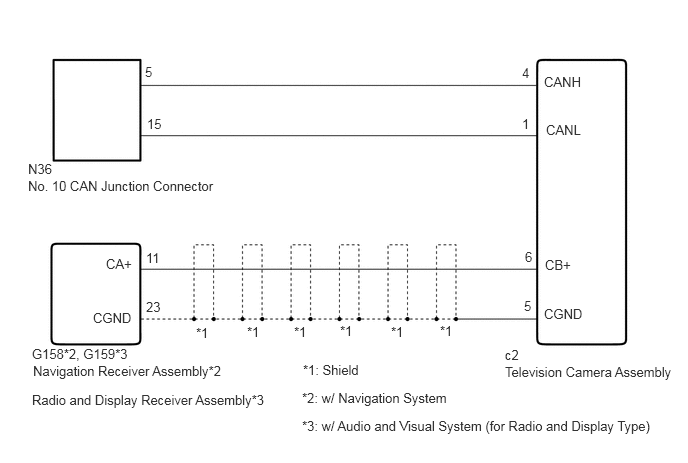
CAUTION / NOTICE / HINT
- NOTICE:
- ·
Because the order of diagnosis is important to allow correct diagnosis, make sure to begin troubleshooting using How to Proceed with Troubleshooting when CAN communication system related DTCs are output.
·Before measuring the resistance of the CAN bus, turn the ignition switch off and leave the vehicle for 1 minute or more without operating the key, switches or opening or closing the doors. After that, disconnect the cable from the negative (-) battery terminal and leave the vehicle for 1 minute or more before measuring the resistance.
·After turning the ignition switch off, waiting time may be required before disconnecting the cable from the battery terminal. Therefore, make sure to read the disconnecting the cable from the battery terminal notice before proceeding with work.
Click hereGeneral>INTRODUCTION>REPAIR INSTRUCTION>PRECAUTION
·Inspect the fuses for circuits related to this system before performing the following procedure.
·After performing repairs, perform the DTC check procedure and confirm that the DTCs are not output again.
·DTC check procedure: Turn the ignition switch to ON and wait at least 20 seconds.
·After the repair, perform CAN Bus Check and check that all the ECUs and sensors connected to the CAN communication system are displayed.
- HINT:
- ·
Operating the ignition switch, any switches or any doors triggers related ECU and sensor communication with the CAN, which causes resistance variation.
·Even after DTCs are cleared, if a DTC is stored again after driving the vehicle for a while, the malfunction may be occurring due to vibration of the vehicle. In such a case, wiggling the ECUs or wire harness while performing the inspection below may help determine the cause of the malfunction.
PROCEDURE
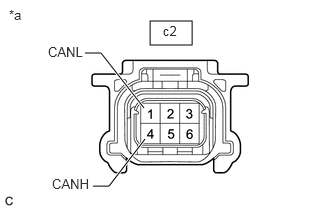
| *a | Front view of wire harness connector
(to Television Camera Assembly) |
Disconnect the cable from the negative (-) battery terminal.
Disconnect the television camera assembly connector.
Measure the resistance according to the value(s) in the table below.
- Standard Resistance:
Tester Connection Condition Specified Condition c2-4 (CANH) - c2-1 (CANL) Cable disconnected from negative (-) battery terminal 54 to 69 Ω
- Result:
Proceed to OK NG
OK
NG
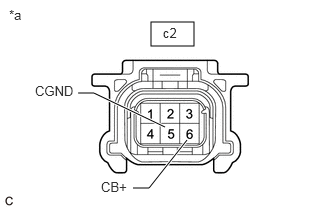
| *a | Front view of wire harness connector
(to Rear Television Camera Assembly) |
Connect the cable to the negative (-) battery terminal.
- NOTICE:
-
When disconnecting the cable, some systems need to be initialized after the cable is reconnected.
-
Click hereGeneral>INTRODUCTION>REPAIR INSTRUCTION>INITIALIZATION
Measure the voltage according to the value(s) in the table below.
- Standard Voltage:
Tester Connection Switch Condition Specified Condition c2-6 (CB+) - Body ground Ignition switch ACC 5.5 to 7.05 V
Measure the resistance according to the value(s) in the table below.
- Standard Resistance:
Tester Connection Condition Specified Condition c2-5 (CGND) - Body ground Always Below 1 Ω
- Result:
Proceed to OK NG
OK
NG
*1: w/ Navigation System
*2: w/ Audio and Visual System (for Radio and Display Type)
Disconnect the G158*1 or G159*2 navigation receiver assembly*1 or radio and display receiver assembly*2 connector.
Measure the resistance according to the value(s) in the table below.
- Standard Resistance:
w/ Navigation System Tester Connection Condition Specified Condition c2-6 (CB+) - G158-11 (CA+) Always Below 1 Ω c2-5 (CGND) - G158-23 (CGND) Always Below 1 Ω c2-6 (CB+) or G158-11 (CA+) - Body ground Always 10 kΩ or higher c2-5 (CGND) or G158-23 (CGND) - Body ground Always 10 kΩ or higher
w/ Audio and Visual System (for Radio and Display Type) Tester Connection Condition Specified Condition c2-6 (CB+) - G159-11 (CA+) Always Below 1 Ω c2-5 (CGND) - G159-23 (CGND) Always Below 1 Ω c2-6 (CB+) or G159-11 (CA+) - Body ground Always 10 kΩ or higher c2-5 (CGND) or G159-23 (CGND) - Body ground Always 10 kΩ or higher
- Result:
Proceed to OK NG
OK
NG