MAINTENANCE FRONT DISC BRAKE PAD(except 4-Pot Caliper) REMOVAL
CAUTION / NOTICE / HINT
- CAUTION:
- ·
Vehicle may slip off the vehicle hoist if the vehicle hoist is handled incorrectly.
Danger! Life-threatening injuries!
-Observe safety information on raising the vehicle using a vehicle hoist.
-For additional information see:
Click hereGeneral>INTRODUCTION>REPAIR INSTRUCTION>VEHICLE LIFT AND SUPPORT LOCATIONS
- NOTICE:
- ·
General information on changing the brake pads:
-For vehicles older than 48 months it is recommended to replace the retaining spring or expanding spring.
-The pad wear indicator wire LH must be replaced once it has been removed because the pad wear indicator wire LH loses its retention capability in the brake pad.
·A CBS reset must be done after every brake pad exchange:
-A CBS reset in the vehicle is possible in the event of a partially ground down pad wear indicator wire LH. The CBS display in the multi-display is active.
-In the event of a pad wear indicator wire LH that is not partially ground down, a CBS reset is only possible with the diagnosis system. No CBS display in the multi-display.
Click hereGeneral>INTRODUCTION>REPAIR INSTRUCTION>CONDITION BASED SERVICE (CBS)
·After a front disc brake pad exchange and before applying the brake pedal:
-Apply the electromechanical parking brake.
-In case of non-compliance, a CC message appears and the brake system switches to the emergency program. The brake power assistance is no longer active.
·When exchanging brake pads, reset the CBS display in accordance with factory specification (CBS reset).
·Carry out test braking while driving at low speed because the effectiveness of the brakes may be reduced during the initial braking operations.
·Exaggerated emergency and continuous braking operations for faster bedding-in are not permitted.
·Advise the customer not to perform intentional emergency braking operations for the first 200 km (124 mile) after the brakes have been replaced.
- HINT:
- ·
The following procedure is for the LH side.
·Use the same procedure for the RH side and LH side.
PROCEDURE

 1.REMOVE FRONT WHEEL
2. MEASURE MINIMUM BRAKE DISC THICKNESS
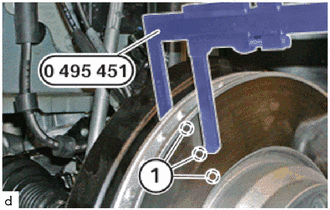
Place the special tool 0 495 451 (34 1 280) at three measuring points in area (1) and measure.
- SST
- 09700-WA090
Compare the measuring results and compare the lowest value with the setpoint value.
- Minimum brake disc thickness:
- Nominal dimension 330x24:
22.4 mm (0.882 in.)
- NOTICE:
-
New front disc brake pads must only be installed if the brake disc thickness is greater than the minimum brake disc thickness.
3.REMOVE PAD WEAR INDICATOR WIRE LH (for LH Side)
- HINT:
- ·
The pad wear indicator wire LH must be replaced once it has been removed because the pad wear indicator wire LH loses its retention capability in the front disc brake pad.
·If a pad wear indicator wire LH that has already been ground has to be replaced even though the minimum front disc brake pad thickness has not yet been reached, you must observe the following:
·The new sliding contact must be filed down with a file to the same length as the sanded sliding contact.
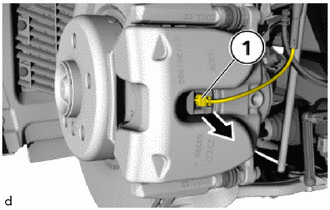
Remove the pad wear indicator wire LH (1) from the front disc brake pad in the direction of the arrow.
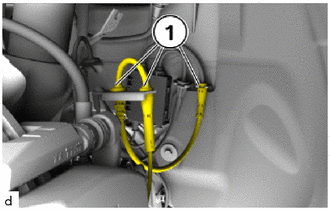
Detach the cable of the pad wear indicator wire LH from the brackets (1).
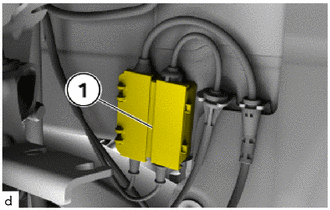
Open the connection box (1).
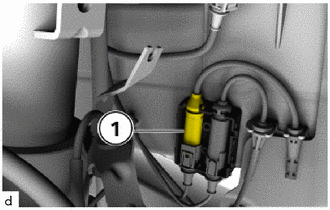
Unlock plug connection (1) and disconnect.
Remove pad wear indicator wire LH.
4.REMOVE FRONT DISC BRAKE PAD
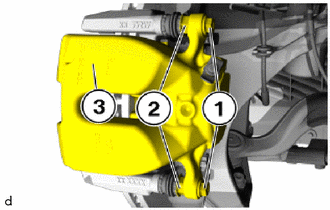
Release the bolts (1), if necessary use the hexagon head (2) for counter support.
Remove the front disc brake cylinder assembly (3).
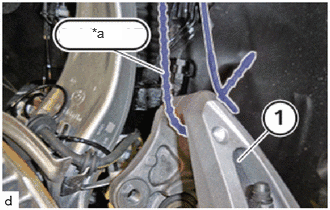
| *a | Rope |
Tie up the front disc brake cylinder assembly (1) with the rope.
- NOTICE:
-
Do not hang the front disc brake cylinder assembly from the front flexible hose.
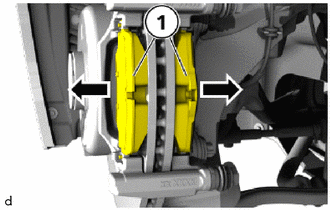
Remove the front disc brake pads (1) in the direction of arrow.
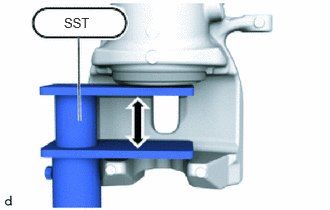
Press brake pistons back using SST.
- SST
- 09719-77010
- HINT:
- ·
When pressing the brake piston back, note the brake fluid level in the brake master cylinder reservoir assembly.
·Overflowing brake fluid will damage the paintwork.