TIRE / WHEEL TIRE AND WHEEL SYSTEM INSPECTION
PROCEDURE

 1.INSPECT TIRES
Inspect the tires for wear and proper inflation pressure.
- Cold Tire Inflation Pressure:
Tire Size Front
kPa (kgf/cm2, psi)Rear
kPa (kgf/cm2, psi)205/65R16 95H 230 (2.3, 33) 220 (2.2, 32) 215/50R18 92V 220 (2.2, 32) 200 (2.0, 29)
- Cold Tire Inflation Pressure (for Spare Tire):
Tire Size kPa (kgf/cm2, psi) T145/90D16 106M 420 (4.2, 60)
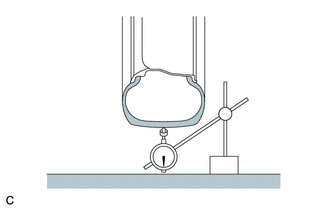
Using a dial indicator, check the runout of the tires.
- Maximum Tire Runout:
1.4 mm (0.0551 in.)
2. ROTATE TIRES
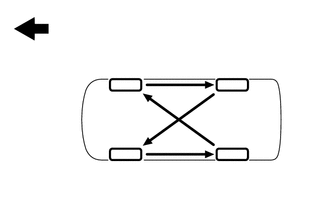
Rotate the tires as shown in the illustration.
3.INSPECT AND ADJUST WHEEL BALANCE
Inspect and adjust the off-the-car balance.
for Steel Wheel:
- Maximum Wheel Imbalance:
8.0 g (0.0176 lb)
- HINT:
- ·
Use clip-on type balance weights for both the inner and outer side.
·If the tires vibrate even after the off-the-car balance adjustment, adjust the wheel balance with on-the-car balancing as necessary.
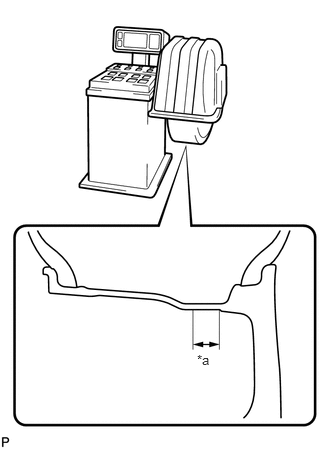
| *a | 25 mm (0.984 in.) |
for Alloy Wheel:
- Maximum Wheel Imbalance:
8.0 g (0.0176 lb)
- NOTICE:
- ·
Use a cleaning detergent to remove dirt, oil and water from the surface where the balance weight is to be adhered.
·Do not touch the adhesive surface of the balance weight.
·Adhere a stick-on type balance weight to the flat surface *a shown in the illustration.
·Push the balance weight with your finger to securely adhere it to the desired position.
·Do not reuse balance weights.
·Use only TOYOTA genuine stick-on type balance weights or equivalent.
- HINT:
- ·
Use clip-on type balance weights for the inner side, and stick-on type balance weights for the outer side.
·If the tires vibrate even after the off-the-car balance adjustment, adjust the wheel balance with on-the-car balancing as necessary.
4.INSPECT FRONT AXLE HUB BEARING
5.INSPECT REAR AXLE HUB BEARING