P0010 Camshaft Position "A" Actuator Circuit (Bank 1)
Diagnostic trouble codes · Vehicles built from Nov 2006
DESCRIPTION
- HINT:
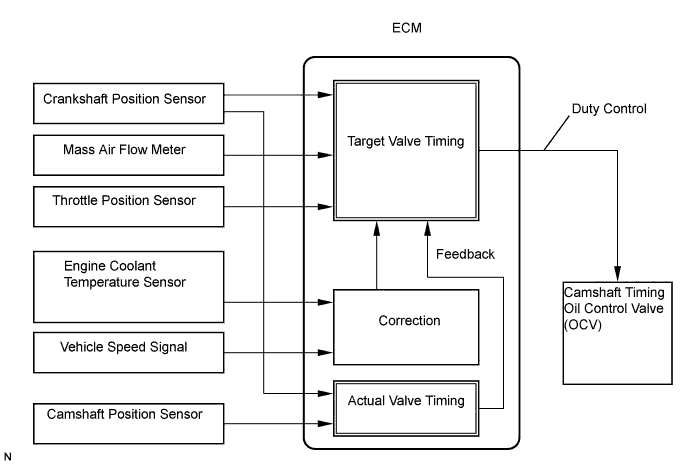
- This DTC relates to the Camshaft Timing Oil Control Valve (OCV) for intake camshaft.
- This DTC relates to the Camshaft Timing Oil Control Valve (OCV) for intake camshaft.

| DTC No. |
DTC Detection Condition |
Trouble Area |
| P0010 |
Open or short in Camshaft Timing Oil Control Valve (OCV) (for intake camshaft) circuit (1 trip detection logic) |
|
WIRING DIAGRAM
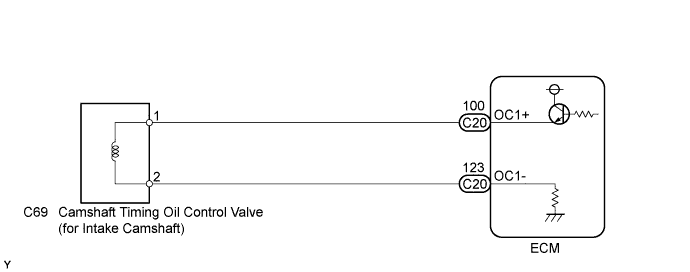
INSPECTION PROCEDURE
- HINT:
- Read freeze frame data using an intelligent tester. The ECM records vehicle and driving condition information as freeze frame data the moment a DTC is stored. When troubleshooting, freeze frame data can help determine if the vehicle was moving or stationary, if the engine was warmed up or not, if the air-fuel ratio was lean or rich, and other data from the time the malfunction occurred.
| 1. CHECK WHETHER DTC OUTPUT RECURS (DTC P0010) |

Connect an intelligent tester to the DLC3.
Turn the ignition switch on (IG).
Turn the tester on.
Select the following menu items: Powertrain / Engine and ECT / DTC / Clear.
Clear DTCs.
Start the engine and warm it up.
Allow the engine to idle 1 minute or more.
Select the following menu items: Powertrain / Engine and ECT / DTC.
Read DTCs.
- Result:
Result
Proceed to
P0010
A
No output
B
|
|
||||

| A | |
 |
| 2. INSPECT CAMSHAFT TIMING OIL CONTROL VALVE ASSEMBLY (FOR INTAKE CAMSHAFT) |
Remove the OCV (for intake camshaft).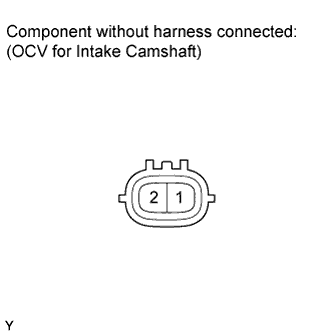
Measure the resistance according to the value(s) in the table below.
- Standard resistance:
Tester Connection
Condition
Specified Condition
1 - 2
20°C (68°F)
6.9 to 7.9 Ω
Apply battery voltage to terminals of the OCV (for intake camshaft). Check the valve operation.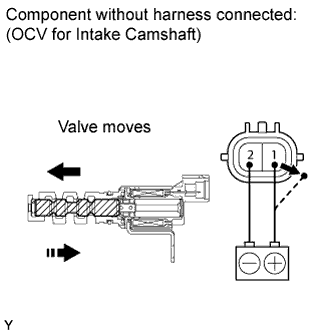
- OK:
- Valve moves quickly.
Reinstall the OCV (for intake camshaft).
|
|
||||
| OK | |
|
| 3. CHECK HARNESS AND CONNECTOR (OCV FOR INTAKE CAMSHAFT - ECM) |
Disconnect the OCV (for intake camshaft) connector.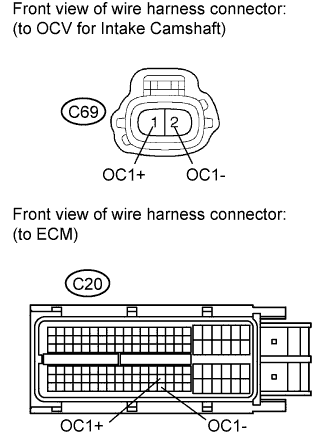
Disconnect the ECM connector.
Measure the resistance according to the value(s) in the table below.
- Standard resistance (Check for open):
Tester Connection
Condition
Specified Condition
C69-1 (OC1+) - C20-100 (OC1+)
Always
Below 1 Ω
C69-2 (OC1-) - C20-123 (OC1-)
Always
Below 1 Ω
- Standard resistance (Check for short):
Tester Connection
Condition
Specified Condition
C69-1 (OC1+) or C20-100 (OC1+) - Body ground
Always
10 kΩ or higher
C69-2 (OC1-) or C20-123 (OC1-) - Body ground
Always
10 kΩ or higher
Reconnect the OCV (for intake camshaft) connector.
Reconnect the ECM connector.
|
|
||||
| OK | ||
 |
||
| ||