DIAGNOSIS SYSTEM
Troubleshooting · Vehicles built from Aug 2005
| CHECK DLC3 |
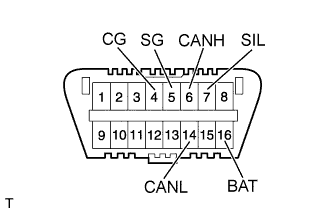  |
The ECU uses ISO 15765-4 for communication. The terminal arrangement of the DLC3 complies with ISO 15031-3 and matches the ISO 15765-4 format.
Symbols (Terminal No.)
Terminal Description
Condition
Specified Condition
SIL (7) - SG (5)
Bus " +" line
During transmission
Pulse generation
CG (4) - Body ground
Chassis ground
Always
Below 1 Ω
SG (5) - Body ground
Signal ground
Always
Below 1 Ω
BAT (16) - Body ground
Battery positive
Always
10 to 14 V
CANH (6) - CANL (14)
CAN bus line
Ignition switch off*
54 to 69 Ω
CANH (6) - CG (4)
HIGH-level CAN bus line
Ignition switch off*
200 Ω or higher
CANL (14) - CG (4)
LOW-level CAN bus line
Ignition switch off*
200 Ω or higher
CANH (6) - BAT (16)
HIGH-level CAN bus line
Ignition switch off*
6 kΩ or higher
CANL (14) - BAT (16)
LOW-level CAN bus line
Ignition switch off*
6 kΩ or higher
- NOTICE:
- *: Before measuring the resistance, leave the vehicle as is for at least 1 minute and do not operate the ignition switch, any other switches or the doors.
- HINT:
-
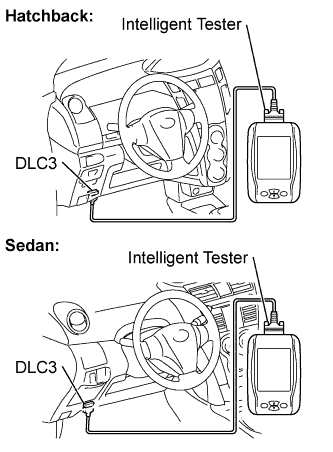
- Connect the cable of the intelligent tester to the DLC3, turn the ignition switch on (IG) and attempt to use the tester. If the display indicates that a communication error has occurred, there is a problem either with the vehicle or with the tester.
- If communication is normal when the tester is connected to another vehicle, inspect the DLC3 of the original vehicle.
- If communication is still not possible when the tester is connected to another vehicle, the problem is probably in the tester itself. Consult the Service Department listed in the tester's instruction manual.
- If communication is normal when the tester is connected to another vehicle, inspect the DLC3 of the original vehicle.
| INSPECT BATTERY VOLTAGE |
- Standard voltage:
- 11 to 14 V
- If the voltage is below 11 V, recharge or replace the battery before proceeding.
| INSPECT FRONT DRIVER SEAT BELT WARNING LIGHT |
Turn the ignition switch on (IG).
When the driver seat belt is not fastened, check that the combination meter's driver seat belt warning light blinks.
When the seat belt is fastened, check that the combination meter's driver seat belt warning light turns off.
| INSPECT FRONT PASSENGER SEAT BELT WARNING LIGHT |
Turn the ignition switch on (IG).
When the front passenger seat is occupied, seat belt is not fastened, check that the front passenger seat belt warning light on the instrument panel blinks.
When the front passenger seat belt is fastened, check that the front passenger seat belt warning light turns off.
| INSPECT SEAT BELT WARNING BUZZER USING DRIVER SEAT BELT |
Turn the ignition switch on (IG).
When the driver seat belt is not fastened within 0.4 seconds of the ignition switch being turned on (IG) and the vehicle speed reaches 20 km/h (12.4 mph) or more, check that the buzzer sounds at 1.2 second intervals for 30 seconds.
After the buzzer has sounded for 30 seconds, check that the buzzer sounds at 0.4 second intervals for a further 90 seconds.
When 120 seconds have elapsed since the buzzer started sounding in step (c) above, check that the buzzer stops sounding.
After the buzzer has stopped sounding, turn the ignition switch off and then start the engine again. With the driver seat belt unfastened, drive the vehicle at 20 km/h (12.4 mph) or more. Check that the buzzer sounds.
After the buzzer has stopped sounding, fasten the driver seat belt, drive the vehicle at 20 km/h (12.4 mph) or more, and then unfasten the seat belt. Check that the buzzer sounds.
After the buzzer has stopped sounding, move the shift lever to R. Then move the shift lever to D. With the driver seat belt unfastened, drive the vehicle at 20 km/h (12.4 mph) or more. Check that the buzzer sounds.