P0190 Fuel Rail Pressure Sensor Circuit
Diagnostic trouble codes · Vehicles built from Nov 2005
DESCRIPTION
The ECM monitors the internal fuel pressure of the common rail using the fuel pressure sensor and controls the fuel metering unit to regulate the internal pressure and maintain it at the target pressure.The pressure sensor is a semiconductor pressure sensor with an electric resistance which varies when pressure is applied to its silicon. The output of this sensor varies in accordance with the internal fuel pressure.
| DTC No. |
DTC Detection Conditions |
Trouble Areas |
| P0190 |
Fuel pressure sensor output voltage 0.2 V or less, or 4.8 V or more for 0.5 seconds (The MIL is illuminated and a DTC is immediately set when a malfunction is detected) |
|
- HINT:
- DTC P0190 is set when the engine idles for approximately 15 seconds.
- When DTC P0190 is set, check the internal fuel pressure of the common rail by selecting the following menu items: Powertrain / Engine and ECT / Data List / Common Rail Pressure.
- Reference:
Engine Speed
Fuel Pressure (MPa)
Idling
Approximately 25 to 36
2,000 rpm (No engine load)
Approximately 27 to 46
3,000 rpm (No engine load)
Approximately 34 to 69
- DTC P0190 is set when the engine idles for approximately 15 seconds.
WIRING DIAGRAM
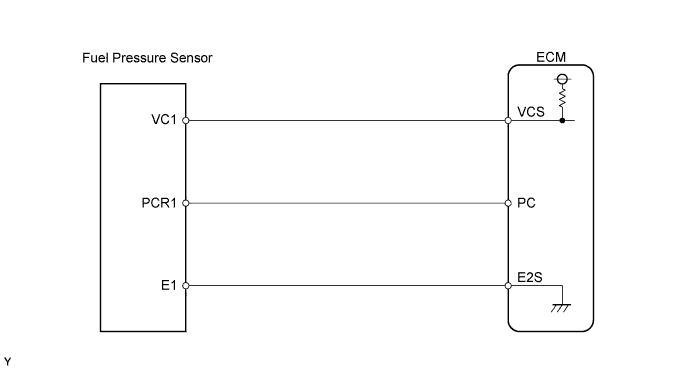

INSPECTION PROCEDURE
- HINT:
- If different DTCs related to different systems that have terminal E2 as the ground terminal are output simultaneously, terminal E2 may have an open circuit.
- Read freeze frame data using an intelligent tester. Freeze frame data record the engine condition when malfunctions are detected. When troubleshooting, freeze frame data can help determine if the vehicle was moving or stationary, if the engine was warmed up or not, if the air-fuel ratio was lean or rich, and other data, from the time the malfunction occurred.
- If different DTCs related to different systems that have terminal E2 as the ground terminal are output simultaneously, terminal E2 may have an open circuit.
| 1. READ VALUE USING INTELLIGENT TESTER (FUEL PRESSURE) |

Connect an intelligent tester to the DLC3.
Start the engine and turn the tester on.
Select the following menu items: Powertrain / Engine and ECT / Data List / Common Rail Pressure.
Check that the internal fuel pressure of the common rail is within the specification below.
- Standard:
Engine Speed
Fuel Pressure (MPa)
Idling
Approximately 25 to 36
2,000 rpm (No engine load)
Approximately 27 to 46
3,000 rpm (No engine load)
Approximately 34 to 69
|
|
||||

| OK | |
 |
| 2. CHECK WHETHER DTC OUTPUT RECURS (FUEL PRESSURE SENSOR DTCS) |
Connect the intelligent tester to the DLC3.
Turn the ignition switch on (IG) and turn the tester on.
Clear DTCs (Click here).
Let the engine idle for 60 seconds, and accelerate the engine speed repeatedly (to 2,500 rpm) for 30 seconds.
Select the following menu items: Powertrain / Engine and ECT / DTC.
Read DTCs.
- Result:
Display (DTC Output)
Proceed To
P0190
A
No output
B
|
|
||||

| A | ||
 |
||
| ||
| 3. CHECK HARNESS AND CONNECTOR (FUEL PRESSURE SENSOR - ECM) |
Disconnect the C56 fuel pressure sensor connector.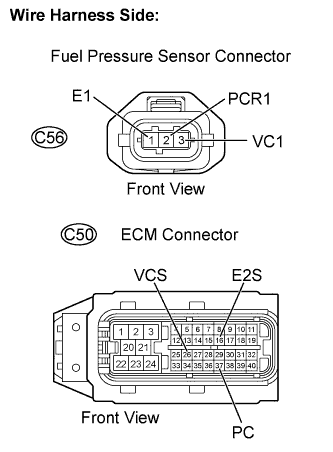
Disconnect the C50 ECM connector.
Check the resistance.
- Standard resistance (Check for open):
Tester Connections
Specified Conditions
PC (C50-37) - PCR1 (C56-2)
Below 1 Ω
VCS (C50-26) - VC1 (C56-3)
E2S (C50-16) - E1 (C56-1)
- Standard resistance (Check for short):
Tester Connections
Specified Conditions
PC (C50-37) or PCR1 (C56-2) - Body ground
10 kΩ or higher
VCS (C50-26) or VC1 (C56-3) - Body ground
E2S (C50-16) or E1 (C56-1) - Body ground
Reconnect the ECM connector.
Reconnect the fuel pressure sensor connector.
|
|
||||
| OK | ||
|
||
| ||