DESCRIPTION
- ANTILOCK BRAKE SYSTEM
- ELECTRONIC STABILITY PROGRAM
- TRACTION CONTROL
- ELECTRONIC VARIABLE BRAKE PROPORTIONING
ANTILOCK BRAKE SYSTEM
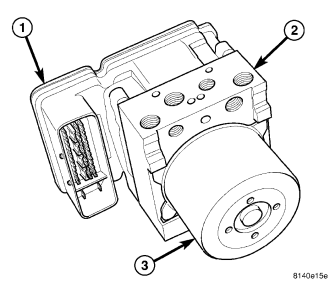
This vehicle uses an antilock brake system designated MK25e. For this vehicle, MK25e is standard with Electronic Stability Program (ESP) and All-Speed Traction Control.
This antilock brake system uses components of the base brake system, but also features the following components:
- Integrated Control Unit (ICU) - Hydraulic Control Unit (HCU) (2) and Antilock Brake Module (ABM) (1)
- Wheel Speed Sensors (WSS) - Four sensors (one at each wheel)
The MK25e ICU is made up of the Hydraulic Control Unit (HCU) and the Antilock Brake Module (ABM). For additional information on these components, (Refer to 5 - BRAKES/HYDRAULIC/MECHANICAL/HCU (HYDRAULIC CONTROL UNIT) - DESCRIPTION) (Refer to 8 - ELECTRICAL/ELECTRONIC CONTROL MODULES/ANTILOCK BRAKE MODULE - DESCRIPTION).
ABS
The purpose of the antilock brake system (ABS) is to prevent wheel lockup under braking conditions on virtually any type of road surface. Antilock braking is desirable because a vehicle that is stopped without locking the wheels retains directional stability and some steering capability. This allows the driver to retain greater control of the vehicle during braking.
All vehicles use Electronic Variable Brake Proportioning (EVBP) to balance front-to-rear braking when the brakes are applied in the partial braking range. For more information on electronic brake distribution, (Refer to 5 - BRAKES - ABS - DESCRIPTION).
ELECTRONIC STABILITY PROGRAM
For information on the Electronic Stability Program, (Refer to 5 - BRAKES - DESCRIPTION).
TRACTION CONTROL
For information on the All-Speed Traction Control, (Refer to 5 - BRAKES - DESCRIPTION).
OFF-ROAD ABS
Four-wheel-drive vehicles are equipped with Off-Road ABS. Off-Road ABS provides more sustained wheel lockup than normal ABS for improved stopping performance on plowable surfaces like loose dirt, gravel, sand and mud. Such plowable surfaces move out of the way as the tires roll on them and form a wedge in front of the tires during braking because more sustained wheel lock up causes the tires to drag and the loose surface to build up in front of the tires, helping to stop the vehicle. A vehicle with normal ABS requires a longer stopping distance on the same terrain because the wheels continue rotating, not allowing the drag and build up material in front of the tires.
ELECTRONIC STABILITY PROGRAM
ESP® (Electronic Stability Program), which includes Hydraulic Brake Assist, Traction Control, and Electronic Roll Mitigation is standard on all vehicles. ESP aids the driver in maintaining vehicle directional stability. ESP will do whatever can be done, within the limits of available traction, to keep the car on course.
ESP uses the ABS with Traction Control (MK25E) along with the following components to operate:
- Dynamics (ESP) Sensor
- Steering Angle Sensor (SAS)
The Dynamics Sensor that is mounted under the center console, which is near the center of gravity of the car for effective sensing (Refer to 5 - BRAKES/ELECTRICAL/DYNAMICS SENSOR - DESCRIPTION). The Steering Angle Sensor is located in the steering column (Refer to 5 - BRAKES/ELECTRICAL/STEERING ANGLE SENSOR - DESCRIPTION).
On this vehicle, ESP has three modes: Full-On, Partial and Full-Off. The ESP default mode is Full-On with every key-on. Pressing the ESP Off button in the center stack once activates the Partial mode. In Partial mode, Traction Control is deactivated and ESP operates at a higher threshold, therefore, it will not come on as aggressively as in the Full-On mode. Pressing and holding the ESP button for five seconds or longer turns the system completely off. This condition is confirmed by a single warning chime and a text message in the odometer display “ESP FULL OFF.” The system can be returned to “normal” Full-On mode by briefly pressing and releasing the ESP Off switch.
HYDRAULIC BRAKE ASSIST
Brake Assist is programmed into the ESP® system. Brake assist helps the driver overcome the tendency to not apply the brakes hard enough or quick enough to achieve the minimum stopping distance during a panic stop. During this situation, the ESP® system instantly applies the maximum available pressure to the brakes and the vehicle stops as quickly as available traction will allow.
TRACTION CONTROL
For information on the All-Speed Traction Control, (Refer to 5 - BRAKES - DESCRIPTION).
ELECTRONIC ROLL MITIGATION
ESP Full-On and Partial modes include an algorithm for Electronic Roll Mitigation (ERM). ERM is an algorithm on top of ESP control that is targeted toward preventing wheel lift in the NHTSA Fish Hook maneuvers. These very extreme situations are well out of normal everyday driving, but by chance a high dynamic maneuver occurs, ERM can help return vehicle stability and control to the driver. Electronic Roll Mitigation attempts to determine when a vehicle is in a position to mitigate vehicle rollover and minimize the risk by applying the appropriate braking force to reduce the likelihood that such an event will occur. This added measure is designed to aid the driver in maintaining vehicle stability during an emergency maneuver or accident avoidance situation. ERM will not aid vehicle stability in “trip” situations, such as when a vehicle slides sideways and strikes a curb, which could then cause the side opposite the curb to lift and the vehicle to roll.
TRACTION CONTROL
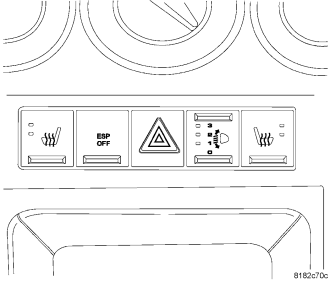
The traction control system that is part of the Electronic Stability Program (ESP), is an all-speed traction control. All-Speed Traction Control enhances mobility and prevents wheel slip when accelerating on slippery surfaces. It also provides a measure of directional stability control. Using the wheel-speed sensors, it can detect excessive yaw and help keep the car on the intended course, as for instance, when accelerating around a curve.
All-Speed Traction Control is effective up to 85 mph (137 km/h).
The traction control system may be turned off or on by depressing the ESP Off switch button located on the instrument panel.
ELECTRONIC VARIABLE BRAKE PROPORTIONING
Vehicles equipped with ABS use Electronic Variable Brake Proportioning (EVBP) to balance front-to-rear braking. The EVBP is used in place of a rear proportioning valve. The EVBP system uses the ABS system to control the slip of the rear wheels in partial braking range. The braking force of the rear wheels is controlled electronically by using the inlet and outlet valves located in the Integrated Control Unit (ICU).
EVBP activation is invisible to the customer since there is no pump motor noise or brake pedal feedback.