MODULE-ANTILOCK BRAKE
DESCRIPTION
The Antilock Brake Module (ABM) is a microprocessor-based device which monitors the antilock brake system (ABS) during normal braking and controls it when the vehicle is in an ABS stop or when in a traction control or Electronic Stability Program (ESP) situation. The ABM utilizes a 47-way electrical connector on the vehicle wiring harness. The power source for the ABM is through the ignition switch in the RUN or ON position.
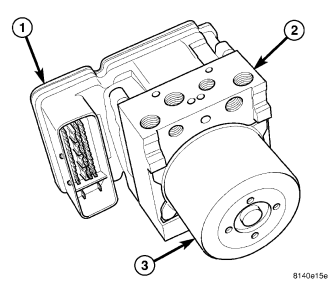
The ABM (1) is mounted to the HCU (2) as part of the Integrated Control Unit (ICU). The ICU is located in the engine compartment on the inboard side of the right body frame rail behind the strut tower. For information on the ICU, (Refer to 5 - BRAKES/HYDRAULIC/MECHANICAL/ICU (INTEGRATED CONTROL UNIT) - DESCRIPTION).
OPERATION
The primary functions of the Antilock Brake Module (ABM) are to:
- Monitor the Antilock Brake System (ABS) and Electronic Stability Program (ESP) for proper operation.
- Detect wheel locking or wheel slipping tendencies by monitoring the speed of all four wheels of the vehicle.
- Control fluid modulation to the wheel brakes while the system is in ABS or traction control mode.
- Modulates fluid pressure to the wheel brakes to control vehicle yaw rate in ESP mode.
- Store diagnostic information.
- Provide communication to the scan tool while in diagnostic mode.
- Illuminate the amber ABS indicator in the instrument cluster.
- Illuminate the yellow ESP/BAS indicator in the instrument cluster (if equipped).
The ABM constantly monitors the ABS and ESP (if equipped) for proper operation. If the ABM detects a fault, it will turn on the amber ABS and yellow ESP/BAS indicators and disable the ABS or ESP if so equipped. The normal base braking system will remain operational at that time.
The ABM continuously monitors the speed of each wheel through the signals generated by the wheel speed sensors to determine if any wheel is beginning to lock. When a wheel locking tendency is detected, the ABM commands the ABM solenoid coils to actuate. The coils then open and close the valves in the HCU that modulate brake fluid pressure in some or all of the hydraulic circuits. The ABM continues to control pressure in individual hydraulic circuits until a locking tendency is no longer present.
REMOVAL
Due to packaging and limited space it is necessary to remove and disassemble the Integrated Control Unit (ICU) to service the Antilock Brake Module (ABM) on this vehicle. (Refer to 5 - BRAKES/HYDRAULIC/MECHANICAL/ICU (INTEGRATED CONTROL UNIT) - REMOVAL)
INSTALLATION
Due to packaging and limited space it is necessary to install the Antilock Brake Module (ABM) on the Hydraulic Control Unit (HCU), then install the Integrated Control Unit (ICU) on the vehicle as an assembly. (Refer to 5 - BRAKES/HYDRAULIC/MECHANICAL/ICU (INTEGRATED CONTROL UNIT) - ASSEMBLY)