REMOVAL
UNDER FLOOR CATALYTIC CONVERTER
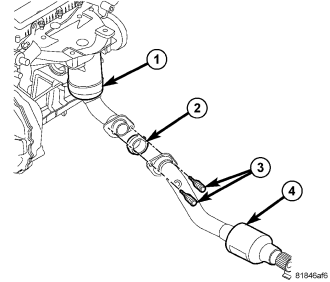
WARNING: THE NORMAL OPERATING TEMPERATURE OF THE EXHAUST SYSTEM IS VERY HIGH. THEREFORE, NEVER WORK AROUND OR ATTEMPT TO SERVICE ANY PART OF THE EXHAUST SYSTEM UNTIL IT IS COOLED. SPECIAL CARE SHOULD BE TAKEN WHEN WORKING NEAR THE CATALYTIC CONVERTER. THE TEMPERATURE OF THE CONVERTER RISES TO A HIGH LEVEL AFTER A SHORT PERIOD OF ENGINE OPERATING TIME.
1. Raise vehicle on hoist and apply penetrating oil to band clamp fastener of component being removed.
NOTE: Do not use petroleum-based lubricants when removing/installing muffler or exhaust pipe isolators as it may compromise the life of the part. A suitable substitute is a mixture of liquid dish soap and water.
2. Remove I-Pipe/Muffler assembly (Refer to 11 - EXHAUST SYSTEM/MUFFLER - REMOVAL).
3. Disconnect oxygen sensor electrical connectors.
NOTE: If spherical gasket is to be reused, mark orientation.
4. Remove flange bolts (3), springs and spherical gasket.
5. Remove under floor catalytic converter (4) from combination manifold/catalytic converter assembly (1).
6. Clean ends of pipes to assure mating of all parts. Discard broken or worn isolators, rusted or overused clamps, supports, and attaching parts.
NOTE: When replacement is required on any component of the exhaust system, you must use original equipment parts (or their equivalent).
CATALYTIC CONVERTER - FWD
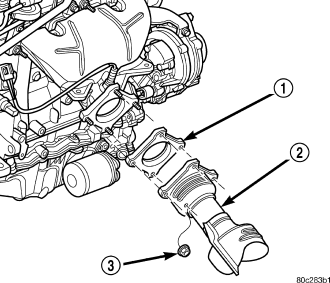
WARNING: The normal operating temperature of the exhaust system is very high. Therefore, never attempt to service any part of the exhaust system until it is cooled. Special care should be taken when working near the catalytic converter. The temperature of the converter rises to a high level after a short period of engine operation time.
NOTE: Before replacing a catalytic converter, determine the root cause of failure. Most catalytic converter failures are caused by air, fuel or ignition problems. Refer to the appropriate service diagnostic information for repair procedures.
1. Loosen intermediate pipe-to catalytic converter clamp.
NOTE: Do not use petroleum-based lubricants when removing/installing muffler or exhaust pipe isolators as it may compromise the life of the part. A suitable substitute is a mixture of liquid dish soap and water.
2. Remove catalytic converter to exhaust manifold attaching fasteners and remove converter from vehicle.
3. Remove I-Pipe/Muffler assembly insolators as necessary to slide I-Pipe/Muffler assembly out of catalytic converter.
4. Remove and discard flange gasket.
NOTE: When replacement is required on any component of the exhaust system, original equipment parts (or equivalent) must be used.
REMOVAL - MANIVERTER
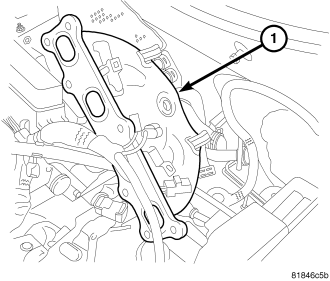
WARNING: THE NORMAL OPERATING TEMPERATURE OF THE EXHAUST SYSTEM IS VERY HIGH. THEREFORE, NEVER ATTEMPT TO SERVICE ANY PART OF THE EXHAUST SYSTEM UNTIL IT IS COOLED. SPECIAL CARE SHOULD BE TAKEN WHEN WORKING NEAR THE CATALYTIC CONVERTER. THE TEMPERATURE OF THE CONVERTER RISES TO A HIGH LEVEL AFTER A SHORT PERIOD OF ENGINE OPERATION TIME.
NOTE: Before replacing a catalytic converter, determine the root cause of failure. Most catalytic converter failures are caused by air, fuel or ignition problems. Refer to the appropriate service diagnostic information for repair procedures.
1. Remove under floor catalytic converter (Refer to 11 - EXHAUST SYSTEM/CATALYTIC CONVERTER - REMOVAL).
NOTE: When replacement is required on any component of the exhaust system, original equipment parts (or equivalent) must be used.
2. Lower vehicle.
3. Remove secondary thermostat (Refer to 7 - COOLING/ENGINE/ENGINE COOLANT THERMOSTAT - REMOVAL).
4. Remove maniverter mounting bolts.
5. Remove maniverter and gasket from the engine compartment.
DIESEL ENGINE
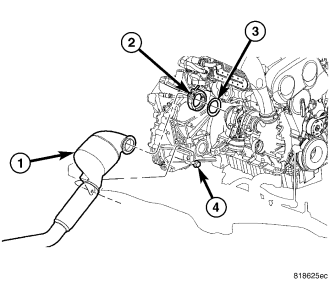
1. Remove intermediate pipe and muffler (Refer to 11 - EXHAUST SYSTEM/INTERMEDIATE PIPE - REMOVAL).
2. Remove catalytic converter mounting bolt (4).
3. Remove clamp (2) and gasket (3).
4. Remove catalytic converter (1) from vehicle.