INSTALLATION
AIRBAG
WARNING: To avoid personal injury or death, on vehicles equipped with airbags, disable the supplemental restraint system before attempting any steering wheel, steering column, airbag, occupant classification system, seat belt tensioner, impact sensor, or instrument panel component diagnosis or service. Disconnect and isolate the battery negative (ground) cable, then wait two minutes for the system capacitor to discharge before performing further diagnosis or service. This is the only sure way to disable the supplemental restraint system. Failure to take the proper precautions could result in accidental airbag deployment.
WARNING: To avoid personal injury or death, use extreme care to prevent any foreign material from entering the passenger airbag, or becoming entrapped between the passenger airbag cushion and the passenger airbag door. Failure to observe this warning could result in occupant injuries upon airbag deployment.
NOTE: The following procedure is for replacement of an ineffective or damaged passenger airbag. If the airbag is ineffective or damaged, but not deployed, review the recommended procedures for handling non-deployed supplemental restraints. (Refer to 8 - ELECTRICAL/RESTRAINTS - STANDARD PROCEDURE - HANDLING NON-DEPLOYED SUPPLEMENTAL RESTRAINTS). If the passenger airbag has been deployed, review the recommended procedures for service after a supplemental restraint deployment before removing the airbag from the vehicle. (Refer to 8 - ELECTRICAL/RESTRAINTS - STANDARD PROCEDURE - SERVICE AFTER A SUPPLEMENTAL RESTRAINT DEPLOYMENT).
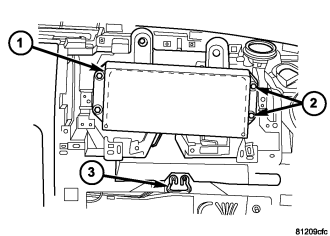
1. Position the passenger airbag unit (1) close enough to the instrument panel to reconnect the electrical connections on each side of the airbag housing.
2. When installing the passenger airbag, reconnect the two instrument panel wire harness connectors to the airbag inflator connector receptacles by pressing straight in on the connectors. Be certain to engage each keyed and color-coded connector to the matching connector receptacle. You can be certain that each connector is fully engaged in its receptacle by listening carefully for a distinct, audible click as the connector latches snap into place.
3. Carefully position the passenger airbag unit onto the two metal brackets on the instrument panel support structure. Be certain that the alignment pin features on each side of the airbag are engaged in the alignment holes in the metal brackets.
4. Install and tighten the two screws (2) on each side of the passenger airbag housing that secure the passenger airbag to the metal brackets on the instrument panel support structure. Tighten the screws to 6 N·m (55 in. lbs.).
5. Reinstall the passenger airbag door onto the instrument panel. (Refer to 8 - ELECTRICAL/RESTRAINTS/PASSENGER AIRBAG DOOR - INSTALLATION).
6. Do not reconnect the battery negative cable at this time. The supplemental restraint system verification test procedure should be performed following service of any supplemental restraint system component. (Refer to 8 - ELECTRICAL/RESTRAINTS - STANDARD PROCEDURE - VERIFICATION TEST).
BRACKETS
WARNING: To avoid personal injury or death on vehicles equipped with airbags, disable the supplemental restraint system before attempting any steering wheel, steering column, driver airbag, passenger airbag, occupant classification system, seat belt tensioner, front impact sensor, side impact sensor, side curtain airbag, or instrument panel component diagnosis or service. Disconnect and isolate the battery negative (ground) cable, then wait two minutes for the system capacitor to discharge before performing further diagnosis or service. This is the only sure way to disable the supplemental restraint system. Failure to take the proper precautions could result in accidental airbag deployment.
NOTE: The passenger airbag mounting brackets cannot be repaired. They must be replaced if ineffective or damaged, or if the passenger airbag has been deployed.
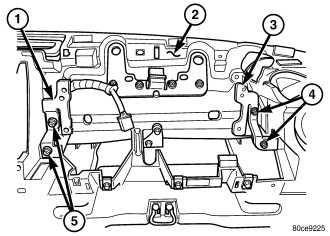
1. Position the inboard (1) or outboard passenger airbag mounting bracket (3) to the instrument panel support structure (2).
2. Install and tighten the two screws (4 or 5) that secure the inboard or outboard passenger airbag mounting bracket(s) to the instrument panel support structure. Tighten the screws to 2 N·m (20 in. lbs.).
3. Reinstall the passenger airbag to the instrument panel. (Refer to 8 - ELECTRICAL/RESTRAINTS/PASSENGER AIRBAG - INSTALLATION).
DOOR
WARNING: To avoid personal injury or death on vehicles equipped with airbags, disable the supplemental restraint system before attempting any steering wheel, steering column, driver airbag, passenger airbag, occupant classification system, seat belt tensioner, front impact sensor, side impact sensor, side curtain airbag, or instrument panel component diagnosis or service. Disconnect and isolate the battery negative (ground) cable, then wait two minutes for the system capacitor to discharge before performing further diagnosis or service. This is the only sure way to disable the supplemental restraint system. Failure to take the proper precautions could result in accidental airbag deployment.
WARNING: To avoid personal injury or death on vehicles equipped with airbags, the passenger airbag door must never be painted. Replacement passenger airbag doors are serviced in the original colors. Paint may change the way in which the material of the airbag door responds to an airbag deployment. Failure to observe this warning could result in occupant injuries upon airbag deployment.
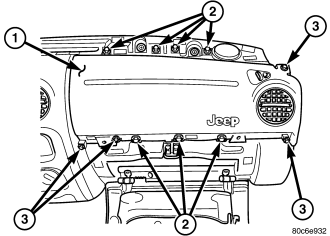
1. Position the passenger airbag door (1) onto the instrument panel.
2. Install and tighten the four large screws (2) that secure the passenger airbag door to the top of the instrument panel. Tighten the screws to 4 N·m (35 in. lbs.).
3. Install and tighten the one small screw (3) that secures the passenger airbag door to the top of the instrument panel. Tighten the screw to 2 N·m (20 in. lbs.).
4. Install and tighten the three large screws (2) that secure the passenger airbag door to the glove box opening upper reinforcement. Tighten the screws to 4 N·m (35 in. lbs.).
5. Install and tighten the three small screws (3) that secure the passenger airbag door to the glove box opening upper reinforcement. Tighten the screws to 2 N·m (20 in. lbs.).
6. Reinstall the passenger side bezel onto the upper glove box opening of the instrument panel. (Refer to 23 - BODY/INSTRUMENT PANEL/IP PASSENGER SIDE BEZEL - INSTALLATION).
7. Reinstall the top cover onto the instrument panel. (Refer to 23 - BODY/INSTRUMENT PANEL/INSTRUMENT PANEL TOP COVER - INSTALLATION).
8. Reconnect the battery negative cable.