REMOVAL
AIRBAG
WARNING: To avoid personal injury or death, on vehicles equipped with airbags, disable the supplemental restraint system before attempting any steering wheel, steering column, airbag, occupant classification system, seat belt tensioner, impact sensor, or instrument panel component diagnosis or service. Disconnect and isolate the battery negative (ground) cable, then wait two minutes for the system capacitor to discharge before performing further diagnosis or service. This is the only sure way to disable the supplemental restraint system. Failure to take the proper precautions could result in accidental airbag deployment.
WARNING: To avoid personal injury or death, when removing a deployed airbag, rubber gloves, eye protection, and a long-sleeved shirt should be worn. There may be deposits on the airbag unit and other interior surfaces. In large doses, these deposits may cause irritation to the skin and eyes.
NOTE: The following procedure is for replacement of an ineffective or damaged passenger airbag. If the airbag is ineffective or damaged, but not deployed, review the recommended procedures for handling non-deployed supplemental restraints. (Refer to 8 - ELECTRICAL/RESTRAINTS - STANDARD PROCEDURE - HANDLING NON-DEPLOYED SUPPLEMENTAL RESTRAINTS). If the passenger airbag has been deployed, review the recommended procedures for service after a supplemental restraint deployment before removing the airbag from the vehicle. (Refer to 8 - ELECTRICAL/RESTRAINTS - STANDARD PROCEDURE - SERVICE AFTER A SUPPLEMENTAL RESTRAINT DEPLOYMENT).
1. Disconnect and isolate the battery negative cable. Wait two minutes for the system capacitor to discharge before further service.
2. Remove the passenger airbag door from the instrument panel. (Refer to 8 - ELECTRICAL/RESTRAINTS/PASSENGER AIRBAG DOOR - REMOVAL).
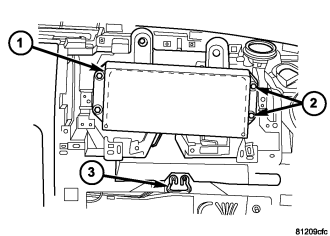
3. Remove the two screws (2) on each side of the passenger airbag housing (1) that secure the passenger airbag to the metal brackets on the instrument panel support structure.
4. Disengage the passenger airbag wire harness connector from the retainer securing the connector to the metal bracket on the instrument panel support structure above the airbag by sliding both halves of the connector to the left.
5. Pull the passenger airbag away from the instrument panel far enough to access the two wire harness connectors for the airbag.
CAUTION: Do not pull on the instrument panel wire harness passenger airbag take outs or pry on the connector insulators to disengage the connectors from the passenger airbag inflator connector receptacles. Improper removal of these wires and their connector insulators can result in damage to the airbag circuits or connector insulators.
6. The instrument panel passenger airbag wire harness connectors are secured by integral latches to the airbag inflator connector receptacles, which are located on the sides of the passenger airbag housing. Depress the latches on each side of each connector insulator and pull the insulators straight out from the airbag inflator to disconnect them from the connector receptacles.
7. Remove the passenger airbag from the instrument panel as a unit.
8. If the passenger airbag has been deployed, both passenger airbag mounting brackets on the instrument panel must be replaced. (Refer to 8 - ELECTRICAL/RESTRAINTS/PASSENGER AIRBAG MOUNTING BRACKET - REMOVAL).
BRACKETS
WARNING: To avoid personal injury or death on vehicles equipped with airbags, disable the supplemental restraint system before attempting any steering wheel, steering column, driver airbag, passenger airbag, occupant classification system, seat belt tensioner, front impact sensor, side impact sensor, side curtain airbag, or instrument panel component diagnosis or service. Disconnect and isolate the battery negative (ground) cable, then wait two minutes for the system capacitor to discharge before performing further diagnosis or service. This is the only sure way to disable the supplemental restraint system. Failure to take the proper precautions could result in accidental airbag deployment.
NOTE: The passenger airbag mounting brackets cannot be repaired. They must be replaced if ineffective or damaged, or if the passenger airbag has been deployed.
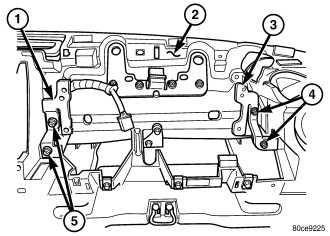
1. Remove the passenger airbag from the instrument panel. (Refer to 8 - ELECTRICAL/RESTRAINTS/PASSENGER AIRBAG - REMOVAL).
2. Remove the two screws (4 or 5) that secure the inboard (1) or outboard passenger airbag mounting bracket (3) to the instrument panel support structure (2).
3. Remove the inboard or outboard passenger airbag mounting bracket(s) from the instrument panel support structure.
DOOR
WARNING: To avoid personal injury or death on vehicles equipped with airbags, disable the supplemental restraint system before attempting any steering wheel, steering column, driver airbag, passenger airbag, occupant classification system, seat belt tensioner, front impact sensor, side impact sensor, side curtain airbag, or instrument panel component diagnosis or service. Disconnect and isolate the battery negative (ground) cable, then wait two minutes for the system capacitor to discharge before performing further diagnosis or service. This is the only sure way to disable the supplemental restraint system. Failure to take the proper precautions could result in accidental airbag deployment.
WARNING: To avoid personal injury or death on vehicles equipped with airbags, when removing a deployed airbag, rubber gloves, eye protection, and a long-sleeved shirt should be worn. There may be deposits on the airbag unit and other interior surfaces. In large doses, these deposits may cause irritation to the skin and eyes.
1. Disconnect and isolate the battery negative cable. Wait two minutes for the system capacitor to discharge before further service.
2. Remove the top cover from the instrument panel. (Refer to 23 - BODY/INSTRUMENT PANEL/INSTRUMENT PANEL TOP COVER - REMOVAL).
3. Remove the passenger side bezel from the upper glove box opening of the instrument panel. (Refer to 23 - BODY/INSTRUMENT PANEL/IP PASSENGER SIDE BEZEL - REMOVAL).
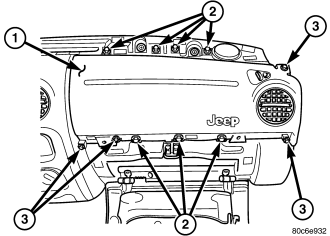
4. Remove the three small screws that secure the passenger airbag door to the glove box opening upper reinforcement .
5. Remove the three large screws (3) that secure the passenger airbag door (1) to the glove box opening upper reinforcement.
6. Remove the one small screw (3) that secures the passenger airbag door to the top of the instrument panel.
7. Remove the four large screws (2) that secure the passenger airbag door to the top of the instrument panel.
8. Remove the passenger airbag door from the instrument panel.