EVAPORATOR-A/C
DESCRIPTION
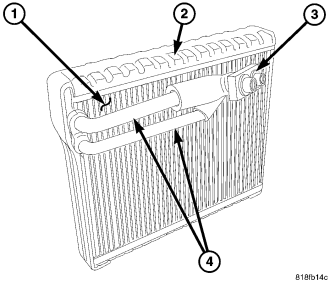
The A/C evaporator (1) is located within the HVAC housing, behind the instrument panel. The A/C evaporator and insulator (2) are positioned in the HVAC housing so that all air entering the housing must pass over the evaporator fins before it is distributed through the heating-A/C system ducts and outlets. However, air passing over the evaporator fins will only be conditioned when the A/C compressor is engaged and circulating refrigerant through the A/C evaporator.
The A/C evaporator tubes (4) are connected and sealed to the A/C expansion valve by use of rubber O-rings and a tapping block (3).
The A/C evaporator can only be serviced by removing and disassembling the HVAC housing.
OPERATION
Refrigerant enters the A/C evaporator from the A/C expansion valve as a low-temperature, low-pressure mixture of liquid and gas. As air flows over the fins of the A/C evaporator, the humidity in the air condenses on the fins, and the heat from the air is absorbed by the refrigerant. Heat absorption causes the refrigerant to boil and vaporize. The refrigerant becomes a low-pressure gas when it leaves the A/C evaporator.
NOTE: Replacement of the refrigerant line O-ring seals and gaskets is required anytime a refrigerant line is opened. Failure to replace the rubber O-ring seals and metal gaskets could result in a refrigerant system leak.
The A/C evaporator has no serviceable parts except for the O-ring seals. The O-ring seals used on the connections are made from a special type of rubber not affected by R-134a refrigerant. The O-ring seals must be replaced whenever an A/C expansion valve is removed from the A/C evaporator.
The A/C evaporator cannot be repaired and must be replaced if found to be leaking or damaged.
REMOVAL
WARNING: Disable the airbag system before attempting any steering wheel, steering column, or instrument panel component diagnosis or service. Disconnect and isolate the negative battery (ground) cable, then wait two minutes for the airbag system capacitor to discharge before performing further diagnosis or service. This is the only sure way to disable the airbag system. Failure to take the proper precautions could result in accidental airbag deployment and possible personal injury or death.
WARNING: Refer to the applicable warnings and cautions for this system before performing the following operation (refer to 24 - HEATING & AIR CONDITIONING/PLUMBING - WARNING) and (refer to 24 - HEATING & AIR CONDITIONING/PLUMBING - CAUTION). Failure to follow the warnings and cautions could result in possible personal injury or death.
NOTE: LHD model with A/C shown in illustrations. RHD and heater-only models similar.
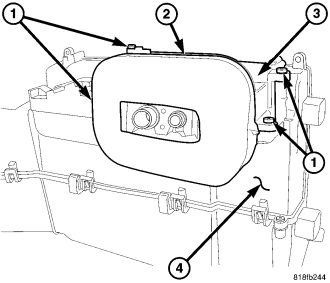
1. Remove the HVAC housing assembly and place it on a workbench (refer to 24 - HEATING & AIR CONDITIONING/DISTRIBUTION /HOUSING-HVAC - HOUSING-HVAC ASSEMBLY - REMOVAL).
2. Remove the air distribution housing from the HVAC housing (refer to 24 - HEATING & AIR CONDITIONING/DISTRIBUTION/HOUSING-HVAC - HOUSING-AIR DISTRIBUTION - REMOVAL).
3. Remove the A/C expansion valve from the A/C evaporator (refer to 24 - HEATING & AIR CONDITIONING/PLUMBING/VALVE-A/C EXPANSION - REMOVAL).
NOTE: If the foam seal for the flange is deformed or damaged, it must be replaced.
4. Remove the foam seal (2) from the flange (3) located on the top of the HVAC housing (4).
5. Remove the four screws (1) that secure the flange to the HVAC housing and remove the flange.
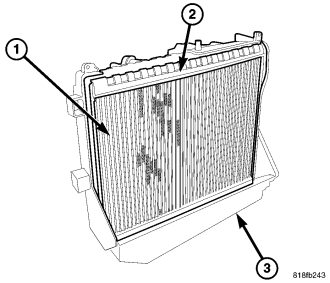
NOTE: If the foam insulator for the evaporator is deformed or damaged, it must be replaced.
6. Carefully remove the A/C evaporator (1) and its insulator (2) from the HVAC housing (3).
INSTALLATION
CAUTION: Be certain to adjust the refrigerant oil level when servicing the A/C refrigerant system (refer to 24 - HEATING & AIR CONDITIONING/PLUMBING/REFRIGERANT OIL - STANDARD PROCEDURE - REFRIGERANT OIL LEVEL). Failure to properly adjust the refrigerant oil level will prevent the A/C system from operating as designed and can cause serious A/C compressor damage.
NOTE: When replacing multiple A/C system components, refer to the Refrigerant Oil Capacities chart to determine how much oil should be added to the refrigerant system (refer to 24 - HEATING & AIR CONDITIONING/PLUMBING/REFRIGERANT OIL - STANDARD PROCEDURE - REFRIGERANT OIL LEVEL).
NOTE: If only the A/C evaporator is being replaced, add 50 milliliters (1.7 fluid ounces) of refrigerant oil to the refrigerant system. Use only refrigerant oil of the type recommended for the A/C compressor in the vehicle.
NOTE: Replacement of the refrigerant line O-ring seals and gaskets is required anytime a refrigerant line is opened. Failure to replace the rubber O-ring seals and metal gaskets could result in a refrigerant system leak.
NOTE: Make sure that the evaporator drain within the HVAC housing is clean and unrestricted and that the insulator is properly positioned.
NOTE: If the foam insulator for the evaporator is deformed or damaged, it must be replaced.
1. Install the A/C evaporator (1) into the HVAC housing (3). Make sure that the evaporator drain within the HVAC housing is clean and unrestricted and that the insulator (2) around the A/C evaporator is properly positioned.
2. Install the flange (3) onto the top of the HVAC housing (4).
3. Install the four screws (1) that secure the flange to the HVAC housing. Tighten the screws to 1.2 N·m (10 in lbs.).
NOTE: If the foam seal for the flange is deformed or damaged, it must be replaced.
4. Install the foam seal (2) onto the flange.
5. Install the A/C expansion valve onto the A/C evaporator (refer to 24 - HEATING & AIR CONDITIONING/PLUMBING/VALVE-A/C EXPANSION - INSTALLATION).
6. Install the air distribution housing onto the HVAC housing (refer to 24 - HEATING & AIR CONDITIONING/DISTRIBUTION/HOUSING-HVAC - HOUSING-AIR DISTRIBUTION - INSTALLATION).
7. Install the HVAC housing assembly (refer to 24 - HEATING & AIR CONDITIONING/DISTRIBUTION/HOUSING-HVAC - HOUSING-HVAC ASSEMBLY - INSTALLATION).
8. If the A/C evaporator is being replaced, add 50 milliliters (1.7 fluid ounces) of refrigerant oil to the refrigerant system. When replacing multiple A/C system components, refer to the Refrigerant Oil Capacities chart to determine how much oil should be added to the refrigerant system (refer to 24 - HEATING & AIR CONDITIONING/PLUMBING/REFRIGERANT OIL - STANDARD PROCEDURE - REFRIGERANT OIL LEVEL). Use only refrigerant oil of the type recommended for the A/C compressor in the vehicle.