U660E AUTOMATIC TRANSMISSION / TRANSAXLE AUTOMATIC TRANSAXLE SYSTEM P2714 Pressure Control Solenoid "D" Performance (Shift Solenoid Valve SLT)
SYSTEM DESCRIPTION
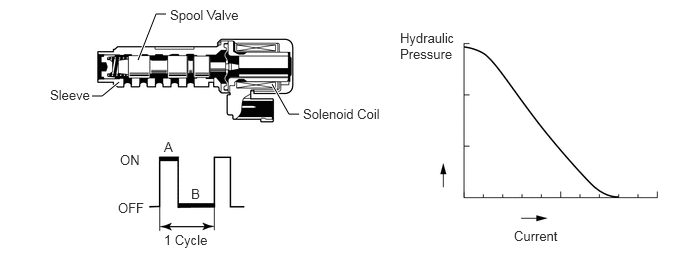
The linear solenoid valve (SLT) controls the transmission line pressure for smooth transmission operation based on signals from the throttle position sensor and the vehicle speed sensor. The TCM adjusts the duty ratio (*) of the SLT solenoid valve to control hydraulic line pressure coming from the primary regulator valve. Appropriate line pressure assures smooth shifting with varying engine outputs.
(*): Duty Ratio
The duty ratio is the ratio of the period of continuity in one cycle. For example, if A is the period of continuity in one cycle, and B is the period of non-continuity, then
Duty Ratio = A/(A + B ) x 100 (%)
| DTC No. | DTC Detection Condition | Trouble Area |
|---|---|---|
| P2714 | The TCM detects a malfunction in the shift solenoid valve SLT (ON side) according to the difference in the speed between the turbine and the output shaft, and also by the transmission fluid pressure. (2-trip detection logic) | ·
Shift solenoid valve SLT remains open ·
Shift solenoid valve SL1, SL2, SL3 or SL4 remains open or closed ·
Valve body (blocked) ·
Automatic transaxle (clutch, brake or gear, etc.) |
MONITOR DESCRIPTION
The TCM calculates the amount of clutch slip based on the turbine speed, output shaft speed, and gear ratio. If the amount of clutch slip exceeds a specified level, the TCM will set this DTC and illuminate the MIL.
When the shift solenoid valve SLT remains on, oil pressure goes down and clutch engagement force decreases.
- NOTICE:
-
If driving continues under these conditions, the clutches will burn out and the vehicle will no longer be drivable.
PROCEDURE
Connect the intelligent tester to the DLC3.
Turn the ignition switch on (IG) and turn the intelligent tester on.
Enter the following items: "Powertrain / ECT / DTC / Current or Pending".
Read the DTCs using the intelligent tester.
- Result:
Display (DTC output) Proceed to Only "P2714" is output A "P2714" and other DTCs are output B
- HINT:
-
If a solenoid is stuck ON, DTCs for several solenoids including the malfunctioning solenoid will be detected.
B
A
- NOTICE:
- ·
Perform the test at the normal operating ATF (Automatic Transmission Fluid) temperature: 50 to 80°C (122 to 176°F)
·Be sure to prevent the SST hose from interfering with the exhaust pipe.
·This check must be conducted after checking and adjusting the engine.
·Perform the test with the A/C OFF.
- HINT:
-
Performing the Active Test using the intelligent tester allows relays, VSVs, actuators and other items to operate without removing any parts. Performing the Active Test as the first step in troubleshooting is one method to save diagnostic time.
-
It is possible to display the Data List during the Active Test.
Turn the ignition switch off.
Lift the vehicle up.
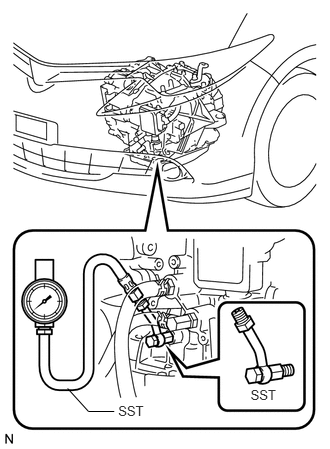
Remove the test plug on the transmission case center right side and connect SST.
- SST
- 09992-00095 (09992-00231, 09992-00271)
Lower the vehicle.
Fully apply the parking brake and chock the 4 wheels.
Connect the intelligent tester to the DLC3.
Start the engine.
Warm up the ATF (Automatic Transmission Fluid).
Measure the line pressure when the engine is idling.
Turn on the tester.
Enter the following items: "Powertrain / ECT / Active Test / Activate the Solenoid (SLT)".
Follow the instructions on the tester and perform the Active Test.
Measure the line pressure with SST.
| Tester Display | Test Part | Control Range |
|---|---|---|
| Activate the Solenoid (SLT)* | [Test Details]
Operate the shift solenoid SLT and raise the line pressure. [Vehicle Condition] ·
Vehicle stopped. ·
IDL: ON
|
[Solenoid (SLT)]
0: OFF / 1: ON |
*: "Activate the Solenoid (SLT)" in the Active Test is performed to check that the line pressure changes by connecting the SST to the automatic transaxle. The same SST is used in the Hydraulic Test (See page Drivetrain>U660E (AUTOMATIC TRANSMISSION / TRANSAXLE)>AUTOMATIC TRANSAXLE SYSTEM>HYDRAULIC TEST) as well.
- HINT:
-
The pressure values in Active Test and HYDRAULIC TEST are different from each other.
- OK:
The line pressure changes as specified when performing the Active Test.
OK
NG
- NOTICE:
-
This test should always be performed by at least 2 people.
- HINT:
-
Performing the Active Test using the intelligent tester allows relays, VSVs, actuators and other items to be operated without removing any parts. Performing the Active Test as the first step in troubleshooting is one method to save diagnostic time.
-
The Data List can be displayed during the Active Test.
Warm up the engine.
Turn the ignition switch off.
Connect the intelligent tester to the DLC3.
Start the engine.
Turn on the tester.
Enter the following items: "Powertrain / ECT / Active Test".
Follow the instructions on the tester and perform the Active Test.
| Item | Test Details | Diagnostic Note |
|---|---|---|
| Control the Shift Position | [Test Details]
Operate the shift solenoid valve and set each shift position by yourself. [Vehicle Condition] ·
IDL: ON [Others] ·
Press "→" button: Shift up ·
Press "←" button: Shift down |
It is possible to check the operation of the shift solenoid valves. |
- NOTICE:
- ·
This test can be conducted when the vehicle is stopped.
·When shifting gears using the Active Test function, do not operate the accelerator pedal for 2 seconds before and after shifting gears.
- HINT:
-
The shift position commanded by the TCM is shown on the "Data List / Shift Status" display on the intelligent tester.
Check the vehicle speed and the gear position when the engine speed is 1,000 rpm.
- HINT:
-
Because the torque converter assembly has not engaged, it may be difficult to obtain the speeds specified in 4th, 5th, and 6th gears, however a difference of speed should still be evident following each gear change.
- Standard:
1st 2nd 3rd 4th 5th 6th 8 to 12 km/h (5 to 7.5 mph) 15 to 19 km/h (9.3 to 11.8 mph) 21 to 25 km/h (13.0 to 15.5 mph) 31 to 35 km/h (19.3 to 21.7 mph) 44 to 48 km/h (27.3 to 29.8 mph) 52 to 56 km/h (32.3 to 34.8 mph)
Compare the TCM gear shift command and the actual gear position.
- Result:
Actuator gear position under malfunction TCM gear shift command Proceed to 1st 2nd 3rd 4th 5th 6th Shift solenoid SL1 Stuck ON 1st 2nd 3rd 4th 4th 4th A Stuck OFF N*1 N*1 N*1 N*1 5th 6th Shift solenoid SL2 Stuck ON 4th 4th 4th 4th 5th 6th B Stuck OFF 1st 2nd 3rd 1st N*1 N*1 Shift solenoid SL3 Stuck ON 2nd 2nd 3rd 4th 5th 6th C Stuck OFF 1st 1st 3rd 4th 5th N*1 Shift solenoid SL4 Stuck ON*3 3rd 3rd 3rd 4th 5th 5th D Stuck OFF 1st 2nd 1st 4th N*1 6th Shift solenoid SLT Stuck ON N*2 N*2 N*2 N*2 N*2 N*2 E Stuck OFF*3 1st 2nd 3rd 4th 5th 6th
- HINT:
- ·
*1: Neutral
·*2: If the shift solenoid SLT is stuck on, the line pressure will be low. Therefore, the amount of torque that can be transmitted by each gear is lower than the normal limit. When the engine power exceeds this lowered limit, the engine speed will increase freely.
·*3: When the shift solenoid SLT is stuck OFF, gear shifting is normal.
E
A
B
C
D
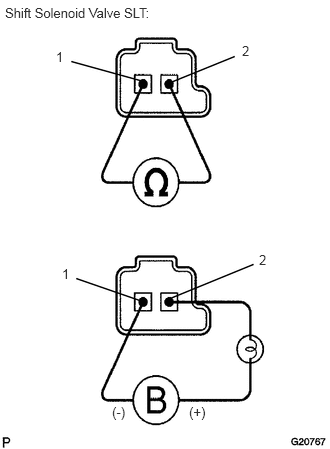
Remove the shift solenoid valve SLT.
Measure the resistance according to the value(s) in the table below.
- Standard resistance:
Tester Connection Specified Condition 1 - 2 5.0 to 5.6 Ω
(at 20°C (68°F))
Connect a positive (+) lead through a 21 W bulb to terminal 2 and a negative (-) lead to terminal 1 of the solenoid valve connector, then check the movement of the valve.
- OK:
The solenoid makes an operating sound.
OK
NG
Check the valve body assembly (See page Drivetrain>U660E (AUTOMATIC TRANSMISSION / TRANSAXLE)>VALVE BODY ASSEMBLY>REMOVAL).
- OK:
There are no foreign objects on each valve.
OK
NG
Check the torque converter assembly (See page Drivetrain>U660E (AUTOMATIC TRANSMISSION / TRANSAXLE)>TORQUE CONVERTER CLUTCH AND DRIVE PLATE>INSPECTION).
- OK:
The torque converter assembly operates normally.
OK
NG