Home › SUSPENSION & AXLE › TIRE AND WHEEL › TIRE PRESSURE WARNING SYSTEM

DTC    C2191/91    Vehicle Speed Signal Error (Test Mode DTC)

for Preparation Click here


DESCRIPTION

The tire pressure warning ECU receives a vehicle speed signal from the combination meter. This DTC is stored upon entering test mode, and cleared when a vehicle speed signal of 20 km/h (12 mph) is detected for 3 seconds or more. This DTC is output only in test mode.

HINT:
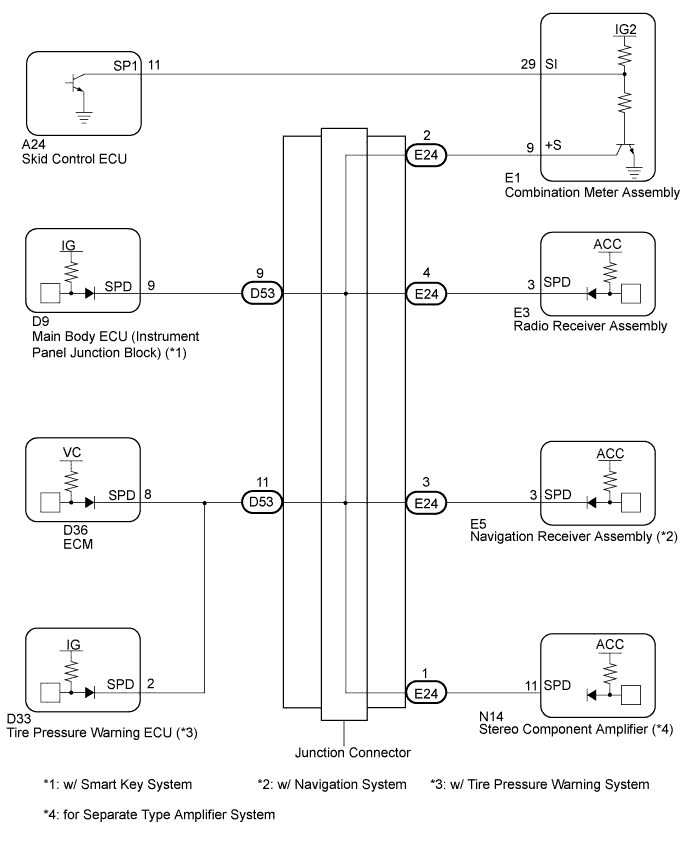
The meter CPU receives vehicle speed signals from this circuit. The vehicle speed sensor detects the voltage that varies according to the vehicle speed. The skid control ECU supplies power to the vehicle speed sensor. The skid control ECU detects vehicle speed signals based on the pulses of the voltage. The skid control ECU transmits vehicle speed signals as pulses to the meter CPU. A voltage of 12 V is output from the combination meter assembly and then input to the skid control ECU. The signal is changed to a pulse signal at the transistor in the combination meter assembly. A voltage of 12 V or 5 V is output from each ECU or relay and then input to the combination meter assembly. Each ECU controls the respective system based on the pulse signal.


DTC No.
DTC Detection Condition
Trouble Area
C2191/91
Vehicle speed signal circuit malfunction
  1. Combination meter
  2. Vehicle speed sensor
  3. Harness or connector
  4. Tire pressure warning ECU

WIRING DIAGRAM


E152375E01


INSPECTION PROCEDURE

NOTICE:
  1. When replacing the tire pressure warning ECU, read the transmitter IDs stored in the old ECU using Techstream and write them down before removal.
  2. It is necessary to perform initialization (Click here) after registration (Click here) of the transmitter IDs into the tire pressure warning ECU if the ECU has been replaced.

1.READ VALUE USING TECHSTREAM (VEHICLE SPEED)
  1. Turn the ignition switch off.

  1. Connect Techstream to the DLC3.

  1. Turn the ignition switch on (IG) and turn the tester on.

  1. Enter the following menus: Chassis / Tire Pressure Monitor / Data List.

  1. Check that the values indicated on the tester and on the combination meter are the same.

    Tire Pressure Monitor 
    Tester Display
    Measurement Item/Range
    Normal Condition
    Diagnostic Note
    Vehicle Speed
    Vehicle speed/
    min.: 0 km/h (0 mph)
    max.: 255 km/h (158 mph)
    Almost same as actual vehicle speed
    Speed indicated on combination meter

    OK:
    Vehicle speed indicated on the tester and on the combination meter are the same.


NG
Go to step 2
OK

USE SIMULATION METHOD TO CHECK (Click here)  

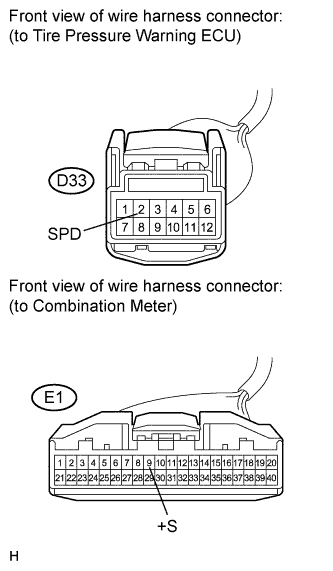
2.CHECK HARNESS AND CONNECTOR (ECU - COMBINATION METER)


    C159184E06
  1. Disconnect the D33 ECU connector.

  1. Disconnect the E1 meter connector.

  1. Measure the resistance according to the value(s) in the table below.

    Standard resistance:
    Tester Connection
    Condition
    Specified Condition
    D33-2 (SPD) - E1-9 (+S)
    Always
    Below 1 Ω
    D33-2 (SPD) - Body ground
    Always
    10 kΩ or higher


NG
REPAIR OR REPLACE HARNESS OR CONNECTOR
OK


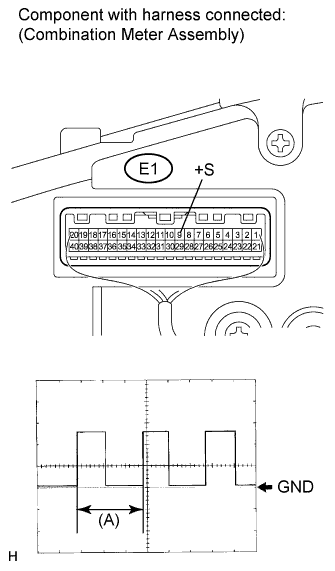
3.INSPECT TIRE PRESSURE WARNING ECU (SPD SIGNAL)


    E152386E01
  1. Remove the combination meter (Click here).

  1. Reconnect D33 and E1 connectors.

  1. Jack up the vehicle.

  1. Shift the lever to the neutral position.

  1. Turn the ignition switch on (IG).

  1. Check the waveform of the ECU connector using an oscilloscope while turning the wheel slowly.

    Result:
    Tester Connection
    Switch Condition
    Specified Condition
    E1-9 (+S) - Body ground
    Ignition switch on (IG)
    Correct waveform appears as shown
    Tool Setting 
    Item
    Contents
    Tool Setting
    5 V/DIV., 20 ms/DIV.
    Vehicle Condition
    Driving wheel rotating slowly

    OK:
    The waveform is displayed as shown in the illustration.

    HINT:
    When the system is functioning normally, one wheel revolution generates 4 pulses. As the vehicle speed increases, the width indicated by (A) in the illustration narrows.


NG
GO TO METER / GAUGE SYSTEM (Click here)
OK

REPLACE TIRE PRESSURE WARNING ECU (Click here)