C1745/45 Exhaust Solenoid
Diagnostic trouble codes · Vehicles built Aug 2013 – Jul 2014
Versions by build date: Aug 2013 – Jul 2014 from Aug 2014
DESCRIPTION
The suspension control ECU operates the exhaust solenoid valve (height control compressor), releases the air from the height control cylinder assembly (pneumatic cylinder) and lowers the vehicle height.When the vehicle height is lowered, the suspension control ECU opens the height control valve and then operates the exhaust solenoid valve to release compressed air to the outside.
The exhaust solenoid valve is on the compressor unit and has only one valve.
| DTC Code |
DTC Detection Condition |
Trouble Area |
| C1745/45 |
Either condition is met:
|
|
- HINT:
- Once the suspension control ECU stores DTC C1745/45 in memory, vehicle height control is suspended until a normal signal is input to the suspension control ECU from the exhaust solenoid valve. However, control is resumed if the ignition switch is turned off and then to ON again.
- Malfunction in the exhaust solenoid valve:
Height control indicator N comes on or blinks and HI and LO do not come on by operating the height control switch "up" or "down".
- Once the suspension control ECU stores DTC C1745/45 in memory, vehicle height control is suspended until a normal signal is input to the suspension control ECU from the exhaust solenoid valve. However, control is resumed if the ignition switch is turned off and then to ON again.
WIRING DIAGRAM
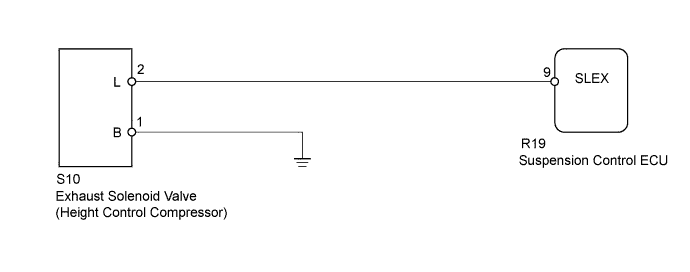

INSPECTION PROCEDURE
- NOTICE:
- When replacing the suspension control ECU, perform registration (Click here).
- HINT:
- If DTC C1782/82 is output at the same time as C1745/45, perform the inspection necessary for DTC C1782/82 first (Click here).
| 1. PERFORM ACTIVE TEST USING INTELLIGENT TESTER (EXHAUST SOLENOID) |

Turn the ignition switch off.
Connect the intelligent tester to the DLC3.
Turn the ignition switch to ON.
Turn the intelligent tester on.
Enter the following menus: Chassis / Air suspension / Active Test.
Air Suspension Tester Display
Test Part
Control Range
Diagnostic Note
Exhaust Solenoid
Exhaust solenoid valve
ON or OFF
- The operating sound of the solenoid (clicking sound) can be heard.
- When the Active Test is performed, Exhaust Solenoid in the Data List changes between ON and OFF accordingly.
- OK:
- Operation of solenoid (clicking sound) can be heard.
Result Result
Proceed to
NG
A
OK (When troubleshooting according to problem symptoms table)
B
OK (When troubleshooting according to DTC chart)
C
- The operating sound of the solenoid (clicking sound) can be heard.
|
|
||||
|
|
||||

| A | |
 |
| 2. CHECK HARNESS AND CONNECTOR (EXHAUST SOLENOID VALVE - SUSPENSION CONTROL ECU) |
Disconnect the S10 exhaust solenoid valve connector.
Disconnect the R19 suspension control ECU connector.
Measure the resistance according to the value(s) in the table below.
- Standard Resistance:
Tester Connection
Condition
Specified Condition
S10-2 (L) - R19-9 (SLEX)
Always
Below 1 Ω
S10-2 (L) - Body ground
Always
10 kΩ or higher
S10-1 (B) - Body ground
Always
Below 1 Ω
|
|
||||
| OK | |
|
| 3. INSPECT HEIGHT CONTROL COMPRESSOR (EXHAUST SOLENOID VALVE) |
Turn the ignition switch off.
Remove the height control compressor (Click here).
Measure the resistance according to the value(s) in the table below.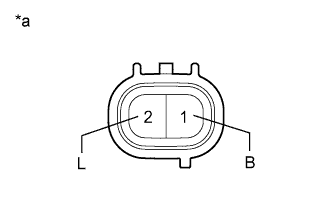
- Standard Resistance:
Tester Connection
Condition
Specified Condition
2 (L) - 1 (B)
20°C (68°F)
10 to 14 Ω
Text in Illustration *a
Component without harness connected
(Exhaust Valve)
Connect the positive (+) lead of the battery to terminal 2 (L) and the negative (-) lead to terminal 1 (B) of the solenoid valve connector. Then check that the valve makes an operating sound.
- OK:
- Operation of solenoid (clicking sound) can be heard.
|
|
||||
| OK | ||
 |
||
| ||