F33A-FTV INTAKE / EXHAUST TURBOCHARGER ON-VEHICLE INSPECTION
CAUTION / NOTICE / HINT
- HINT:
-
Perform "Inspection After Repair" after replacing the turbocharger sub-assembly or No. 2 turbocharger sub-assembly.
-
·
PROCEDURE

 1.INSPECT TURBOCHARGER SUB-ASSEMBLY
- NOTICE:
-
Perform this procedure in a safe location with another person.
Start the engine and warm it up.
Fully accelerate the vehicle with the shift lever in 3rd and measure the boost pressure when the engine speed is 3000 rpm (approximately 64 km/h (40 mph)).
- Powertrain > Engine > Data List
-
Tester Display Intake Manifold Absolute Pressure Target Boost Pressure - 50003 372 385,268
- Standard Pressure:
-
25 kPa (0.3 kgf/cm2, 4 psi) or higher
If the result is not as specified, check the waste gate valve actuator with bracket assembly and turbocharger sub-assembly.
2.INSPECT EXHAUST GAS CONTROL VALVE
When a vacuum pump is connected and a vacuum is applied, check that the valve operates at 18 kPa (137 mmHg, 5.37 in.Hg).
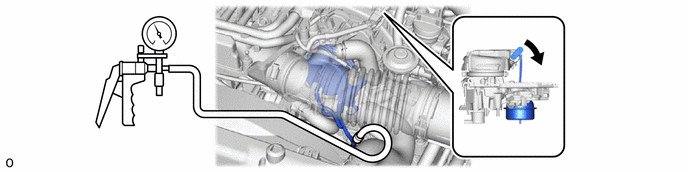
When the above condition is maintained, check that the needle does not move and the vacuum is maintained.
If the result is not as specified, check the turbocharger actuator assembly.
Click hereEngine / Hybrid System>F33A-FTV (INTAKE / EXHAUST)>TURBOCHARGER>INSPECTION
3.VISUALLY INSPECT HOSES, CONNECTIONS AND GASKETS
Check that there is no damage and cracks on the hoses and gaskets, and that there are no air or oil leaks from connections.
- HINT:
-
Cracked hoses and gaskets or loose connections may cause the engine to run improperly or stall.
4.CHECK TURBOCHARGER COMPENSATION CODE
- NOTICE:
-
·
When the turbocharger sub-assembly, engine or ECM (no old data) is replaced, use this procedure and the GTS to manually input the compensation code and register it in the ECM.
·A VN turbo fully closed calibration value is individually set as the compensation code for the turbocharger sub-assembly. Therefore, perform VN turbo offset voltage value calibration as follows when performing replacement.
When the turbocharger sub-assembly is replaced, use this procedure and the GTS to manually input the ID code and register it in the ECM.
Read the turbocharger compensation code.