Home › ENGINE › 1NZ-FXE ENGINE MECHANICAL › ENGINE

ENGINE > ON-VEHICLE INSPECTION

for Preparation Click here


1. INSPECT AIR CLEANER FILTER ELEMENT
  1. Remove the air filter.

  1. Visually check that the air filter is not excessively damaged or oily.
    If necessary, replace the air filter.


2. INSPECT IGNITION TIMING
  1. Set the vehicle to inspection mode (Click here).

  1. Warm up the engine.

  1. Connect the Techstream to the DLC3.

  1. Turn the power switch on (IG).

  1. Enter the following menus:
    Power Train / Engine and ECT / Data List / IGN Advance

    Standard ignition timing:
    8 to 12° @ BTDC

    NOTICE:
    1. Turn all the electrical systems OFF.
    2. Inspect the engine idle speed with the cooling fan OFF.

    HINT:
    Refer to the Techstream operator's manual if you need help selecting the DATA LIST.

  1. Check that the ignition timing advances immediately when the engine speed is increased.


3. INSPECT ENGINE IDLE SPEED
  1. Set the vehicle to inspection mode (Click here).

  1. Warm up the engine.

  1. Connect the Techstream to the DLC3.

  1. Turn the power switch on (IG).

  1. Enter the following menus:
    Power Train / Engine and ECT / Data List / Engine Speed

    Standard idle speed:
    950 to 1,050 rpm (P range)

    NOTICE:
    1. Turn all the electrical systems OFF.
    2. Inspect the engine idle speed with the cooling fan OFF.

    HINT:
    Refer to the Techstream operator's manual if you need help selecting the DATA LIST.


4. INSPECT COMPRESSION
  1. Remove the windshield wiper link (Click here).

  1. Remove the front cowl top panel outer.

  1. Set the vehicle to inspection mode (Click here).

  1. Warm up the engine.

  1. Remove the air cleaner assembly.

  1. Disconnect all the fuel injector connectors.

  1. Disconnect the 4 ignition coil connectors and remove the 4 bolts. Then remove the 4 ignition coils.

    NOTICE:
    If inspecting the compression with the ignition coil connector disconnected, a DTC will be detected. After the inspection, check the DTC.

  1. Remove all the spark plugs.


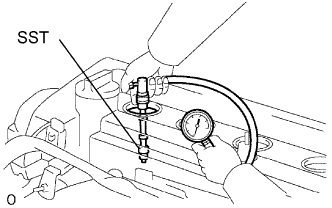
    A057119E02
  1. Connect SST (attachment) to a compression gauge.

    SST
    09992-00500  

  1. Install the compression gauge with SST into the spark plug hole.

  1. Connect the Techstream to the DLC3.

  1. Turn the power switch on (IG).

  1. Enter the following menus:
    DIAGNOSIS / OBD/MOBD / HV ECU / ACTIVE TEST / COMPRESS TEST

  1. Turn the power switch ON (IG) while depressing the brake pedal. Then, measure the compression pressure of each cylinder.

    Standard compression pressure:
    882 kPa (9.0 kgf/cm2, 128 psi)

    Minimum pressure:
    686 kPa (7.0 kgf/cm2, 99 psi)

    Difference between each cylinder:
    98 kPa (1.0 kgf/cm2, 14 psi) or less

    NOTICE:
    1. Measure the compression pressure as quickly as possible.
    2. After performing all the procedures, be sure to clear DTCs stored in the memory. Then check that the normal code is output.

    If the compression pressure is low, pour a light coat of engine oil into the cylinder block, and then measure the compression pressure again.

    HINT:
    1. If the compression increases after pouring engine oil, the piston ring may be damaged.
    2. If the compression does not change after pouring engine oil, defects may be occurring around the valve.

  1. Install all the spark plugs.

    Torque:
    18 N*m{ 184 kgf*cm , 13 ft.*lbf }

  1. Install the 4 ignition coil connectors.

    Torque:
    9.0 N*m{ 92 kgf*cm , 80 in.*lbf }

  1. Connect the 4 ignition coil connectors.

  1. Connect all the fuel injector connectors.

  1. Install the air cleaner assembly.

  1. Install the front cowl top panel outer.

  1. Install the windshield wiper link (Click here).


5. INSPECT CO/HC
  1. Set the vehicle to inspection mode (Click here).

  1. Run the engine at 2,500 rpm for approximately 180 seconds.

  1. Insert a CO/HC meter testing probe at least 40 cm (1.3 ft.) into the btailpipe during idling.

  1. Immediately check the CO/HC concentration at idle and 2,500 rpm.

    HINT:
    When performing the 2 mode (2,500 rpm and idle) test, check that the CO/HC concentration complies with local regulations.

  1. If the CO/HC concentration does not comply with regulations, troubleshoot in the order given below.

    1. Check the heated oxygen sensor operation (Click here).

    2. See the table below for possible causes, and then inspect the applicable causes and repair it if necessary.

      CO
      HC
      Problems
      Causes
      Normal
      High
      Rough idle
      1. Faulty ignition:
        1. Incorrect timing
        2. Plugs are contaminated, plugs are shorted or plug gaps are incorrect
      2. Incorrect valve clearance
      3. Leaks in intake and exhaust valves
      4. Leaks in cylinders
      Low
      High
      Rough idle
      (Fluctuating HC reading)
      1. Vacuum leaks:
        1. Ventilation hoses
        2. Intake manifold
        3. Throttle body
        4. IAC valve
        5. Brake booster line
      2. Lean mixture causing misfire
      High
      High
      Rough idle
      (Black smoke from exhaust)
      1. Restricted air filter
      2. Plugged ventilation valve
      3. Faulty SFI system:
        1. Faulty pressure regulator
        2. Defective ECT sensor
        3. Defective mass air flow meter
        4. Faulty ECM
        5. Faulty injectors
        6. Faulty throttle position sensor