SUSPENSION CONTROL AIR SUSPENSION SYSTEM C1745 Exhaust Solenoid Valve Circuit Malfunction
DESCRIPTION
The suspension control ECU operates the exhaust solenoid valve (height control compressor), releases the air from the height control cylinder assembly (pneumatic cylinder), and lowers vehicle height.
When the vehicle height is lowered, the suspension control ECU opens the height control valve and then operates the exhaust solenoid valve to release the compressed air to the outside.
The exhaust solenoid valve is on the compressor unit and has only one valve.
| DTC Code | Detection Condition | Trouble Area |
|---|---|---|
| C1745 | When either of the following is detected:
·
With the exhaust valve not activated, an open signal of the exhaust valve is detected for 1 second or more. ·
With the exhaust valve activated, a short signal of the exhaust valve is detected 8 times successively. |
·
Wire harness or connector ·
Exhaust solenoid valve (No. 1 height control compressor) ·
Suspension control ECU |
- HINT:
- ·
Once the ECU stores DTC C1745 in the memory, the vehicle height control is suspended until a normal signal is input to the ECU from the exhaust solenoid valve. However, control is resumed if the ignition switch is turned off, then to ON again.
·Malfunction in the exhaust solenoid valve:
The height control indicator light "N" comes on or blinks, and "HI" and "LO" do not come on by operating the height control switch "UP" or "DOWN".
WIRING DIAGRAM
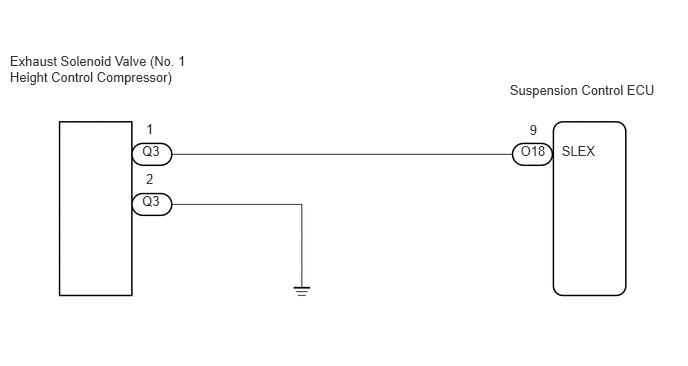
CAUTION / NOTICE / HINT
- NOTICE:
-
After replacing the suspension control ECU, perform registration (See page Suspension>SUSPENSION CONTROL>AIR SUSPENSION SYSTEM>REGISTRATION).
- HINT:
- ·
If DTC C1781 (ECU malfunction) and/or C1782 (power source circuit) is displayed, perform the inspection necessary for DTC C1781 (See page Suspension>SUSPENSION CONTROL>AIR SUSPENSION SYSTEM>C1781) and/or C1782 (See page Suspension>SUSPENSION CONTROL>AIR SUSPENSION SYSTEM>C1782) first.
·If DTC C1781 and the C1782 are output at the same time, perform the inspection necessary for DTC C1782 first.
PROCEDURE
Connect the Techstream to the DLC3.
Turn the ignition switch to ON, and turn the Techstream main switch on.
Enter the following menus: Chassis / Air suspension / Active Test.
| Tester Display | Test Part | Control Range | Diagnostic Note |
|---|---|---|---|
| Exhaust Solenoid | Exhaust solenoid valve | ON or OFF | Operation sound of solenoid (clicking sound) can be heard |
- OK:
Operation of solenoid (clicking sound) can be heard
| Result | Proceed to |
|---|---|
| NG | A |
| OK (When troubleshooting according to the Problem Symptoms Table) | B |
| OK (When troubleshooting according to the DTC Chart) | C |
A
B
C
(See pageGeneral>INTRODUCTION>HOW TO TROUBLESHOOT ECU CONTROLLED SYSTEMS>HOW TO PROCEED WITH TROUBLESHOOTING)
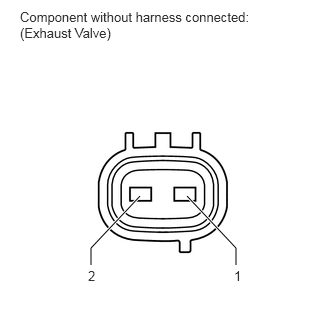
Turn the ignition switch off.
Disconnect Q3 solenoid valve connector.
Measure the resistance according to the value(s) in the table below.
- Standard Resistance:
Tester Connection Condition Specified Condition 1 - 2 20°C (68°F) 10 to 14 Ω
Connect the battery positive (+) lead to terminal 1 and the negative (-) lead to terminal 2 of the solenoid valve connector. Then check that the valve makes an operating sound.
- OK:
Operation of solenoid (clicking sound) can be heard
OK
NG
Disconnect the O18 ECU connector.
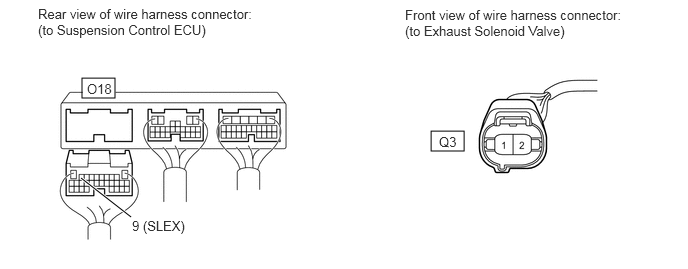
Measure the resistance according to the value(s) in the table below.
- Standard Resistance:
Tester Connection Condition Specified Condition Q3-1 - O18-9 (SLEX) Always Below 1 Ω Q3-1 or O18-9 (SLEX) - Body ground Always 10 kΩ or higher Q3-2 - Body ground Always Below 1 Ω
OK
NG