HYBRID / BATTERY CONTROL HYBRID BATTERY SYSTEM "HAVE TRACTION BATTERY INSPECTED" is displayed
DESCRIPTION
The battery ECU assembly monitors the SOC (state of charge) of the HV battery. When it finds the HV battery has deteriorated excessively, it will display "Have Traction Battery Inspected" on the multi-information display. If "Have Traction Battery Inspected" is displayed, perform "Battery Diagnosis" and replace the HV battery as necessary.
CAUTION / NOTICE / HINT
- CAUTION:
- ·
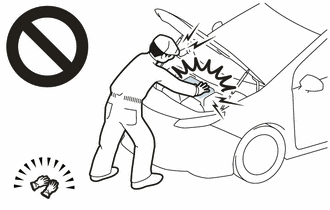
Before the following operations are conducted, take precautions to prevent electric shock by turning the ignition switch off, wearing insulated gloves, and removing the service plug grip from HV battery.
-Inspecting the high-voltage system
-Disconnecting the low voltage connector of the inverter with converter assembly
-Disconnecting the low voltage connector of the HV battery
·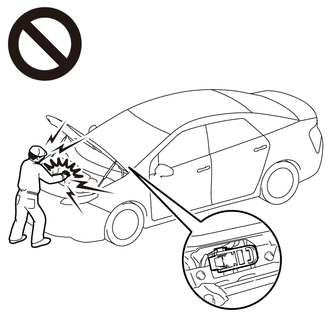
To prevent electric shock, make sure to remove the service plug grip to cut off the high voltage circuit before servicing the vehicle.
·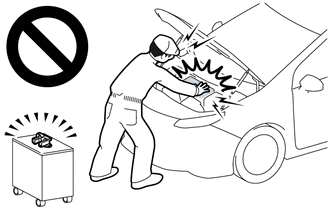
After removing the service plug grip from the HV battery, put it in your pocket to prevent other technicians from accidentally reconnecting it while you are working on the high-voltage system.
·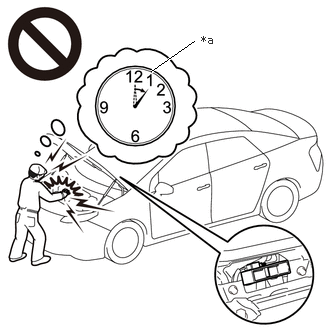 1.573,0.74 2.021,0.427 true 2.094,0.344 2.354,0.51 0.26,0.167 10 false *a
*a Without waiting for 10 minutes
After removing the service plug grip, wait for at least 10 minutes before touching any of the high-voltage connectors or terminals. After waiting for 10 minutes, check the voltage at the terminals in the inspection point in the inverter with converter assembly. The voltage should be 0 V before beginning work.
Click hereEngine / Hybrid System>HYBRID / BATTERY CONTROL>HYBRID BATTERY SYSTEM>PRECAUTION
- HINT:
-
Waiting for at least 10 minutes is required to discharge the high-voltage capacitor inside the inverter with converter assembly.
·Make sure to insulate the high-voltage connectors and terminals of the HV battery with insulating tape after removing it.
If the HV battery stored without insulating the connectors and terminals, electric shock or fire may result.
·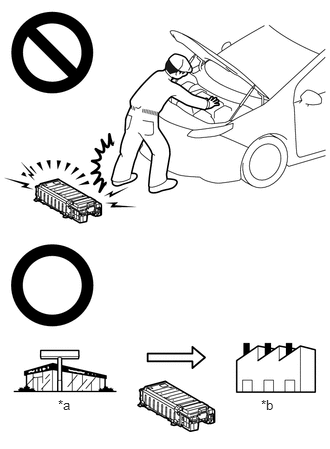 0.604,4.135 0.917,4.333 0.313,0.198 10 false *a 2.719,4.135 3.031,4.333 0.313,0.198 10 false *b
*a Dealer *b Battery Collection Agent
When disposing of an HV battery, make sure to return it through an authorized collection agent who is capable of handling it safely. If the HV battery is returned via the manufacturer specified route, it will be returned properly and in a safe manner by an authorized collection agent.
-Accidents such as electric shock may result if the HV battery is disposed of improperly or abandoned. Therefore, make sure to return all HV batteries through an authorized collection agent.
·Before returning the HV battery, make sure to perform a recovery inspection.
Click hereEngine / Hybrid System>HYBRID / BATTERY CONTROL>HV BATTERY>RECOVERY INSPECTION
·Before returning the HV supply stack sub-assembly, make sure to perform a recovery inspection.
Click hereEngine / Hybrid System>HYBRID / BATTERY CONTROL>HV BATTERY STACK>RECOVERY INSPECTION
·Make a note of the output DTCs as some of them may be necessary for recovery inspection of the HV battery and HV supply stack sub-assemblies.
·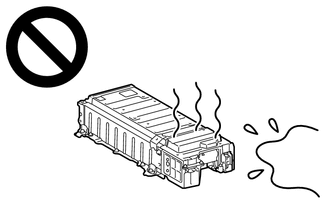
After removing the HV battery, keep it away from water. Exposure to water may cause the HV battery to produce heat, resulting in a fire.
- NOTICE:
- ·
If "Have Traction Battery Inspected" is displayed on the multi-information display, the message will not be cleared until one of the following conditions is met. If the traction battery is used continually without performing battery diagnosis for a few weeks*, "VEHICLE START WILL SOON BE DISABLED" and "Have Traction Battery Inspected" are displayed and the use of the HV battery is limited. If it is used more, the power on (READY) operation will be disabled.
*: The timing may vary depending on vehicle usage.
·"Have Traction Battery Inspected" is cleared when both of the following conditions are met:
(a)"Prediagnostic Battery Charge" and "Battery Diagnosis" have been performed.
(b)"003" (There is no need to replace HV battery) is displayed on the GTS.
·After the ignition switch is turned off, there may be a waiting time before disconnecting the auxiliary negative (-) battery terminal.
Click hereGeneral>SETUP>WHEN DISCONNECTING OR RECONNECTING BATTERY TERMINAL>BEFORE DISCONNECTING BATTERY
·When disconnecting and reconnecting the auxiliary battery
Click hereGeneral>SETUP>WHEN DISCONNECTING OR RECONNECTING BATTERY TERMINAL>WORK PROCEDURE
- HINT:
-
When disconnecting and reconnecting the auxiliary battery, there is an automatic learning function that completes learning when the respective system is used.
-
Click hereGeneral>SETUP>WHEN DISCONNECTING OR RECONNECTING BATTERY TERMINAL>AUTOMATIC LEARNING CHART
PROCEDURE
Enter the following menus: Powertrain / HV Battery / Data List / Hybrid/EV Battery Cell 1 to 48 Internal Resistance.
- Powertrain > HV Battery > Data List
-
Tester Display Measurement Item Range Normal Condition Hybrid/EV Battery Cell 1 Internal Resistance Internal resistance of each battery cell Min.: 0.000 ohm, Max.: 0.025 ohm Always: 0.006 Ω or less Hybrid/EV Battery Cell 2 Internal Resistance Internal resistance of each battery cell Min.: 0.000 ohm, Max.: 0.025 ohm Always: 0.006 Ω or less Hybrid/EV Battery Cell 3 Internal Resistance Internal resistance of each battery cell Min.: 0.000 ohm, Max.: 0.025 ohm Always: 0.006 Ω or less Hybrid/EV Battery Cell 4 Internal Resistance Internal resistance of each battery cell Min.: 0.000 ohm, Max.: 0.025 ohm Always: 0.006 Ω or less Hybrid/EV Battery Cell 5 Internal Resistance Internal resistance of each battery cell Min.: 0.000 ohm, Max.: 0.025 ohm Always: 0.006 Ω or less Hybrid/EV Battery Cell 6 Internal Resistance Internal resistance of each battery cell Min.: 0.000 ohm, Max.: 0.025 ohm Always: 0.006 Ω or less Hybrid/EV Battery Cell 7 Internal Resistance Internal resistance of each battery cell Min.: 0.000 ohm, Max.: 0.025 ohm Always: 0.006 Ω or less Hybrid/EV Battery Cell 8 Internal Resistance Internal resistance of each battery cell Min.: 0.000 ohm, Max.: 0.025 ohm Always: 0.006 Ω or less Hybrid/EV Battery Cell 9 Internal Resistance Internal resistance of each battery cell Min.: 0.000 ohm, Max.: 0.025 ohm Always: 0.006 Ω or less Hybrid/EV Battery Cell 10 Internal Resistance Internal resistance of each battery cell Min.: 0.000 ohm, Max.: 0.025 ohm Always: 0.006 Ω or less Hybrid/EV Battery Cell 11 Internal Resistance Internal resistance of each battery cell Min.: 0.000 ohm, Max.: 0.025 ohm Always: 0.006 Ω or less Hybrid/EV Battery Cell 12 Internal Resistance Internal resistance of each battery cell Min.: 0.000 ohm, Max.: 0.025 ohm Always: 0.006 Ω or less Hybrid/EV Battery Cell 13 Internal Resistance Internal resistance of each battery cell Min.: 0.000 ohm, Max.: 0.025 ohm Always: 0.006 Ω or less Hybrid/EV Battery Cell 14 Internal Resistance Internal resistance of each battery cell Min.: 0.000 ohm, Max.: 0.025 ohm Always: 0.006 Ω or less Hybrid/EV Battery Cell 15 Internal Resistance Internal resistance of each battery cell Min.: 0.000 ohm, Max.: 0.025 ohm Always: 0.006 Ω or less Hybrid/EV Battery Cell 16 Internal Resistance Internal resistance of each battery cell Min.: 0.000 ohm, Max.: 0.025 ohm Always: 0.006 Ω or less Hybrid/EV Battery Cell 17 Internal Resistance Internal resistance of each battery cell Min.: 0.000 ohm, Max.: 0.025 ohm Always: 0.006 Ω or less Hybrid/EV Battery Cell 18 Internal Resistance Internal resistance of each battery cell Min.: 0.000 ohm, Max.: 0.025 ohm Always: 0.006 Ω or less Hybrid/EV Battery Cell 19 Internal Resistance Internal resistance of each battery cell Min.: 0.000 ohm, Max.: 0.025 ohm Always: 0.006 Ω or less Hybrid/EV Battery Cell 20 Internal Resistance Internal resistance of each battery cell Min.: 0.000 ohm, Max.: 0.025 ohm Always: 0.006 Ω or less Hybrid/EV Battery Cell 21 Internal Resistance Internal resistance of each battery cell Min.: 0.000 ohm, Max.: 0.025 ohm Always: 0.006 Ω or less Hybrid/EV Battery Cell 22 Internal Resistance Internal resistance of each battery cell Min.: 0.000 ohm, Max.: 0.025 ohm Always: 0.006 Ω or less Hybrid/EV Battery Cell 23 Internal Resistance Internal resistance of each battery cell Min.: 0.000 ohm, Max.: 0.025 ohm Always: 0.006 Ω or less Hybrid/EV Battery Cell 24 Internal Resistance Internal resistance of each battery cell Min.: 0.000 ohm, Max.: 0.025 ohm Always: 0.006 Ω or less Hybrid/EV Battery Cell 25 Internal Resistance Internal resistance of each battery cell Min.: 0.000 ohm, Max.: 0.025 ohm Always: 0.006 Ω or less Hybrid/EV Battery Cell 26 Internal Resistance Internal resistance of each battery cell Min.: 0.000 ohm, Max.: 0.025 ohm Always: 0.006 Ω or less Hybrid/EV Battery Cell 27 Internal Resistance Internal resistance of each battery cell Min.: 0.000 ohm, Max.: 0.025 ohm Always: 0.006 Ω or less Hybrid/EV Battery Cell 28 Internal Resistance Internal resistance of each battery cell Min.: 0.000 ohm, Max.: 0.025 ohm Always: 0.006 Ω or less Hybrid/EV Battery Cell 29 Internal Resistance Internal resistance of each battery cell Min.: 0.000 ohm, Max.: 0.025 ohm Always: 0.006 Ω or less Hybrid/EV Battery Cell 30 Internal Resistance Internal resistance of each battery cell Min.: 0.000 ohm, Max.: 0.025 ohm Always: 0.006 Ω or less Hybrid/EV Battery Cell 31 Internal Resistance Internal resistance of each battery cell Min.: 0.000 ohm, Max.: 0.025 ohm Always: 0.006 Ω or less Hybrid/EV Battery Cell 32 Internal Resistance Internal resistance of each battery cell Min.: 0.000 ohm, Max.: 0.025 ohm Always: 0.006 Ω or less Hybrid/EV Battery Cell 33 Internal Resistance Internal resistance of each battery cell Min.: 0.000 ohm, Max.: 0.025 ohm Always: 0.006 Ω or less Hybrid/EV Battery Cell 34 Internal Resistance Internal resistance of each battery cell Min.: 0.000 ohm, Max.: 0.025 ohm Always: 0.006 Ω or less Hybrid/EV Battery Cell 35 Internal Resistance Internal resistance of each battery cell Min.: 0.000 ohm, Max.: 0.025 ohm Always: 0.006 Ω or less Hybrid/EV Battery Cell 36 Internal Resistance Internal resistance of each battery cell Min.: 0.000 ohm, Max.: 0.025 ohm Always: 0.006 Ω or less Hybrid/EV Battery Cell 37 Internal Resistance Internal resistance of each battery cell Min.: 0.000 ohm, Max.: 0.025 ohm Always: 0.006 Ω or less Hybrid/EV Battery Cell 38 Internal Resistance Internal resistance of each battery cell Min.: 0.000 ohm, Max.: 0.025 ohm Always: 0.006 Ω or less Hybrid/EV Battery Cell 39 Internal Resistance Internal resistance of each battery cell Min.: 0.000 ohm, Max.: 0.025 ohm Always: 0.006 Ω or less Hybrid/EV Battery Cell 40 Internal Resistance Internal resistance of each battery cell Min.: 0.000 ohm, Max.: 0.025 ohm Always: 0.006 Ω or less Hybrid/EV Battery Cell 41 Internal Resistance Internal resistance of each battery cell Min.: 0.000 ohm, Max.: 0.025 ohm Always: 0.006 Ω or less Hybrid/EV Battery Cell 42 Internal Resistance Internal resistance of each battery cell Min.: 0.000 ohm, Max.: 0.025 ohm Always: 0.006 Ω or less Hybrid/EV Battery Cell 43 Internal Resistance Internal resistance of each battery cell Min.: 0.000 ohm, Max.: 0.025 ohm Always: 0.006 Ω or less Hybrid/EV Battery Cell 44 Internal Resistance Internal resistance of each battery cell Min.: 0.000 ohm, Max.: 0.025 ohm Always: 0.006 Ω or less Hybrid/EV Battery Cell 45 Internal Resistance Internal resistance of each battery cell Min.: 0.000 ohm, Max.: 0.025 ohm Always: 0.006 Ω or less Hybrid/EV Battery Cell 46 Internal Resistance Internal resistance of each battery cell Min.: 0.000 ohm, Max.: 0.025 ohm Always: 0.006 Ω or less Hybrid/EV Battery Cell 47 Internal Resistance Internal resistance of each battery cell Min.: 0.000 ohm, Max.: 0.025 ohm Always: 0.006 Ω or less Hybrid/EV Battery Cell 48 Internal Resistance Internal resistance of each battery cell Min.: 0.000 ohm, Max.: 0.025 ohm Always: 0.006 Ω or less
- Powertrain > HV Battery > Data List
-
Tester Display Hybrid/EV Battery Cell 1 Internal Resistance Hybrid/EV Battery Cell 2 Internal Resistance Hybrid/EV Battery Cell 3 Internal Resistance Hybrid/EV Battery Cell 4 Internal Resistance Hybrid/EV Battery Cell 5 Internal Resistance Hybrid/EV Battery Cell 6 Internal Resistance Hybrid/EV Battery Cell 7 Internal Resistance Hybrid/EV Battery Cell 8 Internal Resistance Hybrid/EV Battery Cell 9 Internal Resistance Hybrid/EV Battery Cell 10 Internal Resistance Hybrid/EV Battery Cell 11 Internal Resistance Hybrid/EV Battery Cell 12 Internal Resistance Hybrid/EV Battery Cell 13 Internal Resistance Hybrid/EV Battery Cell 14 Internal Resistance Hybrid/EV Battery Cell 15 Internal Resistance Hybrid/EV Battery Cell 16 Internal Resistance Hybrid/EV Battery Cell 17 Internal Resistance Hybrid/EV Battery Cell 18 Internal Resistance Hybrid/EV Battery Cell 19 Internal Resistance Hybrid/EV Battery Cell 20 Internal Resistance Hybrid/EV Battery Cell 21 Internal Resistance Hybrid/EV Battery Cell 22 Internal Resistance Hybrid/EV Battery Cell 23 Internal Resistance Hybrid/EV Battery Cell 24 Internal Resistance Hybrid/EV Battery Cell 25 Internal Resistance Hybrid/EV Battery Cell 26 Internal Resistance Hybrid/EV Battery Cell 27 Internal Resistance Hybrid/EV Battery Cell 28 Internal Resistance Hybrid/EV Battery Cell 29 Internal Resistance Hybrid/EV Battery Cell 30 Internal Resistance Hybrid/EV Battery Cell 31 Internal Resistance Hybrid/EV Battery Cell 32 Internal Resistance Hybrid/EV Battery Cell 33 Internal Resistance Hybrid/EV Battery Cell 34 Internal Resistance Hybrid/EV Battery Cell 35 Internal Resistance Hybrid/EV Battery Cell 36 Internal Resistance Hybrid/EV Battery Cell 37 Internal Resistance Hybrid/EV Battery Cell 38 Internal Resistance Hybrid/EV Battery Cell 39 Internal Resistance Hybrid/EV Battery Cell 40 Internal Resistance Hybrid/EV Battery Cell 41 Internal Resistance Hybrid/EV Battery Cell 42 Internal Resistance Hybrid/EV Battery Cell 43 Internal Resistance Hybrid/EV Battery Cell 44 Internal Resistance Hybrid/EV Battery Cell 45 Internal Resistance Hybrid/EV Battery Cell 46 Internal Resistance Hybrid/EV Battery Cell 47 Internal Resistance Hybrid/EV Battery Cell 48 Internal Resistance - 50003 398 429,430,431,432,433,434,435,436,437,438,439,440,441,442,443,444,445,446,447,448,449,450,451,452,453,454,455,456,457,458,459,460,461,462,463,464,465,466,467,468,469,470,471,472,473,474,475,476
- Result:
Result Proceed to "Hybrid/EV Battery Cell 1 to 24 Internal Resistance" is out of the specified range. A "Hybrid/EV Battery Cell 25 to 48 Internal Resistance" is out of the specified range. B All values are not within the specified range. C
Turn the ignition switch off.
A
B
C
Confirm with the owner whether or not to perform "Prediagnostic Battery Charge" and "Battery Diagnosis".
- HINT:
- ·
It takes about 2 hours to perform "Prediagnostic Battery Charge" and "Battery Diagnosis".
·Depending on the vehicle usage, it is possible to reuse the HV battery. However, if it is judged not possible to be reused, replace the HV battery.
- Result:
Result Proceed to "Prediagnostic Battery Charge" and "Battery Diagnosis" is performed. A "Prediagnostic Battery Charge" and "Battery Diagnosis" is not performed. B
A
B
Apply the parking brake and secure the wheels using chocks.
Perform the "Prediagnostic Battery Charge".
Click hereEngine / Hybrid System>HYBRID / BATTERY CONTROL>HYBRID BATTERY SYSTEM>UTILITY
- NOTICE:
- ·
If the fuel level warning light is illuminated, add enough fuel that the light turns off, and then perform "Prediagnostic Battery Charge".
·Perform HV battery charging with appropriate HV battery temperature, between 0°C (32°F) and 47°C (116.6°F).
·Do not perform prediagnostic battery charge while the master warning is illuminated.
·Perform prediagnostic battery charge with the HV battery installed correctly.
·Do not perform prediagnostic battery charge while changing from inspection mode to another mode.
- HINT:
- ·
If the HV battery temperature is low (below 0°C (32°F)), drive the vehicle until the temperature reaches 0°C (32°F) or more and perform "Prediagnostic Battery Charge" again.
·If the HV battery temperature is high (above 47°C (116.6°F)), leave the vehicle with the ignition switch to ON (READY) and park (P) selected. Wait until the HV battery temperature drops to 43°C (109.4°F) or lower, and then perform "Prediagnostic Battery Charge" again.
·If the HV battery temperature is low (below 0°C (32°F)) and the ignition switch cannot be turned to ON (READY), place the vehicle in a warm environment (20°C (68°F) or higher). Wait until the HV battery temperature reaches 0°C (32°F) or higher, and then perform "Prediagnostic Battery Charge" again.
- Result:
Proceed to NEXT
NEXT
Perform the "Battery Diagnosis".
Click hereEngine / Hybrid System>HYBRID / BATTERY CONTROL>HYBRID BATTERY SYSTEM>UTILITY
- NOTICE:
- ·
Perform this diagnosis with the engine coolant at -10°C (14°F) or more.
·Perform HV battery diagnosis with appropriate HV battery temperature (between 0°C (32°F) and 47°C (116.6°F)).
·Do not perform battery diagnosis while the master warning is illuminated.
·Perform battery diagnosis with the HV battery installed correctly.
·Do not perform battery diagnosis while changing from inspection mode to another mode.
·The IG off timer function automatically turns the ignition switch off 10 minutes after the battery diagnosis completes. Make sure to confirm the diagnosis result as soon as possible.
·Make sure to turn the ignition switch off after battery diagnosis to prevent the auxiliary battery from being discharged.
·If differences among SOCs of each HV battery exceed the specifications, the master warning may illuminate when "Battery Diagnosis" is complete. In this case, check for hybrid system related DTCs. If DTC P300016 is output, leave the vehicle with the ignition switch to ON (READY) for 10 minutes or more allowing the vehicle to charge the HV battery. Then clear the DTCs.
·If the vehicle is left with the ignition switch to ON after battery diagnosis, the master warning may illuminate. If DTC P300000 is output, perform troubleshooting by following the inspection procedure for the DTC.
·Wait 1 hours or more before turning the ignition switch to ON after the ignition switch is turned off. If the ignition switch is turned to ON shortly after battery diagnosis, the master warning may illuminate.
- HINT:
-
As the "Battery Diagnosis" discharges the HV battery to a low SOC, if the ignition switch is turned on immediately after the "Battery Diagnosis" is completed, DTC P31AB16 (Hybrid Battery Cell Low Voltage) may be stored. For this reason, leave the vehicle as is for 1 hours to allow the HV battery SOC to recover.
Check the battery diagnosis result.
- Result:
Result Proceed to OK ("There is no need to replace HV battery.") A NG (Replace the listed No. 1 HV supply stack sub-assembly) B NG (Replace the listed No. 2 HV supply stack sub-assembly) C
A
B
C
Turn the ignition switch to ON (READY).
- HINT:
- ·
Charge the HV battery with the ignition switch to ON (READY) to recover the SOC after "Battery Diagnosis".
·The READY indicator illuminates and the engine starts.
Leave the vehicle with park (P) selected until the engine stops.
- HINT:
-
The engine stops when the SOC of the HV battery reaches the specified amount.
Turn the ignition switch off.
- Result:
Proceed to NEXT
NEXT