P0327 Knock Sensor 1 Circuit Low Input (Bank 1 or Single Sensor)
Diagnostic trouble codes · Vehicles built from Aug 2005
DESCRIPTION
The flat type knock sensor (non-resonant type) has a structure that can detect vibration in a wider band of frequencies, from approximately 5 to 15 kHz, and has the following features:- The knock sensor is fitted on the cylinder block to detect engine knocking.
- The sensor contains a piezoelectric element which generates a voltage when it becomes deformed.
| DTC No. |
DTC Detection Condition |
Trouble Area |
| P0327 |
Knock sensor output voltage is below normal range (3 trip detection logic) |
|
- HINT:
- If the ECM detects DTC P0327, it enters fail-safe mode in which the corrective retard angle value is set to the maximum value.
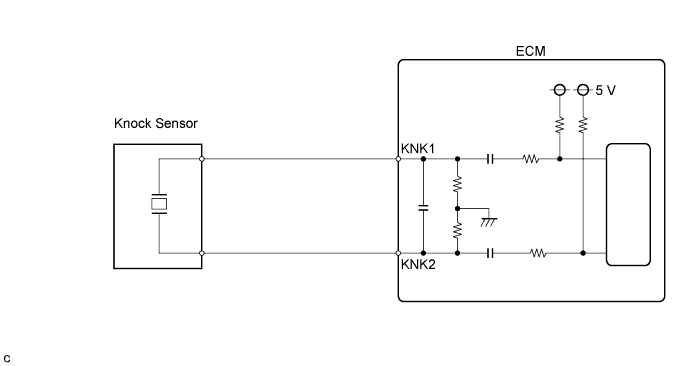
WIRING DIAGRAM

CONFIRMATION DRIVING PATTERN
- CAUTION:
- Strictly observe traffic laws when performing the confirmation driving pattern.
INSPECTION PROCEDURE
- NOTICE:
- Perform electronic throttle learning after replacing the ECM (Click here).
- HINT:
- Read freeze frame data using the intelligent tester. The ECM records vehicle and driving condition information as freeze frame data the moment a DTC is stored. When troubleshooting, freeze frame data can help determine if the vehicle was moving or stationary, if the engine was warmed up or not, if the air-fuel ratio was lean or rich, and other data from the time the malfunction occurred.
- The knock feedback value change can be confirmed by running the engine at high load, for example, activating the air conditioning system and revving up the engine.
Refer to the following procedure.
- Connect an intelligent tester to the DLC3.
- Start the engine and turn the tester ON.
- Warm up the engine.
- Select the following menu items: Powertrain / Engine and ECT / Data List / Knock Feedback Value.
- Read the values displayed on the tester while driving the vehicle.
- Read freeze frame data using the intelligent tester. The ECM records vehicle and driving condition information as freeze frame data the moment a DTC is stored. When troubleshooting, freeze frame data can help determine if the vehicle was moving or stationary, if the engine was warmed up or not, if the air-fuel ratio was lean or rich, and other data from the time the malfunction occurred.
Malfunction does not occur
Knock Feedback Values change
Malfunctions occur
Knock Feedback Values do not change
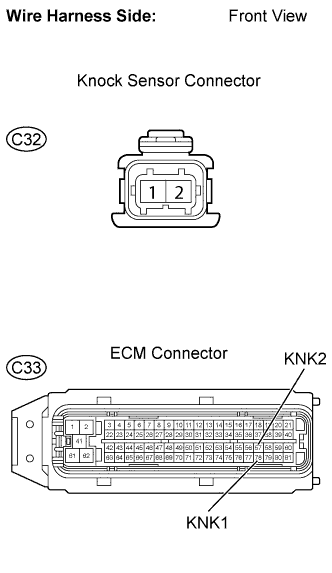
| 1. CHECK HARNESS AND CONNECTOR (KNOCK SENSOR - ECM) |

 |
Disconnect the knock sensor connector.
Disconnect the ECM connector.
Check the resistance.
- Standard resistance (Check for open):
Tester Connection
Specified Condition
KNK1 (C33-78) - Knock sensor (C32-1)
Below 1 Ω
KNK2 (C33-57) - Knock sensor (C32-2)
Below 1 Ω
- Standard resistance (Check for short)::
Tester Connection
Specified Condition
KNK1 (C33-78) or Knock sensor (C32-1) - Body ground
10 kΩ or higher
KNK2 (C33-57) - Knock sensor (C32-2) - Body ground
10 kΩ or higher
Reconnect the knock sensor connector.
Reconnect the ECM connector.
|
|
||||

| OK | |
 |
| 2. INSPECT KNOCK SENSOR (SENSOR INSTALLATION) |
Check the knock sensor installation.
- Torque:
- 20 N*m{ 204 kgf*cm , 15 ft.*lbf }
|
|
||||
| OK | |
|
| 3. CONFIRM MALFUNCTION DISAPPEARS WHEN A NORMAL KNOCK SENSOR IS INSTALLED |
Replace the knock sensor with a new one.
- Torque:
- 20 N*m{ 204 kgf*cm , 15 ft.*lbf }
Perform the driving test.
Drive the vehicle at an engine speed of 3,200 rpm or more, with an engine load of 50 % or more for 1 minute or more after warm-up.
- CAUTION:
- Strictly observe traffic laws when performing the confirmation driving pattern.
- HINT:
- Example: The vehicle is driven at approximately 110 km/h (70 mph) in 5th gear.
Wait for approximately 10 minutes or more, and then start the engine.
Connect the intelligent tester to the DLC3.
Select the following menu items: Powertrain / Engine and ECT / DTC / Pending.
Read DTCs.
- Result:
Display (DTC Output)
Proceed To
No DTC output
A
P0327
B
|
|
||||
| B | ||
 |
||
| ||