ENG A-STOP System Check
Precautions: Precautions for Diagnosing Trouble · Precautions for Servicing ENG A-STOP System · Precautions for Replacing ENG A-STOP Control Module · Precautions for Control Systems · General safety (00)
| Step | Action | Yes | No |
|---|---|---|---|
| 1 |
Customer complaint analysis
1)Perform Step 1. Customer Complaint Analysis.
Was customer complaint analysis performed?
|
Go to Step 2.
|
Perform customer complaint analysis.
|
| 2 |
DTC check, record and clearance
1)Check for DTC (including pending DTC).

Is there any DTC(s)?
|
Print DTC or write it down and clear it referring to DTC Clearance. Then go to Step 3.
|
Go to Step 3.
|
| 3 |
Trouble symptom confirmation
1)Check trouble symptom.
Is trouble symptom identified?
|
Go to Step 4.
|
Go to Step 5.
|
| 4 |
Rechecking and recording DTC
1)Recheck for DTC.
Is there any DTC(s)?
|
Go to Step 6.
|
Go to Step 7.
|
| 5 |
ENG A-STOP symptom diagnosis
1)Perform Step 5. ENG A-STOP System Symptom Diagnosis.
Are check and repair completed?
|
Go to Step 8.
|
Check and repair defective part, and then go to Step 8.
|
| 6 |
Troubleshooting for DTC
1)Perform troubleshooting for applicable DTC.
Are check and repair completed?
|
Go to Step 8.
|
Check and repair defective part, and then go to Step 8.
|
| 7 |
Intermittent problem check
1)Check for intermittent problem.
Is there any faulty condition?
|
Repair or replace defective part, and then go to Step 8.
|
Go to Step 8.
|
| 8 |
Final confirmation test
1)Perform Step 8. Final Confirmation Test.
Is there any problem symptom, DTC or abnormal condition?
|
Go to Step 4.
|
End.
|
Step 1. Customer Complaint Analysis
Record details of the problem (failure, complaint) and how it occurred as described by the customer.
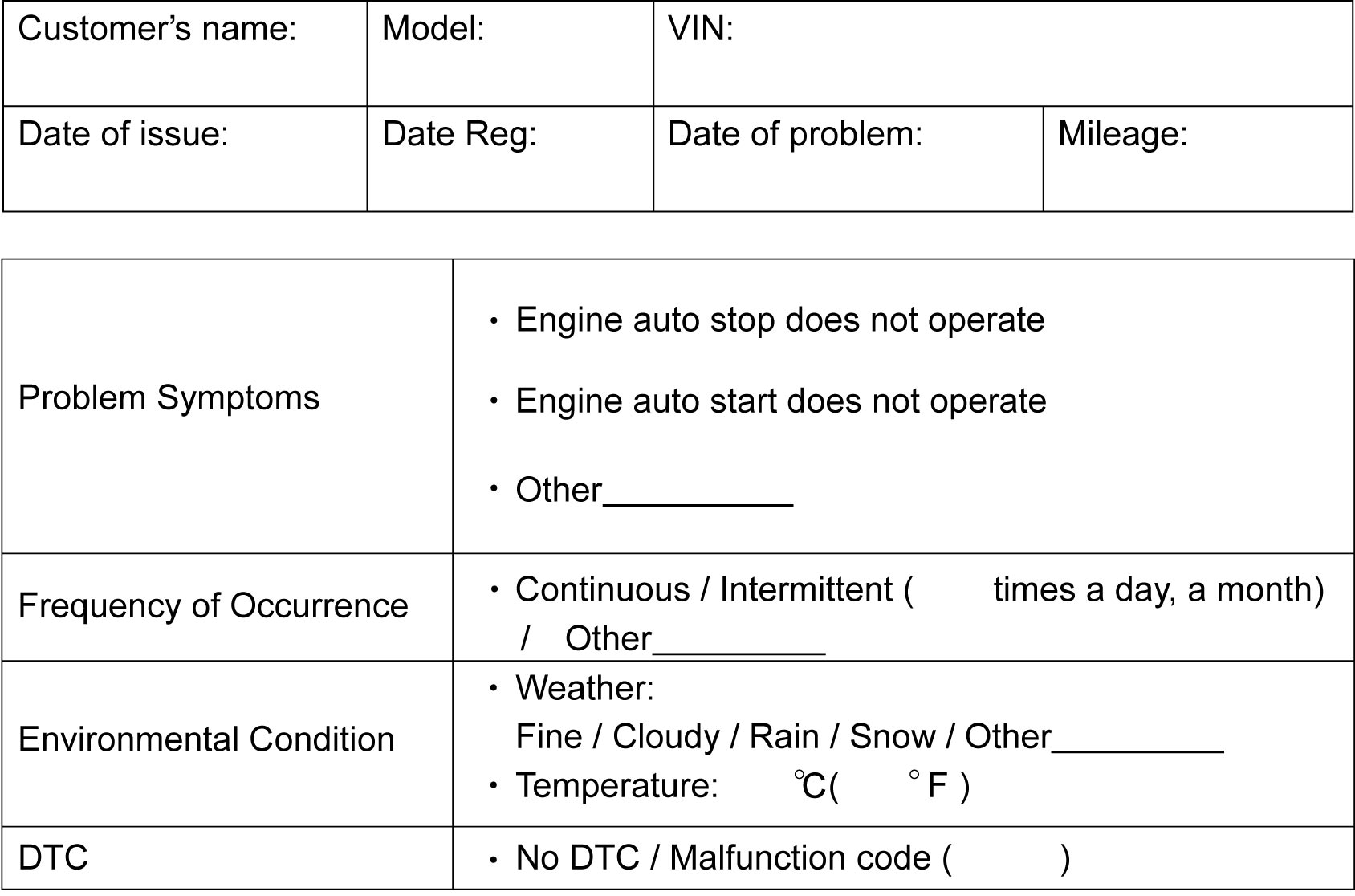
For this purpose, such a questionnaire form shown below will facilitate collecting information for proper analysis and diagnosis.
NOTE:
The form is a standard sample. It should be modified according to characteristics of each market.
Customer questionnaire form (Example)
Step 2. DTC Check, Record and Clearance
First, check for DTCs (current and pending DTCs).
If DTCs are indicated, print DTC or write them down and then clear them.
Step 3. Trouble Symptom Confirmation
If there is no DTC in Step 2:
Based on information obtained in Step 1. Customer Complaint Analysis and Step 2. DTC Check, Record and Clearance, check trouble symptoms.
If there is any DTC in Step 2:
Recheck DTC according to “DTC Confirmation Procedure” described in each DTC troubleshooting.
Step 4. Rechecking and Recording DTC
Refer to DTC Check for checking procedure.
Step 5. ENG A-STOP System Symptom Diagnosis
Perform ENG A-STOP System Symptom Diagnosis based on symptom found in vehicle, checking the following items.
•Customer complaint analysis
•Trouble symptom confirmation
•Trouble symptom confirmation
Step 6. Troubleshooting for DTC
Perform troubleshooting for applicable DTC and repair or replace faulty parts.
Step 7. Intermittent Problem Check
If there is no DTC in Step 2:
Check for intermittent problem.
If there is any DTC in Step 2:
Check parts related to detected DTC (e.g. wire harness, connector, etc.).
Step 8. Final Confirmation Test
Check that the problem symptom does not recur and the vehicle is free from any abnormal conditions. If what has been repaired is related to DTC, clear DTC once, perform DTC confirmation procedure and check that no DTC is indicated.