1BZ-FPE ENGINE CONTROL ELECTRONIC CONTROLLED CARBURETOR SYSTEM P0171 System Too Lean (Bank 1) P0172 System Too Rich (Bank 1)
DESCRIPTION
Fuel trim refers to the feedback compensation value compared to the basic injection time. Fuel trim includes short-term fuel trim and long-term fuel trim.
Short-term fuel trim is the short-term fuel compensation used to maintain the air-fuel ratio at its ideal theoretical value. The signal from the oxygen sensor indicates whether the air-fuel ratio is RICH or LEAN compared to the ideal theoretical value, triggering a reduction in fuel volume if the air-fuel ratio is rich, and an increase in fuel volume if it is lean.
Long-term fuel trim is overall fuel compensation carried out long-term to compensate for continual deviation of the short-term fuel trim form the central value due to individual engine differences, wear overtime and changes in the usage environment.
If both the short-term fuel trim and long-term fuel trim are LEAN or RICH beyond a certain value, it is detected as a malfunction and the CHK ENG (MIL) on the multi information display.
| DTC No. | DTC Detecting Condition | Trouble Area |
|---|---|---|
| P0171/25 | When air-fuel ratio feedback is stable after engine warming up, fuel trim is considerably in error on LEAN side
(2 trip detection logic) |
·
Air induction system ·
Vacuum sensor ·
Injector blockage ·
Ignition system ·
Water temp. sensor ·
Fuel pressure ·
Gas leakage on exhaust system ·
Open or short in oxygen sensor circuit ·
Oxygen sensor ·
Engine ECU |
| P0172/26 | When air-fuel ratio feedback is stable after engine warming up, fuel trim is considerably in error on RICH side
(2 trip detection logic) |
·
Air induction system ·
Vacuum sensor ·
Injector blockage ·
Ignition system ·
Water temp. sensor ·
Fuel pressure ·
Gas leakage on exhaust system ·
Open or short in oxygen sensor circuit ·
Oxygen sensor ·
Engine ECU |
- HINT:
- ·
When the DTC P0171 is recorded, the actual air-fuel ratio is on the LEAN side. When DTC P0172 is recorded, the actual air-fuel ratio is on the RICH side.
·If the vehicle runs out of fuel, the air-fuel ratio is LEAN and DTC P0171 is recorded. The CHK ENG (MIL) then comes on.
·If the total of the short-term fuel trim value and long-term fuel trim value is within -38 % to +38 %, the system is functioning normally.
·The oxygen sensor output voltage and the short-term fuel trim value can be read using the hand-held tester.
WIRING DIAGRAM
Refer to DTC P0130 (Click hereEngine / Hybrid System>1BZ-FPE (ENGINE CONTROL)>ELECTRONIC CONTROLLED CARBURETOR SYSTEM>P0130).
CAUTION / NOTICE / HINT
- When using hand-held tester:
- HINT:
-
Read freeze frame data using hand-held tester. Because freeze frame records the engine conditions when the malfunction is detected. When troubleshooting, it is useful for determining whether the vehicle was running or stopped, the engine was warmed up or not, the air-fuel ratio was lean or rich, etc. at the time of the malfunction.
PROCEDURE
OK
NG
Click hereEngine / Hybrid System>1BZ-FPE (FUEL)>INJECTOR>ON-VEHICLE INSPECTION
- Result:
Proceed to OK NG
OK
NG
Check vacuum sensor.
Click hereEngine / Hybrid System>1BZ-FPE (FUEL)>VACUUM SENSOR>INSPECTION
Check water temperature sensor.
Click hereEngine / Hybrid System>1BZ-FPE (FUEL)>WATER TEMPERATURE SENSOR>INSPECTION
- Result:
Proceed to OK NG
OK
NG
Click hereEngine / Hybrid System>1BZ-FPE (ENGINE CONTROL)>IGNITION SYSTEM>ON-VEHICLE INSPECTION
- Result:
Proceed to OK NG
OK
NG
- Result:
Proceed to OK NG
OK
NG
- Result:
Proceed to OK NG
OK
NG
PREPARATION:
Warm up the oxygen sensor with the engine speed at 2,500 rpm for approx. 90 sec.
CHECK:
Used the hand-held tester to read the output voltage of the oxygen sensor during idling.
- OK:
Oxygen sensor output voltage:
Alternates repeatedly between less than 0.4 V and more than 0.55 V (See the following table).
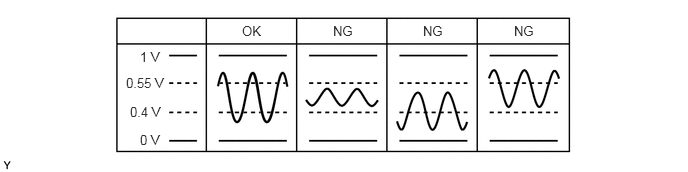
- Result:
Proceed to OK NG
OK
NG
Click hereEngine / Hybrid System>1BZ-FPE (ENGINE CONTROL)>ELECTRONIC CONTROLLED CARBURETOR SYSTEM>P0130
- Result:
Proceed to GO
GO
- Result:
Proceed to YES NO
YES
NO
- Result:
Proceed to YES NO
YES
NO
- Result:
Proceed to OK NG
OK
NG