P0746 Pressure Control Solenoid "A" Performance (Shift Solenoid Valve SL1)
Diagnostic trouble codes · Vehicles built Aug 2009 – Oct 2010
Also covers:
- P0771 Shift Solenoid "E" Performance (Shift Solenoid Valve SR)
Versions by build date: Dec 2007 – Jul 2009 Aug 2009 – Oct 2010 Nov 2010 – Jul 2011 Aug 2011 – Jul 2012 Aug 2012 – Jul 2014 from Aug 2014
DESCRIPTION
The ECM uses signals from the output shaft speed sensor and input speed sensor to detect the actual gear position (1st, 2nd, 3rd, 4th or 5th gear).Then the ECM compares the actual gear with the shift schedule in the ECM memory to detect mechanical problems of the shift solenoid valves, valve body or automatic transmission (clutch, brake or gear, etc.).
| DTC No. |
DTC Detection Condition |
Trouble Area |
| P0746 |
The gear required by the ECM does not match the actual gear when driving (2-trip detection logic) |
|
| P0771 |
The gear required by the ECM does not match the actual gear when driving (2-trip detection logic*1, 1-trip detection logic*2) |
|
- HINT:
- *1: w/ OBD
- *2: w/o OBD
- *1: w/ OBD
MONITOR DESCRIPTION
This DTC indicates stuck ON malfunction or stuck OFF malfunction of the shift solenoid valve SR or SL1. The ECM controls the gearshifts by turning the shift solenoid valves ON/OFF. When the gear position directed by the ECM and the actual gear position do not match, the ECM stores the DTCs.INSPECTION PROCEDURE
- HINT:
- Using the intelligent tester to perform Active Tests allows relays, VSVs, actuators and other items to be operated without removing any parts. This non-intrusive functional inspection can be very useful because intermittent operation may be discovered before parts or wiring is disturbed. Performing Active Tests early in troubleshooting is one way to save diagnostic time. Data List information can be displayed while performing Active Tests.
- Warm up the engine.
- Turn the ignition switch off.
- Connect the intelligent tester to the DLC3.
- Turn the ignition switch to ON.
- Turn the tester on.
- Enter the following menus: Powertrain / Engine and ECT / Active Test.
- According to the display on the tester, perform the Active Test.
- HINT:
- While driving, the shift position can be changed with the intelligent tester.
- Comparing the shift position directed by the Active Test with the actual shift position enables the problem to be confirmed (Click here).
Engine and ECT Tester Display
Test Part
Control Range
Diagnostic Note
Control the Shift Position
Operate shift solenoid valve and set each shift position by yourself
- Press "→" button: Shift up
- Press "←" button: Shift down
Possible to check operation of shift solenoid valves
[Vehicle Condition]
50 km/h (30 mph) or less
- Press "→" button: Shift up
- HINT:
- This test can be conducted when the vehicle speed is 50 km/h (30 mph) or less.
- The 4th to 5th up-shifting must be performed with the accelerator pedal released.
- The 5th to 4th down-shifting must be performed with the accelerator pedal released.
- Do not operate the accelerator pedal for at least 2 seconds after shifting and do not shift successively.
- The shift position directed by the ECM is shown in the Data List / Shift Status display on the intelligent tester.
- The shift solenoid valve SR and SL1 are turned on/off normally when the shift lever is in D:
- This test can be conducted when the vehicle speed is 50 km/h (30 mph) or less.
Gearshift controlled by ECM
1st
2nd
3rd
4th
5th
Shift solenoid valve SR
OFF
OFF
OFF
OFF
ON
Shift solenoid valve SL1
OFF
OFF
OFF
OFF
ON
| 1. CHECK ANY OTHER DTCS OUTPUT (IN ADDITION TO DTCS P0746 AND P0771) |

Connect the intelligent tester to the DLC3.
Turn the ignition switch to ON.
Turn the tester on.
Enter the following menus: Powertrain / Engine and ECT / Trouble Codes.
Read the DTCs using the intelligent tester.
Result Result
Proceed to
Only P0746 and P0771 are output
Only DTC P0771 is output
A
P0746, P0771 and other DTCs are output
B
- HINT:
- If any codes besides P0746 and P0771 are output, perform troubleshooting for those DTCs first
|
|
||||

| A | |
 |
| 2. PERFORM ACTIVE TEST USING INTELLIGENT TESTER (ACTIVE THE SOLENOID (SLT)) |
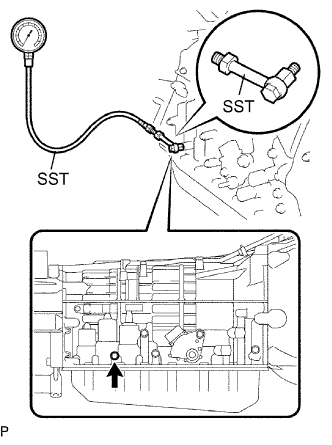  |
- NOTICE:
- Perform the test at the normal operating ATF (Automatic Transmission Fluid) temperature: 50 to 80°C (122 to 176°F).
- Be careful to prevent SST hose from interfering with the exhaust pipe.
- Perform the test with the A/C off.
- Perform the test at the normal operating ATF (Automatic Transmission Fluid) temperature: 50 to 80°C (122 to 176°F).
- HINT:
- Using the intelligent tester to perform Active Tests allows relays, VSVs, actuators and other items to be operated without removing any parts. This non-intrusive functional inspection can be very useful because intermittent operation may be discovered before parts or wiring is disturbed. Performing Active Tests early in troubleshooting is one way to save diagnostic time. Data List information can be displayed while performing Active Tests.
Remove the test plug on the transmission case center right side and connect SST.
- SST
- 09992-00095
(09992-00231, 09992-00271)
Connect the intelligent tester to the DLC3.
Start the engine and warm it up.
Measure the line pressure with SST.
Turn the tester on.
Enter the following menus: Powertrain / Engine and ECT / Active Test.
According to the display on the tester, perform the Active Test.
Measure the line pressure with SST.
*: Active the Solenoid (SLT) in the Active Test is performed to check the line pressure changes by connecting SST to the automatic transmission, which is used in the Hydraulic Test (Click here) as well. Please note that the pressure values in the Active Test and Hydraulic Test are different.Engine and ECT Tester Display
Test Part
Control Range
Diagnostic Note
Active the Solenoid (SLT)*
Operate the shift solenoid SLT and raise line pressure
ON or OFF - HINT:
- OFF: Line pressure up (when Active Test "Active the Solenoid (SLT)" is performed, ECM commands SLT solenoid to turn OFF)
- ON: No action (normal operation)
- OFF: Line pressure up (when Active Test "Active the Solenoid (SLT)" is performed, ECM commands SLT solenoid to turn OFF)
[Vehicle Condition] - Vehicle stopped
- Engine idling
- OK:
- The line pressure changes as specified when performing the Active Test.
|
|
||||
| OK | |
|
| 3. INSPECT SHIFT SOLENOID VALVE SL1 |
Remove the shift solenoid valve SL1.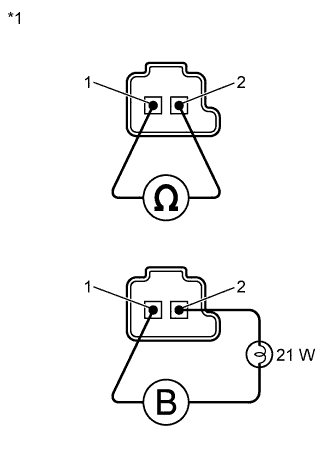
Measure the resistance according to the value(s) in the table below.
- Standard Resistance:
Tester Connection
Condition
Specified Condition
1 - 2
20°C (68°F)
5.0 to 5.6 Ω
Text in Illustration *1
Component without harness connected:
(Shift Solenoid Valve SL1)
Connect the positive (+) lead with a 21 W bulb to terminal 2 and the negative (-) lead to terminal 1 of the solenoid valve connector, then check the movement of the valve.
- OK:
- The solenoid makes operating sounds.
|
|
||||
| OK | |
|
| 4. INSPECT SHIFT SOLENOID VALVE SR |
Remove the shift solenoid valve SR.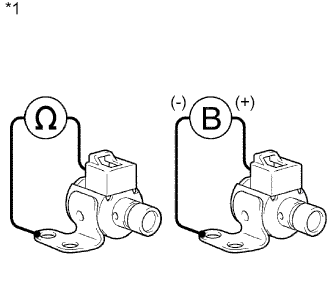
Measure the resistance according to the value(s) in the table below.
- Standard Resistance:
Tester Connection
Condition
Specified Condition
1 - Solenoid body
20°C (68°F)
11 to 15 Ω
Text in Illustration *1
Component without harness connected:
(Shift Solenoid Valve SR)
Connect the positive (+) lead to the terminal of the solenoid connector, and the negative (-) lead to the solenoid body.
- OK:
- The solenoid makes operating sounds
|
|
||||
| OK | |
|
| 5. INSPECT TRANSMISSION VALVE BODY ASSEMBLY |
Check the transmission valve body assembly.
- HINT:
- Refer to Problem Symptoms Table Chapter 2 (Click here).
- OK:
- There are no foreign objects on any valves and they operate smoothly.
|
|
||||
| OK | ||
 |
||
| ||