ENGINE > ON-VEHICLE INSPECTION |
| 1. INSPECT IGNITION TIMING |
Warm up the engine.
When using the intelligent tester:
Connect the intelligent tester to the DLC3.
Enter the following menus: Powertrain / Engine and ECT / Data List / All Data / IGN Advance.
Inspect the ignition timing during idling.
Check that the ignition timing advances immediately when the engine speed is increased.
![]() |
When not using the intelligent tester:
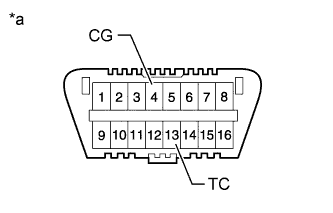
| *a | Front view of DLC3: |
Using SST, connect terminals 13 (TC) and 4 (CG) of the DLC3.
![]() |
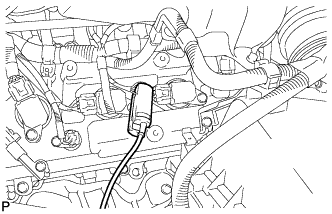
Connect the tester probe of a timing light to the wire of the ignition coil connector for the No. 1 cylinder.
![]() |
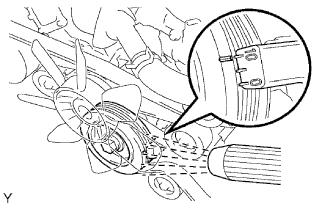
Inspect the ignition timing during idling.
Remove SST from the DLC3.
Inspect the ignition timing during idling.
Disconnect the timing light from the engine.
| 2. INSPECT ENGINE IDLING SPEED |
Warm up the engine.
When using the intelligent tester:
Connect the intelligent tester to the DLC3.
Enter the following menus: Powertrain / Engine and ECT / Data List / All Data / Engine Speed.
Inspect the engine idling speed.
![]() |
When not using the intelligent tester:
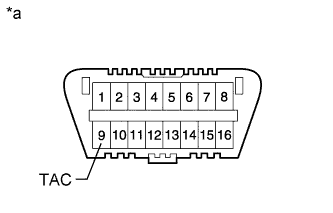
| *a | Front view of DLC3: |
Connect SST to terminal 9 (TAC) of the DLC3.
Race the engine at 2500 rpm for approximately 90 seconds.
Inspect the engine idling speed.
| 3. INSPECT COMPRESSION |
Warm up and stop the engine.
Remove the 6 spark plugs (Click here).
Disconnect the 6 fuel injector connectors.
Inspect the cylinder compression pressure.
Insert a compression gauge into the spark plug hole (Procedure "A").
While cranking the engine, measure the compression pressure (Procedure "B").
Repeat procedures "A" and "B" for each cylinder.
If the cylinder compression is low, pour a small amount of engine oil into the cylinder through the spark plug hole and repeat procedures "A" and "B" for cylinders with low compression.
Connect the 6 injector connectors.
Install the 6 spark plugs (Click here).
| 4. INSPECT CO/HC |
Start the engine.
Run the engine at 2500 rpm for approximately 180 seconds.
Insert the CO/HC meter testing probe at least 40 cm (1.31 ft) into the tailpipe during idling.
Immediately check the CO/HC concentration during idling and/or at 2500 rpm.
If the CO/HC concentration does not comply with regulations, perform troubleshooting in the order given below.
Check the A/F sensor operation (Click here) and heated oxygen sensor operation (Click here).
See the table below for possible causes, and then inspect and correct the corresponding causes if necessary.
| CO | HC | Symptom | Causes |
| Normal | High | Rough idling |
|
| Low | High | Rough idling (Fluctuating HC reading) |
|
| High | High | Rough idle (Black smoke from exhaust) |
|